
[Paper Review] T3P: Demystifying Low-Earth Orbit Satellite Broadband
This paper presents T3P, a testbed and analysis framework for measuring and optimizing performance in Low-Earth Orbit (LEO) satellite broadband networks, specifically SpaceX Starlink. Using a distributed testbed called LEOScope across multiple European locations, the authors quantify latency fluctuations, develop predictive models for latency and throughput (achieving 3.65% MAPE), and optimize BBRv2 congestion control, improving throughput by up to 115% with minimal latency increase.
The Internet is going through a massive infrastructural revolution with the advent of low-flying satellite networks, 5/6G, WiFi7, and hollow-core fiber deployments. While these networks could unleash enhanced connectivity and new capabilities, it is critical to understand the performance characteristics to efficiently drive applications over them. Low-Earth orbit (LEO) satellite mega-constellations like SpaceX Starlink aim to offer broad coverage and low latencies at the expense of high orbital dynamics leading to continuous latency changes and frequent satellite hand-offs. This paper aims to quantify Starlink's latency and its variations and components using a real testbed spanning multiple latitudes from the North to the South of Europe. We identify tail latencies as a problem. We develop predictors for latency and throughput and show their utility in improving application performance by up to 25%. We also explore how transport protocols can be optimized for LEO networks and show that this can improve throughput by up to 115% (with only a 5% increase in latency). Also, our measurement testbed with a footprint across multiple locations offers unique trigger-based scheduling capabilities that are necessary to quantify the impact of LEO dynamics.
Motivation & Objective
- To understand the performance characteristics of real-world LEO satellite networks, particularly Starlink’s dynamic latency and throughput behavior.
- To identify tail latency as a critical bottleneck affecting application performance in LEO networks.
- To develop predictive models for latency and throughput tailored to LEO dynamics using telemetry and orbital data.
- To optimize end-to-end transport protocols like BBRv2 for LEO networks to improve throughput and resilience.
- To build a scalable, distributed testbed (LEOScope) with trigger-based scheduling to capture LEO-specific network dynamics.
Proposed method
- Deployed a distributed testbed, LEOScope, with 5 measurement clients across two countries using Starlink terminals and Azure-based servers.
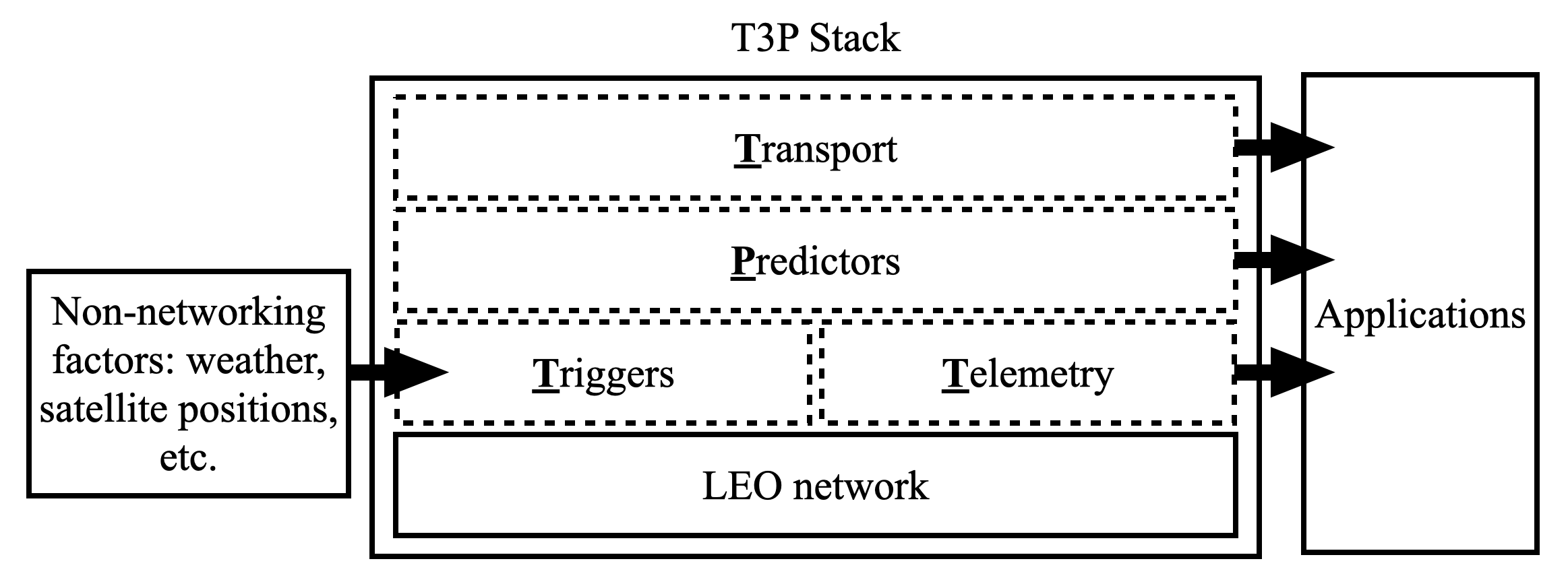
- Collected real-time telemetry from Starlink terminals via gRPC APIs, including terminal orientation and satellite positions from Celestrak.
- Built time-series prediction models using XGBoost and LSTM to forecast latency and throughput based on orbital dynamics and historical data.
- Integrated throughput predictions into an Adaptive Bitrate (ABR) video streaming algorithm (RobustMPC) to improve Quality of Experience (QoE).
- Conducted a 2D parameter space search on BBRv2 to identify optimal congestion control settings for LEO’s fluctuating RTTs and loss patterns.
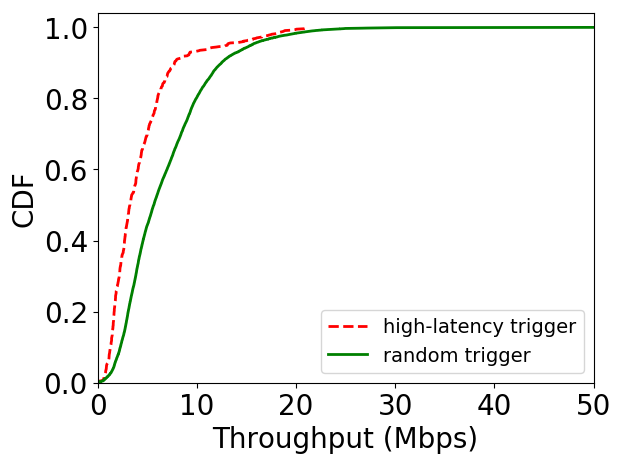
- Enabled trigger-based scheduling and scavenger mode in LEOScope to efficiently capture transient satellite handoffs and scale experiments.
Experimental results
Research questions
- RQ1How do latency and throughput vary across different geographic locations and orbital dynamics in Starlink’s LEO network?
- RQ2To what extent do tail latencies (e.g., 11–16× median) impact application performance in LEO networks?
- RQ3Can predictive models based on telemetry and orbital data accurately forecast latency and throughput in LEO networks?
- RQ4How can application-layer performance (e.g., video streaming QoE) be improved using LEO-aware predictions?
- RQ5What BBRv2 parameter configurations optimize throughput and latency in LEO networks with high RTT variability and frequent handoffs?
Key findings
- Starlink exhibits high median throughput and low median latency, but tail latencies can be 11–16 times higher than the median, significantly impacting performance.
- The best-performing latency prediction model achieves a Mean Absolute Percentage Error (MAPE) of 3.65%, while the throughput predictor achieves 19.2% MAPE.
- Integrating throughput predictions into the RobustMPC ABR algorithm improves video streaming Quality of Experience (QoE) by up to 25%.
- Optimized BBRv2 configurations achieve 115% higher throughput than default settings, with only a 5% increase in latency.
- The LEOScope testbed successfully captures real LEO dynamics and generates realistic link profiles useful for simulation and emulation.
- The study demonstrates that LEO-aware transport and application-layer optimizations can significantly enhance performance in dynamic satellite networks.
Better researchstarts right now
From reading papers to final review, dramatically reduce your research time.
No credit card · Free plan available
This review was created by AI and reviewed by human editors.