
[Paper Review] TabMT: Generating tabular data with masked transformers
TabMT proposes a novel masked Transformer architecture for generating high-quality synthetic tabular data, leveraging improved masking techniques to handle heterogeneous data types, missing values, and privacy trade-offs. It achieves state-of-the-art performance across diverse datasets, outperforming GANs, VAEs, and autoregressive models in quality, diversity, and robustness—especially in privacy-preserving generation with temperature-controlled trade-offs.
Autoregressive and Masked Transformers are incredibly effective as generative models and classifiers. While these models are most prevalent in NLP, they also exhibit strong performance in other domains, such as vision. This work contributes to the exploration of transformer-based models in synthetic data generation for diverse application domains. In this paper, we present TabMT, a novel Masked Transformer design for generating synthetic tabular data. TabMT effectively addresses the unique challenges posed by heterogeneous data fields and is natively able to handle missing data. Our design leverages improved masking techniques to allow for generation and demonstrates state-of-the-art performance from extremely small to extremely large tabular datasets. We evaluate TabMT for privacy-focused applications and find that it is able to generate high quality data with superior privacy tradeoffs.
Motivation & Objective
- To develop a robust, scalable, and privacy-aware generative model for synthetic tabular data that addresses limitations in existing approaches.
- To enable effective generation of high-quality tabular data across datasets of varying sizes, from small to large.
- To natively handle missing data during training and generation without requiring imputation or data preprocessing.
- To provide a flexible privacy trade-off mechanism via temperature scaling, enabling controlled data utility and privacy.
- To demonstrate superior performance over existing generative models, including GANs, VAEs, and autoregressive Transformers, in both quality and structural fidelity.
Proposed method
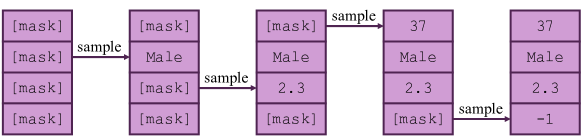
- TabMT employs a masked Transformer architecture that predicts masked tokens bidirectionally across tabular fields, enabling joint modeling of heterogeneous data types.
- It uses a learnable masking strategy where each row applies a unique masking probability, allowing flexible conditioning during generation.
- The model is trained using a masked token prediction objective, where masked fields are reconstructed from context, improving representation learning.
- Embeddings are generated per sample by averaging field-level representations, used for downstream evaluation via Fréchet Inception Distance (FID) and Inception Score.
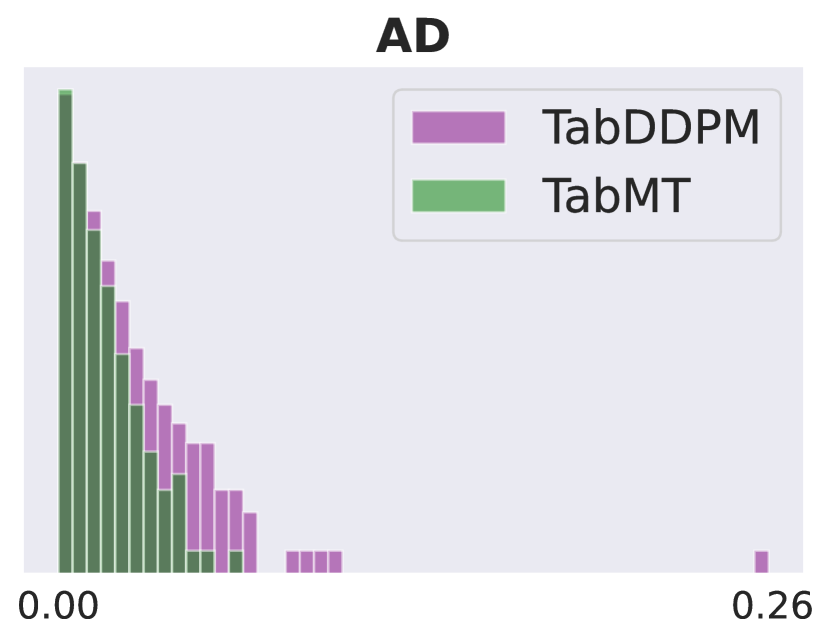
- The model supports temperature scaling during inference to control the trade-off between data quality and privacy, reducing mode collapse and improving diversity.
- Quantization is applied to continuous fields to enable discrete tokenization, facilitating training and generation while preserving data structure.
Experimental results
Research questions
- RQ1Can a masked Transformer architecture achieve state-of-the-art performance in synthetic tabular data generation across diverse datasets?
- RQ2How does TabMT handle missing data during training and generation, and what impact does this have on data quality and privacy?
- RQ3To what extent can TabMT balance privacy and data quality through temperature scaling, and how does it compare to other privacy-preserving methods?
- RQ4How does TabMT perform on domain-specific benchmarks, such as netflow data generation, compared to specialized models like NFGAN?
- RQ5What is the scalability of TabMT across datasets of varying sizes, and how does model size affect generation quality and diversity?
Key findings
- TabMT achieved a precision of 88.10% and recall of 91.12% on the netflow dataset, outperforming NFGAN, which had only 77.64% precision and 63.32% recall.
- TabMT-L achieved 99.43% diversity on the netflow dataset, compared to only 46.97% for NFGAN, indicating superior sample coverage and reduced mode collapse.
- TabMT reduced the median violation rate of netflow invariants by 20x compared to NFGAN, with the lowest error rate of 6.54e-06 on TCP flags and 1.14e-05 on private IPs.
- The model demonstrated strong scalability, with both precision and recall approaching validation set levels across all model sizes (Small to Large).
- TabMT achieved 100% diversity on the netflow dataset with the largest model (TabMT-L), indicating near-perfect coverage of the data distribution.
- The model’s masking mechanism enabled native handling of missing data, improving robustness and applicability in real-world scenarios with incomplete records.
Read this paper
Open the full text in the Nubint reader and ask about any passage as you read.
Read this paper on NubintThis review was generated by AI from the original paper. Please check the paper before citing it.