
[Paper Review] Tabular Embedding Model (TEM): Finetuning Embedding Models For Tabular RAG Applications
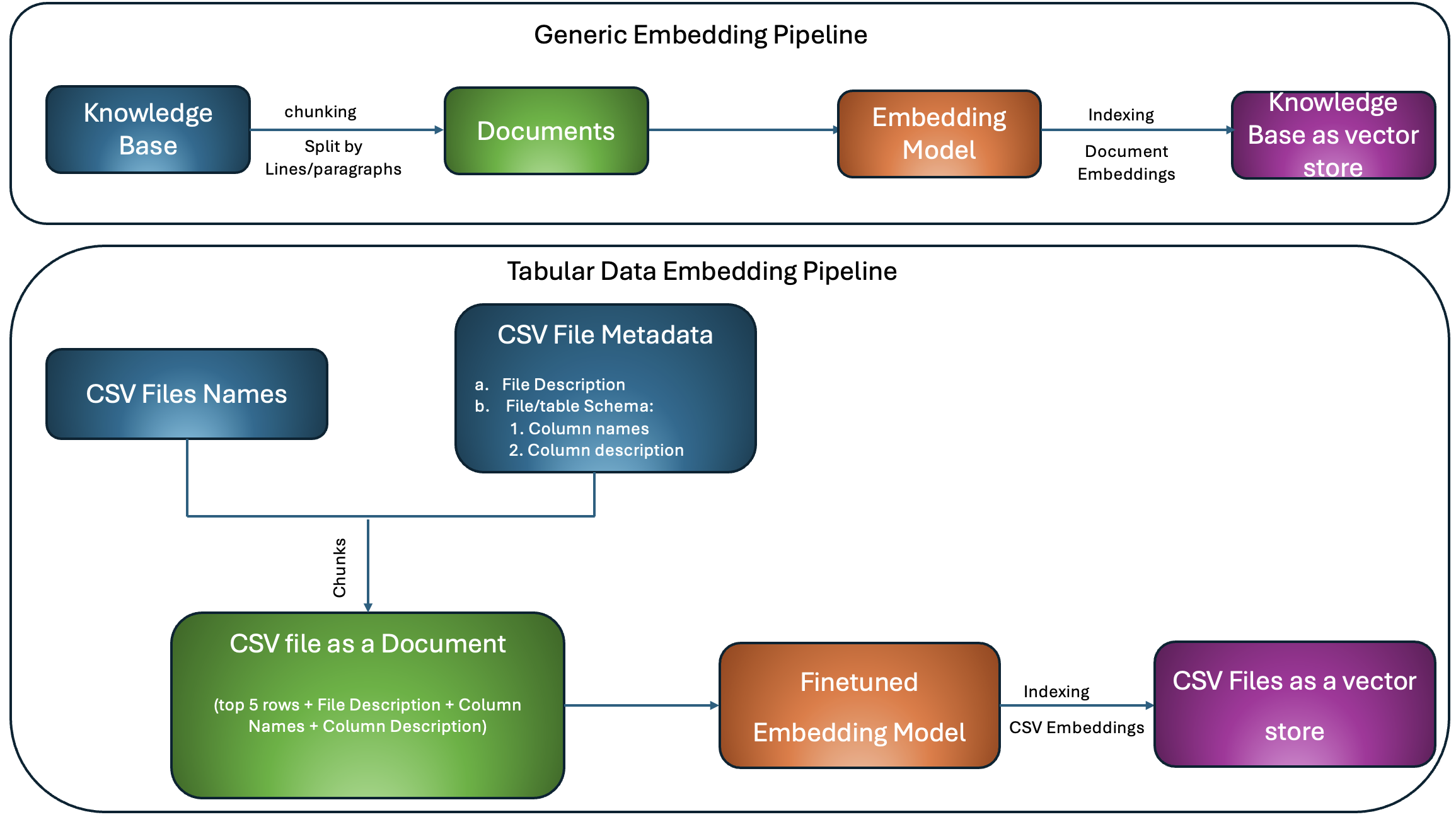
This paper introduces the Tabular Embedding Model (TEM), a fine-tuned lightweight BGE-large-en embedding model optimized for tabular Retrieval-Augmented Generation (RAG) in finance. By fine-tuning on a domain-specific dataset of financial tabular queries, TEM achieves superior performance over SOTA embedding models—outperforming models like text-embedding-3-large and SFR-Embedding-Mistral in precision@10 (0.2160), recall@10 (0.7989), and hit rate@10 (0.4420) despite a smaller size and context window.
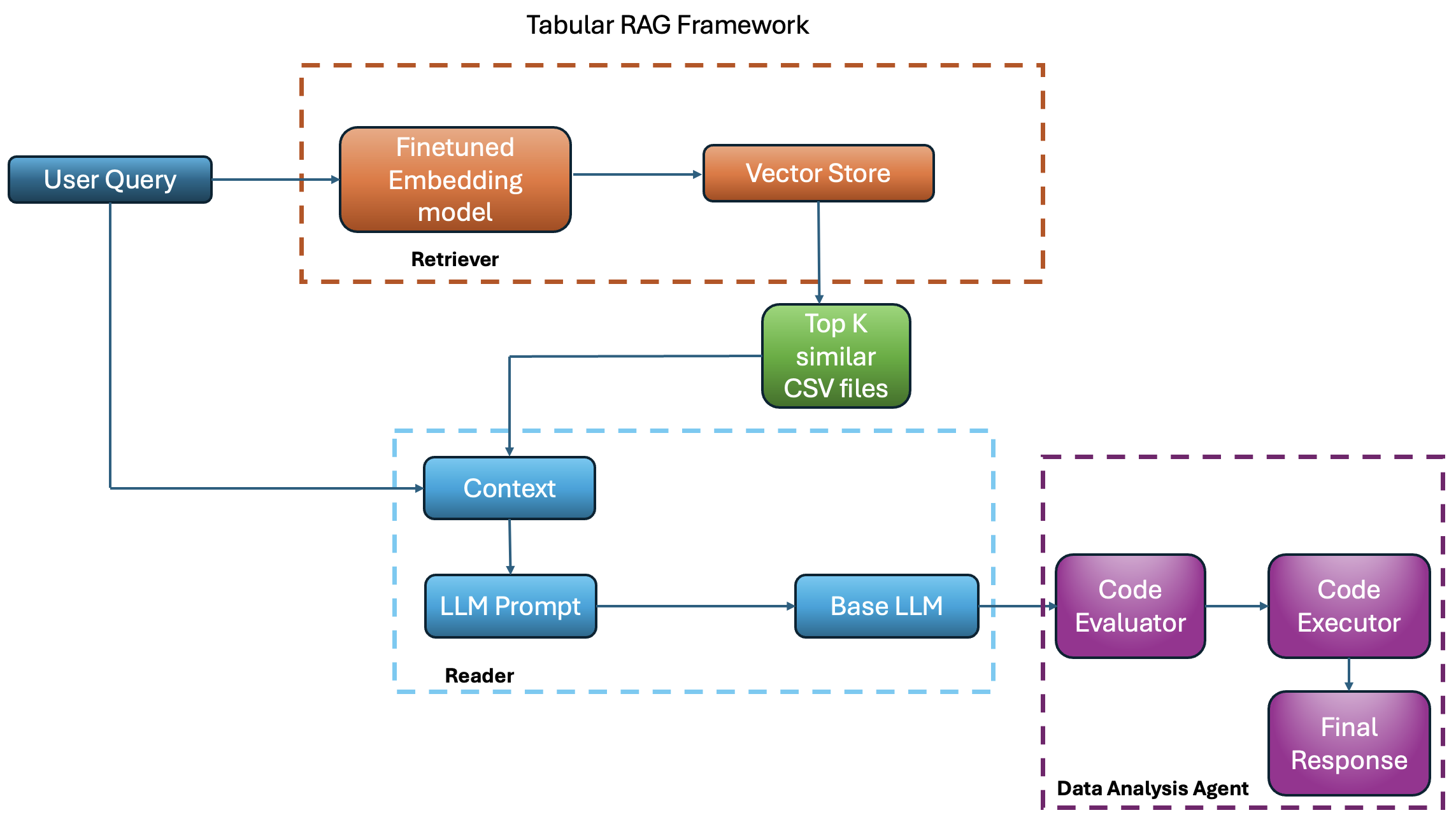
In recent times Large Language Models have exhibited tremendous capabilities, especially in the areas of mathematics, code generation and general-purpose reasoning. However for specialized domains especially in applications that require parsing and analyzing large chunks of numeric or tabular data even state-of-the-art (SOTA) models struggle. In this paper, we introduce a new approach to solving domain-specific tabular data analysis tasks by presenting a unique RAG workflow that mitigates the scalability issues of existing tabular LLM solutions. Specifically, we present Tabular Embedding Model (TEM), a novel approach to fine-tune embedding models for tabular Retrieval-Augmentation Generation (RAG) applications. Embedding models form a crucial component in the RAG workflow and even current SOTA embedding models struggle as they are predominantly trained on textual datasets and thus underperform in scenarios involving complex tabular data. The evaluation results showcase that our approach not only outperforms current SOTA embedding models in this domain but also does so with a notably smaller and more efficient model structure.
Motivation & Objective
- To address the poor performance of general-purpose embedding models in domain-specific tabular RAG applications, especially in high-dimensional financial data.
- To develop a scalable, efficient RAG pipeline that avoids full-dataset embedding by retrieving only relevant files via fine-tuned embeddings.
- To demonstrate that fine-tuning a lightweight open-source embedding model on domain-specific tabular data can outperform larger, general-purpose SOTA models.
- To reduce hallucination and improve retrieval accuracy in complex financial queries requiring analysis across multiple tables or CSV files.
- To validate the effectiveness of a semi-automated role-playing framework using GPT-4 for generating high-quality training and evaluation data.
Proposed method
- Fine-tuned the BGE-large-en-v1.5 embedding model on a custom dataset of financial tabular queries generated via a semi-automated GPT-4 role-playing framework.
- Used a unique RAG workflow where a data analysis agent retrieves only relevant CSV files or database tables based on query embeddings, avoiding full-dataset indexing.
- Performed new word embedding initialization before fine-tuning to improve model convergence and performance on tabular data patterns.
- Employed a retrieval evaluation metric focused on hit rate@10, precision@10, and recall@10, with k=10 to assess retrieval effectiveness across varying numbers of relevant files (n).
- Evaluated performance across multiple n-values (1 to 6) to analyze model robustness under varying retrieval complexity.
- Selected a context window of 512 tokens and embedding dimension of 1024, balancing model efficiency and performance on complex financial queries.
Experimental results
Research questions
- RQ1Can fine-tuning a lightweight, open-source embedding model on domain-specific tabular data significantly improve retrieval performance in financial RAG applications?
- RQ2Does a custom fine-tuning approach outperform general-purpose SOTA embedding models like text-embedding-3-large and SFR-Embedding-Mistral in tabular RAG tasks?
- RQ3How does the performance of the fine-tuned model vary with the number of relevant files (n) required to answer a query?
- RQ4To what extent does new word embedding initialization improve performance on tabular data compared to standard fine-tuning?
- RQ5Can a smaller, efficiently fine-tuned model outperform larger proprietary models like OpenAI’s text-embedding-3-large in retrieval accuracy for structured data?
Key findings
- The fine-tuned TEM model achieved a hit rate@10 of 0.4420, significantly outperforming the next-best model (text-embedding-3-large at 0.3984).
- TEM achieved a precision@10 of 0.2160, surpassing text-embedding-3-large (0.2041) and SFR-Embedding-Mistral (0.2025).
- Recall@10 for TEM reached 0.7989, exceeding all baselines, including the 0.7578 recall of text-embedding-3-large.
- For n=1, TEM achieved a hit rate of 0.7955, outperforming all baselines, including SFR-Embedding-Mistral (0.7784).
- The model maintained strong performance across n=2 to n=4, with hit rates of 0.8482 (n=2) and 0.3871 (n=3), significantly outperforming others in these ranges.
- Despite a smaller context window (512) and model size, TEM outperformed larger models like SFR-Embedding-Mistral and OpenAI’s text-embedding-3-large in all key retrieval metrics.
Read this paper
Open the full text in the Nubint reader and ask about any passage as you read.
Read this paper on NubintThis review was generated by AI from the original paper. Please check the paper before citing it.