
[Paper Review] Tackling Bias in Pre-trained Language Models: Current Trends and Under-represented Societies
This paper presents a comprehensive survey on bias in pre-trained language models, emphasizing the limitations of current mitigation techniques for under-represented and indigenous societies. It advocates for context-specific, community-informed approaches—using New Zealand’s Māori communities as a case study—rather than one-size-fits-all solutions, highlighting the need for inclusive data governance and cross-cultural collaboration in AI development.
The benefits and capabilities of pre-trained language models (LLMs) in current and future innovations are vital to any society. However, introducing and using LLMs comes with biases and discrimination, resulting in concerns about equality, diversity and fairness, and must be addressed. While understanding and acknowledging bias in LLMs and developing mitigation strategies are crucial, the generalised assumptions towards societal needs can result in disadvantages towards under-represented societies and indigenous populations. Furthermore, the ongoing changes to actual and proposed amendments to regulations and laws worldwide also impact research capabilities in tackling the bias problem. This research presents a comprehensive survey synthesising the current trends and limitations in techniques used for identifying and mitigating bias in LLMs, where the overview of methods for tackling bias are grouped into metrics, benchmark datasets, and mitigation strategies. The importance and novelty of this survey are that it explores the perspective of under-represented societies. We argue that current practices tackling the bias problem cannot simply be 'plugged in' to address the needs of under-represented societies. We use examples from New Zealand to present requirements for adopting existing techniques to under-represented societies.
Motivation & Objective
- To identify the limitations of current bias detection and mitigation techniques in pre-trained language models when applied to under-represented and indigenous communities.
- To highlight how generalized, resource-rich country-centric approaches to bias mitigation fail to address the unique sociocultural and linguistic needs of marginalized populations.
- To examine the impact of evolving governmental regulations and legal frameworks on bias research and AI fairness.
- To advocate for community-in-the-loop methodologies and data sovereignty models to ensure equitable participation and benefit-sharing in AI development.
- To propose a shift from post-hoc debiasing to proactive, inclusive design that embeds fairness from the model development phase.
Proposed method
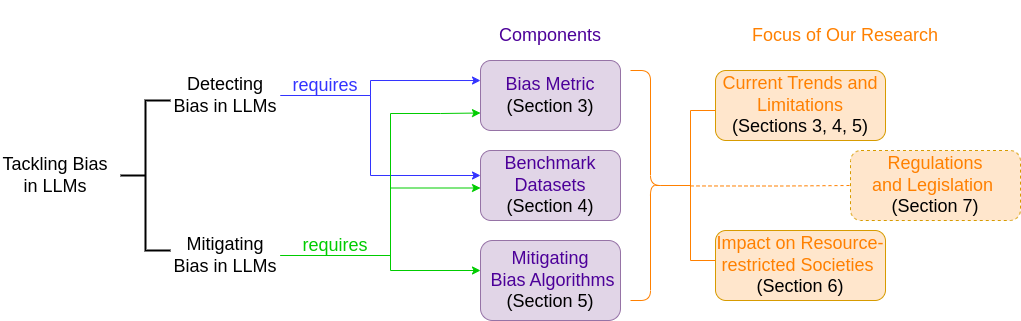
- Systematically categorizes existing bias mitigation techniques into three pillars: bias metrics, benchmark datasets, and mitigation strategies.
- Analyzes current bias detection methods through metrics like representational fairness, group fairness, and stereotypical bias, emphasizing their limitations in cross-cultural contexts.
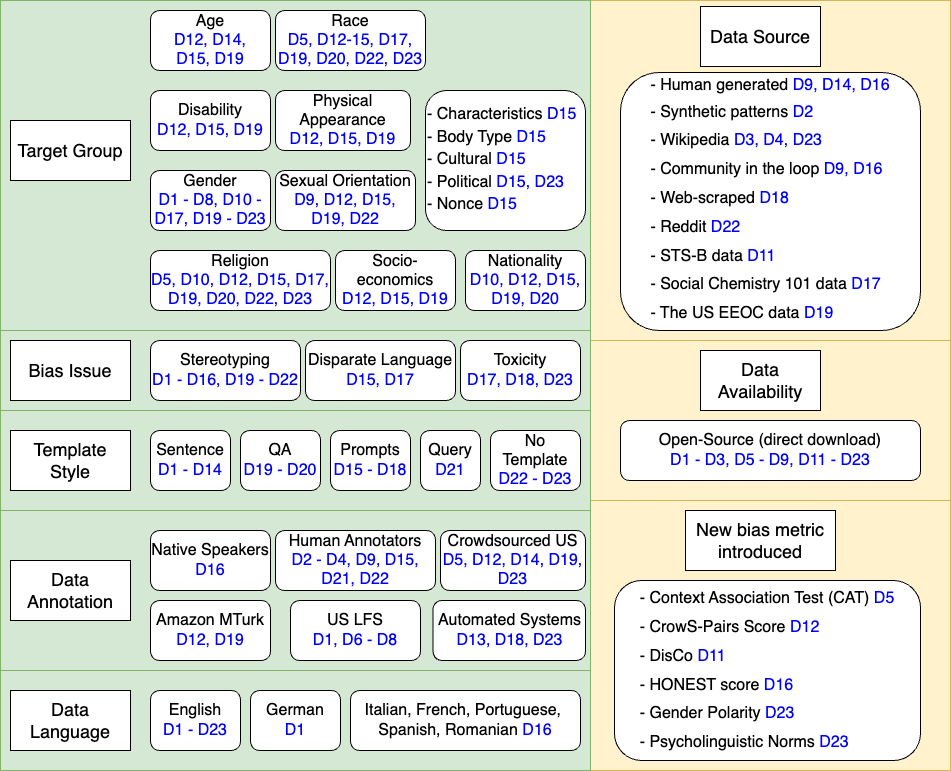
- Evaluates benchmark datasets such as HolisticBias and WinoQueer, which were co-created with marginalized communities to improve representational accuracy.
- Proposes a hybrid approach combining LLM-based stereotype generation with community engagement to expand coverage and reduce blind spots in bias detection.
- Stresses the importance of automated, multi-perspective bias measurement to reduce reliance on subjective human annotation and minimize annotator bias.
- Recommends integrating real-time monitoring systems and regular model audits to detect emergent biases post-deployment, especially in dynamic social contexts.
Experimental results
Research questions
- RQ1How do current bias detection and mitigation techniques in pre-trained language models fall short in addressing the needs of under-represented and indigenous societies?
- RQ2What are the key sociocultural and linguistic challenges that limit the transferability of existing bias mitigation methods to marginalized communities?
- RQ3How can community-informed and community-led data governance models improve fairness and representation in LLMs?
- RQ4To what extent can recent large language models like GPT-4 and Llama 2 inherently reduce bias, and what risks do they pose if misused?
- RQ5How do evolving governmental regulations and legal frameworks influence the development and deployment of fair AI systems in diverse societies?
Key findings
- Current bias mitigation techniques are predominantly focused on binary gender classifications and resource-rich countries like the US, neglecting intersectional and culturally specific biases.
- Benchmark datasets such as HolisticBias and WinoQueer, co-created with marginalized communities, uncovered stereotypes not detectable through traditional methods, demonstrating the value of community involvement.
- A hybrid approach combining LLM-generated stereotypes with community validation expanded stereotype coverage and revealed distinct biases missed by either method alone.
- The reliance on human judgment in bias annotation introduces subjectivity and potential personal bias, underscoring the need for automated, multi-perspective evaluation frameworks.
- Recent models like GPT-4 show reduced bias on many stereotyped topics compared to earlier versions, but their precise instruction-following capabilities also increase the risk of malicious manipulation.
- Ongoing regulatory changes worldwide necessitate adaptive research practices, and inclusive governance involving civil society, policy-makers, and affected communities is essential for sustainable fairness in AI.
Read this paper
Open the full text in the Nubint reader and ask about any passage as you read.
Read this paper on NubintThis review was generated by AI from the original paper. Please check the paper before citing it.