
[Paper Review] TACOS: Task Agnostic Continual Learning in Spiking Neural Networks
TACOS introduces a task-agnostic continual learning framework for spiking neural networks using activity-dependent metaplasticity, synaptic consolidation, and heterosynaptic decay—enabling stable knowledge retention without task boundaries or increasing memory size. It outperforms regularization baselines in domain-incremental learning, reducing catastrophic interference by up to 5x while maintaining 22% higher mean accuracy than a baseline SNN.
Catastrophic interference, the loss of previously learned information when learning new information, remains a major challenge in machine learning. Since living organisms do not seem to suffer from this problem, researchers have taken inspiration from biology to improve memory retention in artificial intelligence systems. However, previous attempts to use bio-inspired mechanisms have typically resulted in systems that rely on task boundary information during training and/or explicit task identification during inference, information that is not available in real-world scenarios. Here, we show that neuro-inspired mechanisms such as synaptic consolidation and metaplasticity can mitigate catastrophic interference in a spiking neural network, using only synapse-local information, with no need for task awareness, and with a fixed memory size that does not need to be increased when training on new tasks. Our model, TACOS, combines neuromodulation with complex synaptic dynamics to enable new learning while protecting previous information. We evaluate TACOS on sequential image recognition tasks and demonstrate its effectiveness in reducing catastrophic interference. Our results show that TACOS outperforms existing regularization techniques in domain-incremental learning scenarios. We also report the results of an ablation study to elucidate the contribution of each neuro-inspired mechanism separately.
Motivation & Objective
- To address catastrophic forgetting in continual learning without requiring task-identity information during training or inference.
- To develop a scalable, energy-efficient continual learning framework in spiking neural networks that mimics biological synaptic mechanisms.
- To achieve stable knowledge retention with a fixed memory budget that does not scale with the number of tasks.
- To investigate the role of activity-dependent metaplasticity and synaptic consolidation in balancing stability and plasticity.
- To demonstrate the effectiveness of neuro-inspired mechanisms in a multi-layer, supervised SNN with local learning rules.
Proposed method
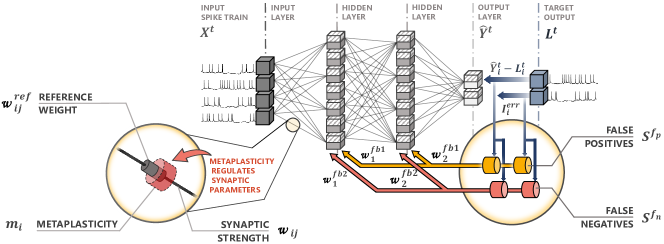
- TACOS employs a complex synaptic model with activity-dependent metaplasticity that dynamically adjusts synaptic strength based on pre- and post-synaptic activity.
- It integrates synaptic consolidation, which reduces spontaneous decay of potentiated synapses, enhancing long-term memory retention.
- Heterosynaptic decay is applied to weaken inactive synapses, promoting selective plasticity and reducing interference.
- Error-driven neuromodulation triggers learning updates only when prediction errors occur, enabling efficient, targeted plasticity.
- All learning rules are synapse-local, requiring no global task information or external supervision.
- The model uses a fixed number of parameters and memory size, independent of the number of tasks learned.
Experimental results
Research questions
- RQ1Can neuro-inspired mechanisms like metaplasticity and synaptic consolidation reduce catastrophic forgetting in spiking neural networks without task boundary information?
- RQ2How does activity-dependent metaplasticity compare to fixed metaplastic states in balancing stability and plasticity?
- RQ3To what extent can TACOS maintain performance across a large number of sequential tasks with limited training data?
- RQ4How does the trade-off between plasticity and stability vary with different levels of metaplasticity in continual learning?
- RQ5Can the model generalize to challenging, real-world continual learning scenarios such as few-shot, domain-incremental learning on Omniglot?
Key findings
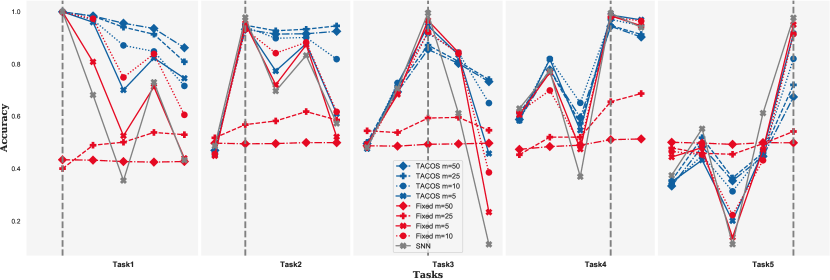
- TACOS reduces catastrophic interference by approximately 5x compared to a baseline SNN in split-MNIST and split-FMNIST tasks.
- Despite having roughly 3x lower plasticity than the baseline, TACOS achieves 22% higher mean accuracy across tasks.
- On the 50-task split-Omniglot benchmark, low metaplasticity (m=25) increased final mean accuracy by 6% over the baseline SNN.
- The model shows an inflection point in performance at a maximum metaplastic state of m=25, indicating an optimal balance between stability and plasticity.
- Ablation studies confirm that both metaplasticity and synaptic consolidation independently contribute to reduced forgetting and improved retention.
- Performance degradation due to reduced training data can be mitigated by scaling metaplasticity and consolidation parameters with task duration.
Read this paper
Open the full text in the Nubint reader and ask about any passage as you read.
Read this paper on NubintThis review was generated by AI from the original paper. Please check the paper before citing it.