
[Paper Review] Take a Step Back: Evoking Reasoning via Abstraction in Large Language Models
Step-Back Prompting uses abstraction to derive high-level concepts and first principles, grounding reasoning to improve multi-task performance in STEM, Knowledge QA, and multi-hop reasoning, achieving notable gains over baselines and CoT prompting.
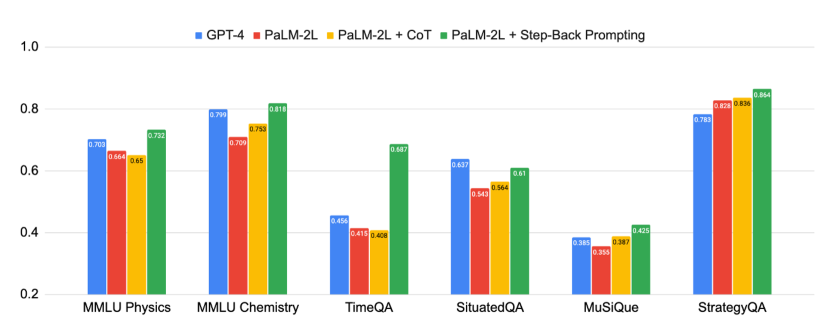
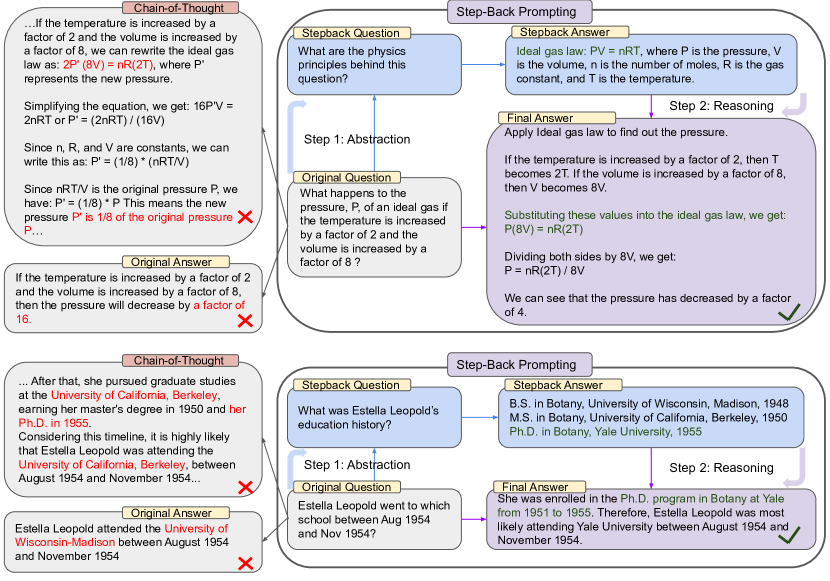
We present Step-Back Prompting, a simple prompting technique that enables LLMs to do abstractions to derive high-level concepts and first principles from instances containing specific details. Using the concepts and principles to guide reasoning, LLMs significantly improve their abilities in following a correct reasoning path towards the solution. We conduct experiments of Step-Back Prompting with PaLM-2L, GPT-4 and Llama2-70B models, and observe substantial performance gains on various challenging reasoning-intensive tasks including STEM, Knowledge QA, and Multi-Hop Reasoning. For instance, Step-Back Prompting improves PaLM-2L performance on MMLU (Physics and Chemistry) by 7% and 11% respectively, TimeQA by 27%, and MuSiQue by 7%.
Motivation & Objective
- Motivate the challenge of complex, detail-rich reasoning for large language models.
- Propose Step-Back Prompting to derive high-level abstractions before solving a problem.
- Demonstrate that abstraction-guided reasoning improves accuracy across STEM, knowledge QA, and multi-hop tasks.
Proposed method
- Two-step Abstraction-and-Reasoning: first derive high-level concepts or principles, then ground solving in these abstractions.
- Use few-shot demonstrations to teach the abstraction step to the LLM.
- Leverage retrieval augmentation (RAG) when appropriate to ground high-level concepts with supporting facts.
- Evaluate on diverse datasets (STEM, Knowledge QA, Multi-Hop) using greedy decoding and a scoring-based evaluation of predictions.
- Compare against baselines including PaLM-2L and GPT-4 with CoT, TDB, and RAG as applicable.
Experimental results
Research questions
- RQ1Does Step-Back Prompting improve accuracy on STEM, Knowledge QA, and Multi-Hop tasks compared to standard prompting and Chain-of-Thought prompts?
- RQ2How robust is the abstraction step to the number of demonstrations?
- RQ3What types of errors are most affected by abstraction-guided reasoning (e.g., reasoning, math, or context loss)?
Key findings
- Step-Back Prompting improves PaLM-2L performance on MMLU Physics by 7 percentage points and on MMLU Chemistry by 11 percentage points, outperforming GPT-4 on both sub-tasks.
- Step-Back Prompting yields a 27% improvement on TimeQA and a 7% improvement on MuSiQue over PaLM-2L baselines.
- Across tasks, Step-Back outperforms CoT and TDB by up to 36% in some analyses, and fixes a substantial portion of base-model errors (up to ~40%), with a smaller proportion of new errors (~12%).
- Ablation shows Step-Back is robust to the number of few-shot demonstrations, often requiring only a single example to teach abstraction.
- Error analysis indicates most remaining errors occur during the Reasoning step rather than the Abstraction step, highlighting Reasoning as the main bottleneck.
Read this paper
Open the full text in the Nubint reader and ask about any passage as you read.
Read this paper on NubintThis review was generated by AI from the original paper. Please check the paper before citing it.