
[Paper Review] TANGOS: Regularizing Tabular Neural Networks through Gradient Orthogonalization and Specialization
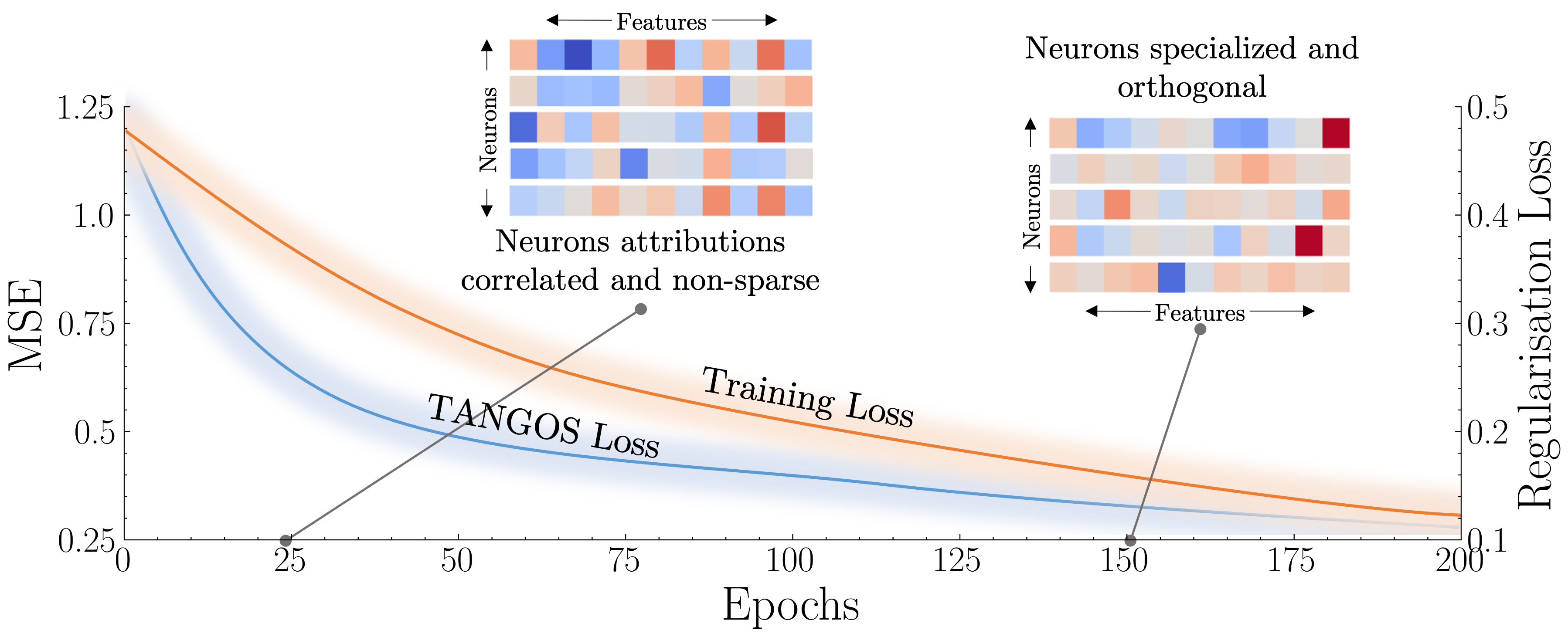
TANGOS is a novel regularization framework for tabular neural networks that enforces gradient orthogonalization and specialization by penalizing overlapping and non-sparse neuron attributions. By encouraging neurons to attend to distinct, sparse input features, TANGOS improves out-of-sample generalization, outperforming standard regularizers and enabling further gains when combined with existing methods.
Despite their success with unstructured data, deep neural networks are not yet a panacea for structured tabular data. In the tabular domain, their efficiency crucially relies on various forms of regularization to prevent overfitting and provide strong generalization performance. Existing regularization techniques include broad modelling decisions such as choice of architecture, loss functions, and optimization methods. In this work, we introduce Tabular Neural Gradient Orthogonalization and Specialization (TANGOS), a novel framework for regularization in the tabular setting built on latent unit attributions. The gradient attribution of an activation with respect to a given input feature suggests how the neuron attends to that feature, and is often employed to interpret the predictions of deep networks. In TANGOS, we take a different approach and incorporate neuron attributions directly into training to encourage orthogonalization and specialization of latent attributions in a fully-connected network. Our regularizer encourages neurons to focus on sparse, non-overlapping input features and results in a set of diverse and specialized latent units. In the tabular domain, we demonstrate that our approach can lead to improved out-of-sample generalization performance, outperforming other popular regularization methods. We provide insight into why our regularizer is effective and demonstrate that TANGOS can be applied jointly with existing methods to achieve even greater generalization performance.
Motivation & Objective
- To address the challenge of overfitting and poor generalization in deep neural networks trained on tabular data.
- To introduce a new regularization method that leverages neuron attributions to promote structural diversity in latent representations.
- To improve generalization performance in low-data regimes by encouraging sparse, non-overlapping feature attention across neurons.
- To demonstrate that TANGOS can be effectively combined with existing regularizers for further performance gains.
- To provide interpretability insights by linking improved performance to increased diversity among weak learners in the latent space.
Proposed method
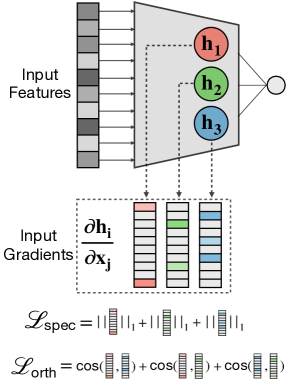
- TANGOS introduces a novel regularizer that operates on gradient attributions of neurons with respect to input features.
- The method penalizes non-orthogonal and non-specialized attributions by encouraging neurons to focus on disjoint, sparse subsets of input features.
- It computes neuron-level attributions via gradient-based saliency maps and applies a joint penalty on the cosine similarity and sparsity of these attributions across neurons.
- The regularizer is differentiable and integrated into the training objective, allowing end-to-end optimization.
- The framework is compatible with standard deep learning components and can be combined with existing regularizers like dropout, weight decay, and batch normalization.
- Experiments are conducted on 20 tabular datasets from UCI, with standard preprocessing including feature standardization, one-hot encoding, and imputation.
Experimental results
Research questions
- RQ1Can gradient attribution-based regularization improve generalization in tabular neural networks?
- RQ2Does enforcing orthogonality and specialization in neuron attributions lead to better model performance on tabular data?
- RQ3How does TANGOS compare to established regularizers like L1, L2, dropout, and batch normalization in terms of out-of-sample performance?
- RQ4Can TANGOS be effectively combined with other regularizers to further enhance generalization?
- RQ5What structural characteristics in the latent space are responsible for TANGOS' improved performance?
Key findings
- TANGOS outperforms baseline models and all standard regularizers (L1, L2, dropout, batch norm, input noise, mixup) on 20 tabular datasets in terms of generalization performance.
- On the Boston housing (BH) dataset, TANGOS achieves a test loss of 0.362 ± 0.021, outperforming the baseline (0.389 ± 0.007) and other regularizers.
- On the Wine Quality (WQ) dataset, TANGOS achieves a test loss of 0.364 ± 0.003, significantly lower than the baseline (0.394 ± 0.033).
- On the Cervical Cancer (CE) dataset, TANGOS achieves a test loss of 0.185 ± 0.009, outperforming the baseline (0.211 ± 0.008).
- TANGOS demonstrates consistent improvement across both regression and classification tasks, with the most notable gains in low-data regimes.
- When combined with other regularizers such as dropout and weight decay, TANGOS achieves even greater performance gains, indicating synergistic effects.
Read this paper
Open the full text in the Nubint reader and ask about any passage as you read.
Read this paper on NubintThis review was generated by AI from the original paper. Please check the paper before citing it.