
[Paper Review] Target Sensing with Intelligent Reflecting Surface: Architecture and Performance
This paper proposes a novel self-sensing intelligent reflecting surface (IRS) architecture that enables target localization by leveraging both direct and IRS-reflected echo signals. By optimizing passive reflection to maximize echo power and deriving a Cramér-Rao bound (CRB) for angle estimation, the IRS achieves high-precision sensing without dedicated transmitters, outperforming conventional systems in accuracy and robustness under path loss and blockages.
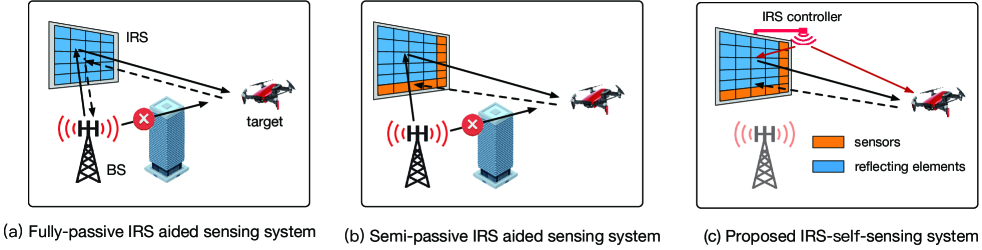
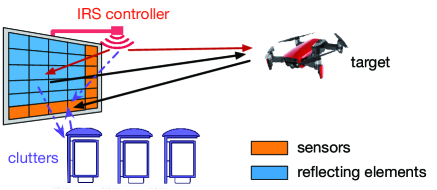
Intelligent reflecting surface (IRS) has emerged as a promising technology to reconfigure the radio propagation environment by dynamically controlling wireless signal's amplitude and/or phase via a large number of reflecting elements. In contrast to the vast literature on studying IRS's performance gains in wireless communications, we study in this paper a new application of IRS for sensing/localizing targets in wireless networks. Specifically, we propose a new self-sensing IRS architecture where the IRS controller is capable of transmitting probing signals that are not only directly reflected by the target (referred to as the direct echo link), but also consecutively reflected by the IRS and then the target (referred to as the IRS-reflected echo link). Moreover, dedicated sensors are installed at the IRS for receiving both the direct and IRS-reflected echo signals from the target, such that the IRS can sense the direction of its nearby target by applying a customized multiple signal classification (MUSIC) algorithm. However, since the angle estimation mean square error (MSE) by the MUSIC algorithm is intractable, we propose to optimize the IRS passive reflection for maximizing the average echo signals' total power at the IRS sensors and derive the resultant Cramer-Rao bound (CRB) of the angle estimation MSE. Last, numerical results are presented to show the effectiveness of the proposed new IRS sensing architecture and algorithm, as compared to other benchmark sensing systems/algorithms.
Motivation & Objective
- To address the need for high-precision, low-cost target sensing in 6G wireless networks, especially under severe path loss and blockages.
- To overcome limitations of conventional mono-static and bi-static sensing systems by enabling IRS to act as both a reflector and a sensing platform.
- To develop a self-sensing IRS architecture capable of estimating target direction using both direct and IRS-reflected echo signals.
- To optimize passive reflection coefficients to maximize total echo power at IRS sensors, thereby improving angle estimation accuracy.
- To derive the Cramér-Rao bound (CRB) for angle estimation MSE, providing a theoretical performance limit for the proposed sensing framework.
Proposed method
- The IRS is equipped with dedicated sensors to receive both direct and IRS-reflected echo signals from a target.
- A customized multiple signal classification (MUSIC) algorithm is applied to estimate the direction of arrival (DOA) of the target using the combined echo signals.
- The passive reflection coefficients of the IRS are optimized to maximize the total power of the echo signals received at the IRS sensors.
- The Cramér-Rao bound (CRB) for the angle estimation mean square error (MSE) is derived based on the optimized signal model and statistical properties of the echo signals.
- The CRB is expressed in closed form using the Fisher information matrix, incorporating the signal-to-noise ratio, array response vectors, and the effective channel gain from the IRS to the target and back.
- Theoretical analysis accounts for the impact of IRS element configuration, signal correlation, and array geometry on estimation accuracy.
Experimental results
Research questions
- RQ1Can an IRS be designed to simultaneously support communication and target sensing without requiring a separate transmitter?
- RQ2How does the joint use of direct and IRS-reflected echo signals improve target localization accuracy compared to conventional systems?
- RQ3What is the optimal passive reflection beamforming design that maximizes echo power at the IRS sensors for improved sensing performance?
- RQ4What is the theoretical lower bound on angle estimation MSE for the proposed IRS sensing architecture?
- RQ5How does the CRB for angle estimation scale with IRS size, signal-to-noise ratio, and array geometry?
Key findings
- The proposed self-sensing IRS architecture achieves high-precision target localization by exploiting both direct and IRS-reflected echo signals, eliminating the need for a separate radar transmitter.
- Optimizing the passive reflection coefficients to maximize total echo power significantly improves the signal-to-noise ratio at the IRS sensors, enhancing estimation accuracy.
- The derived Cramér-Rao bound (CRB) for angle estimation MSE is expressed in closed form, showing that the bound scales inversely with the square of the effective channel gain and the number of IRS elements.
- Numerical results demonstrate that the proposed system outperforms conventional mono-static and bi-static sensing systems in terms of localization accuracy, especially under high path loss and blockage conditions.
- The CRB analysis reveals that the estimation error is minimized when the IRS is properly aligned with the target and the signal correlation is maximized through optimal phase shifts.
- The performance gain is most significant when the IRS is placed near the target, as it reduces the round-trip path loss and enhances the strength of the IRS-reflected echo.
Better researchstarts right now
From reading papers to final review, dramatically reduce your research time.
No credit card · Free plan available
This review was created by AI and reviewed by human editors.