
[Paper Review] Targeted Sub-threshold Search for Strongly-lensed Gravitational-wave Events
This paper presents the TESLA (Targeted Ed Subthreshold Lensing seArch) pipeline, a GstLAL-based method that uses targeted template banks derived from confirmed gravitational-wave events to detect subthreshold, strongly lensed counterparts. It significantly improves recovery of faint lensed signals compared to alternative template banks, demonstrating superior sensitivity and effectiveness in identifying lensed pairs in O3a data.
Strong gravitational lensing of gravitational waves can produce duplicate signals separated in time with different amplitudes. We consider the case in which strong lensing produces superthreshold gravitational-wave events and weaker subthreshold signals buried in the noise background. We present the GstLAL-based TargetEd Subthreshold Lensing seArch search method for the subthreshold signals using reduced template banks targeting specific confirmed gravitational-wave events. We perform a simulation campaign to assess the performance of the proposed search method. We show that it can effectively uprank potential subthreshold lensed counterparts to the target gravitational-wave event. We also compare its performance to other alternative solutions to the posed problem and demonstrate that our proposed method outperforms the other solutions. The method described in this paper has already been deployed in the recent LVK Collaboration-wide search for lensing signatures of gravitational waves in the first half of LIGO/Virgo third observing run O3a [R. Abbott et al. (LIGO Scientific, Virgo Collaborations), Astrophys. J. 923, 14 (2021).].
Motivation & Objective
- To develop a method for detecting subthreshold gravitational-wave signals that are strongly lensed counterparts to confirmed superthreshold events.
- To address the challenge of identifying faint, lensed gravitational-wave signals buried in noise, which are undetectable by standard matched-filtering pipelines.
- To improve search sensitivity by constructing targeted template banks based on posterior samples from confirmed events, rather than using generic or random banks.
- To assess the performance of the TESLA pipeline against alternative template bank strategies in simulated O3a-like data.
Proposed method
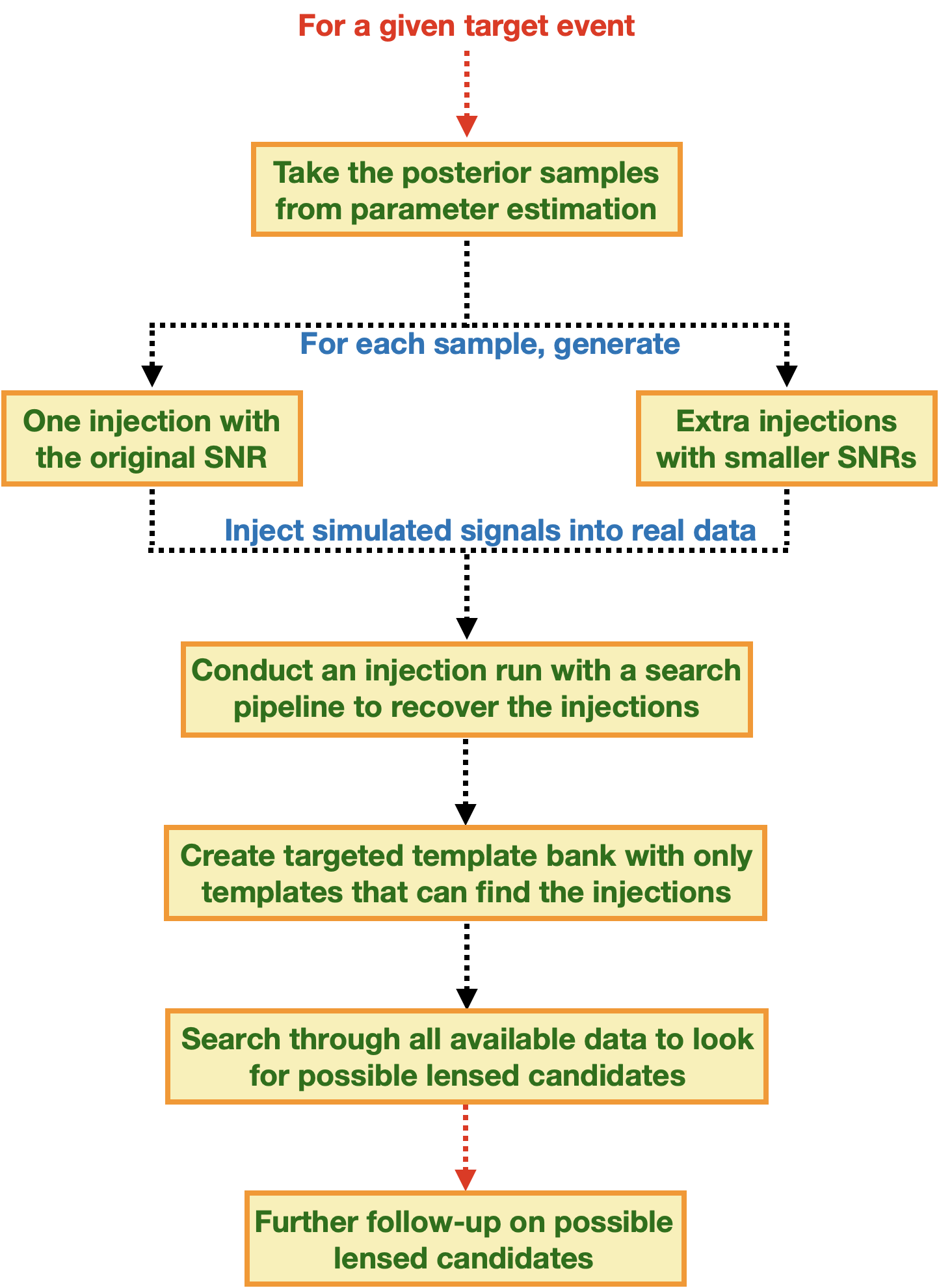
- The TESLA pipeline uses posterior samples from Bayesian parameter estimation of a confirmed gravitational-wave event to construct a targeted template bank focused on the likely parameter space of its lensed counterpart.
- It applies matched filtering with the targeted bank to search for subthreshold signals in the same data stream as the confirmed event, enhancing sensitivity to faint lensed images.
- The method leverages the known sky location and time delay constraints from the primary event to reduce the parameter space and improve signal-to-noise ranking.
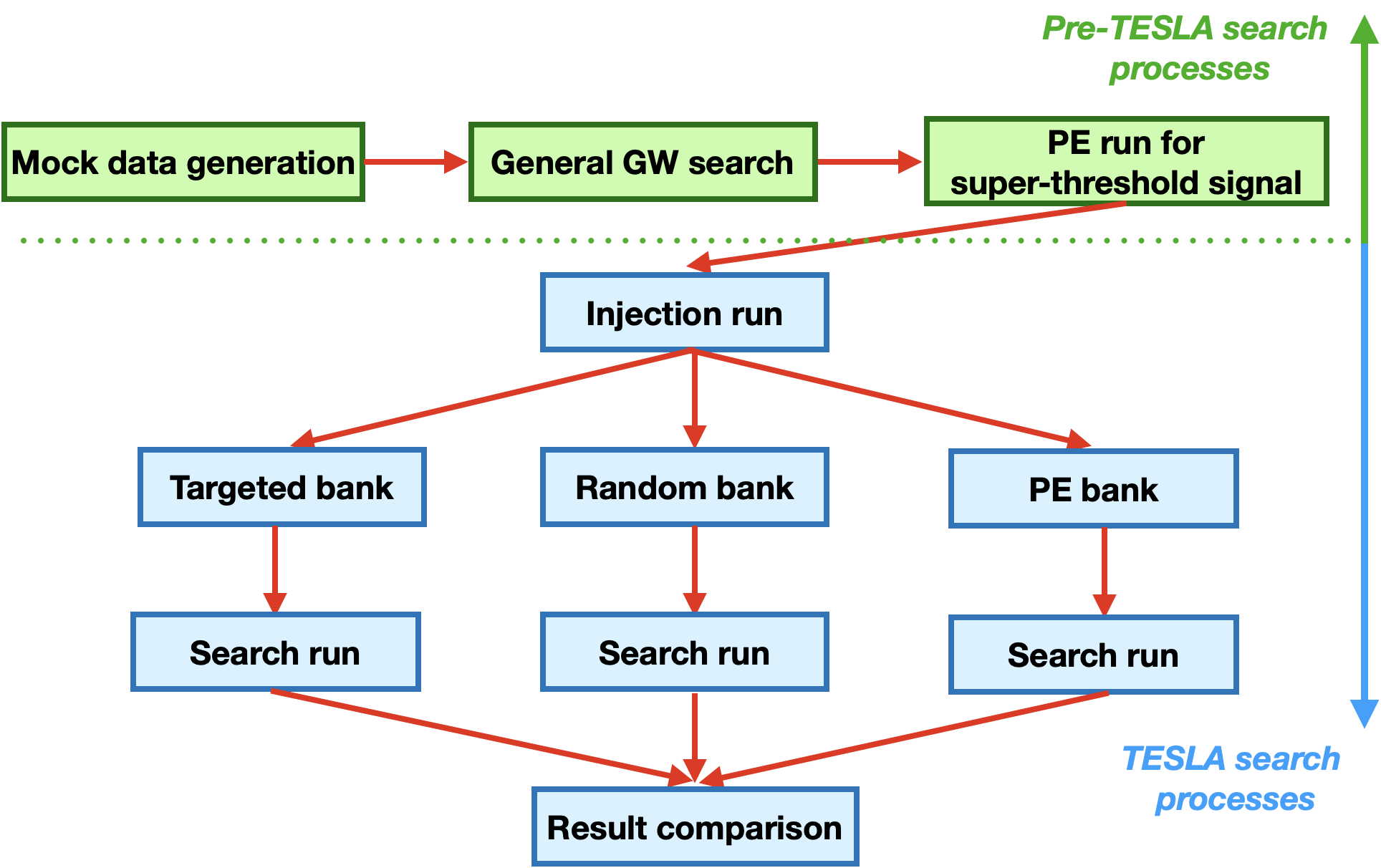
- It performs a mock data challenge using O3a-like power spectral densities and injected lensed signals, comparing TESLA’s performance to four alternative template banks: maximum-posterior, 90% credible region, random selection, and a general bank.
- The pipeline uses a signal-to-noise ratio (SNR) ranking system to uprank potential subthreshold candidates, increasing the likelihood of detecting lensed counterparts.
- Performance is evaluated based on subthreshold signal recovery rate, sensitive range, and robustness across multiple injection trials.
Experimental results
Research questions
- RQ1Can a targeted template bank derived from confirmed gravitational-wave events significantly improve the detection of subthreshold, strongly lensed counterparts?
- RQ2How does the performance of the TESLA pipeline compare to alternative template bank strategies such as maximum-posterior, credible-region, or random template selection?
- RQ3Does the targeted approach outperform general search pipelines in recovering faint lensed signals that are below detection threshold in standard searches?
- RQ4What is the optimal balance between template bank coverage and sensitivity in subthreshold lensing searches?
- RQ5Can the TESLA method be extended to include time-delay and sky-locus constraints to further enhance sensitivity?
Key findings
- The TESLA pipeline successfully upranked the subthreshold lensed signal in simulated O3a data, significantly increasing its likelihood of being identified as a gravitational-wave candidate.
- The targeted template bank constructed by TESLA outperformed all alternative banks—including maximum-posterior, 90% credible region, and random selection—in recovering the injected subthreshold signal.
- The TESLA bank achieved a higher sensitive range for lensed signals similar to the target event, indicating improved detection capability.
- Further narrowing of the template bank beyond the TESLA method did not yield additional sensitivity gains, suggesting the method achieves near-optimal coverage.
- The pipeline has been deployed in the LVK Collaboration’s O3a-wide search for lensing signatures, confirming its practical utility in real-world gravitational-wave data analysis.
Read this paper
Open the full text in the Nubint reader and ask about any passage as you read.
Read this paper on NubintThis review was generated by AI from the original paper. Please check the paper before citing it.