
[Paper Review] Task Adaptive Parameter Sharing for Multi-Task Learning
This paper proposes Task Adaptive Parameter Sharing (TAPS), a method that differentiably selects a minimal subset of layers in a pre-trained model to fine-tune for each downstream task, using a continuous relaxation and sparsity regularization to balance performance and efficiency. TAPS achieves state-of-the-art accuracy in multi-task learning while introducing only 0.46× more task-specific parameters than AdaShare, and matches full fine-tuning performance with significantly reduced memory and parameter overhead across ResNet, DenseNet, and Vision Transformer architectures.
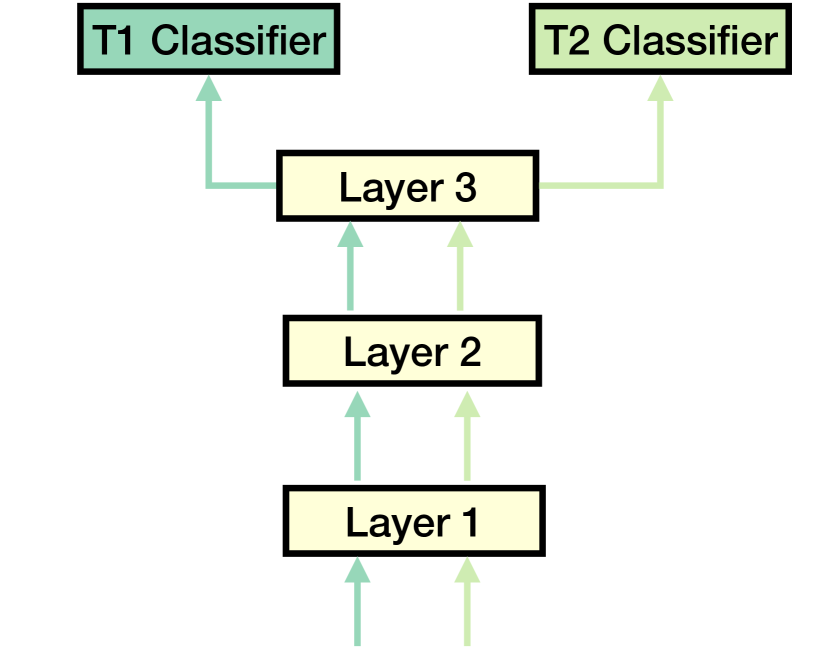
Adapting pre-trained models with broad capabilities has become standard practice for learning a wide range of downstream tasks. The typical approach of fine-tuning different models for each task is performant, but incurs a substantial memory cost. To efficiently learn multiple downstream tasks we introduce Task Adaptive Parameter Sharing (TAPS), a general method for tuning a base model to a new task by adaptively modifying a small, task-specific subset of layers. This enables multi-task learning while minimizing resources used and competition between tasks. TAPS solves a joint optimization problem which determines which layers to share with the base model and the value of the task-specific weights. Further, a sparsity penalty on the number of active layers encourages weight sharing with the base model. Compared to other methods, TAPS retains high accuracy on downstream tasks while introducing few task-specific parameters. Moreover, TAPS is agnostic to the model architecture and requires only minor changes to the training scheme. We evaluate our method on a suite of fine-tuning tasks and architectures (ResNet, DenseNet, ViT) and show that it achieves state-of-the-art performance while being simple to implement.
Motivation & Objective
- To address the high memory and parameter cost of training separate models for each downstream task in multi-task learning.
- To reduce task interference and catastrophic forgetting in incremental and joint multi-task learning settings.
- To discover effective, architecture-specific parameter sharing patterns without architectural modifications or hand-crafted design.
- To enable efficient, scalable multi-task learning with minimal changes to standard training pipelines.
- To achieve performance comparable to full fine-tuning while minimizing task-specific parameter count.
Proposed method
- TAPS formulates layer selection as a continuous, differentiable optimization problem using a straight-through estimator with gating over task-specific weight deltas.
- It introduces a sparsity penalty on the number of active (tuned) layers to encourage sharing with the pre-trained base model.
- The method jointly optimizes for task-specific weights and layer selection via stochastic gradient descent, enabling end-to-end training.
- TAPS does not modify the model architecture; instead, it re-trains a small, adaptive subset of existing layers per task.
- The approach is agnostic to model architecture and requires only minor modifications to standard fine-tuning schemes.
- It discovers both intuitive and non-intuitive sharing patterns—e.g., adapting only self-attention layers in Vision Transformers while sharing feed-forward layers.
Experimental results
Research questions
- RQ1Can we learn which layers to adapt in a pre-trained model without architectural modifications or hand-designed rules?
- RQ2Can a differentiable, continuous relaxation of layer selection achieve performance close to full fine-tuning while minimizing task-specific parameters?
- RQ3Does TAPS outperform existing parameter-sharing methods like AdaShare in both joint and incremental multi-task learning settings?
- RQ4Can TAPS discover effective, architecture-specific sharing patterns automatically, such as focusing on attention layers in Vision Transformers?
- RQ5How does TAPS compare in parameter efficiency and training cost to two-phase methods like AdaShare?
Key findings
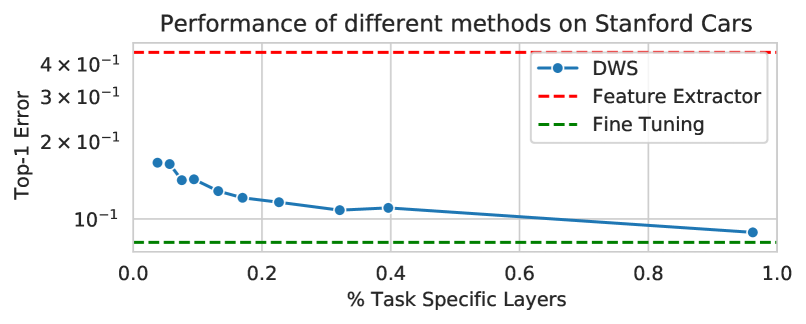
- TAPS achieves state-of-the-art performance on DomainNet with ResNet-34, outperforming AdaShare by 2.18% on average in the incremental MTL setting while being 18% more parameter-efficient.
- In the joint MTL setting, TAPS matches full fine-tuning accuracy (80.28% top-1 accuracy on DomainNet) while introducing only 0.46× more task-specific parameters than AdaShare.
- TAPS discovers task-specific, architecture-aware tuning patterns: for ResNets, it primarily adapts the final layers; for Vision Transformers, it selectively tunes only self-attention layers.
- TAPS maintains stable performance across joint and incremental training, unlike full fine-tuning which suffers from task competition and performance degradation in joint settings.
- TAPS has minimal training overhead compared to AdaShare, which requires a costly two-phase training process involving policy learning and multiple architecture sampling.
- Despite using a larger network (ResNet-50), AdaShare's performance slightly degrades, suggesting capacity is not the limiting factor—highlighting TAPS’s efficiency and robustness.
Read this paper
Open the full text in the Nubint reader and ask about any passage as you read.
Read this paper on NubintThis review was generated by AI from the original paper. Please check the paper before citing it.