
[Paper Review] Task-Specific Normalization for Continual Learning of Blind Image Quality Models
This paper proposes TSN-IQA, a continual learning method for blind image quality assessment that freezes pre-trained convolutional filters for stability and learns task-specific batch normalization parameters for plasticity. By using a lightweight K-means gating mechanism to combine predictions from multiple task-specific heads, the method achieves superior accuracy, robustness to task order and length, and minimal forgetting across six IQA datasets with negligible parameter increase.
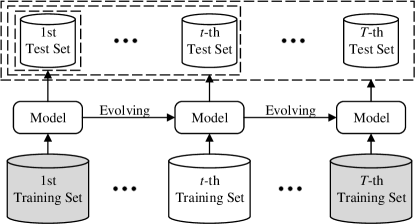
In this paper, we present a simple yet effective continual learning method for blind image quality assessment (BIQA) with improved quality prediction accuracy, plasticity-stability trade-off, and task-order/-length robustness. The key step in our approach is to freeze all convolution filters of a pre-trained deep neural network (DNN) for an explicit promise of stability, and learn task-specific normalization parameters for plasticity. We assign each new IQA dataset (i.e., task) a prediction head, and load the corresponding normalization parameters to produce a quality score. The final quality estimate is computed by black a weighted summation of predictions from all heads with a lightweight $K$-means gating mechanism. Extensive experiments on six IQA datasets demonstrate the advantages of the proposed method in comparison to previous training techniques for BIQA.
Motivation & Objective
- To address catastrophic forgetting in continual learning for blind image quality assessment (BIQA), where models must adapt to new distortion types without losing performance on previously seen data.
- To improve the plasticity-stability trade-off in BIQA continual learning by decoupling feature extraction from task-specific adaptation.
- To enable robust performance across varying task orders and lengths, overcoming limitations of regularization-based methods like LwF.
- To design a lightweight inference mechanism that avoids reliance on test-time oracles or additional deep networks for head weighting.
- To demonstrate generalization to unseen datasets beyond the training tasks, validating the method's adaptability to real-world distribution shifts.
Proposed method
- Freeze all convolutional filters of a pre-trained DNN to preserve learned features and ensure stability across tasks.
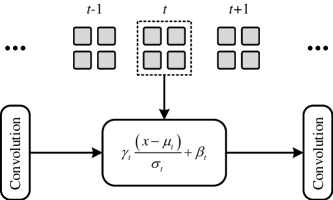
- Introduce task-specific batch normalization (BN) parameters for each new task, allowing plastic adaptation to new distortion types without updating the main network.
- Attach a separate fully connected prediction head to each task, using the corresponding task-specific BN parameters to generate quality scores.
- Combine predictions from all heads using a lightweight K-means gating (KG) mechanism that computes dynamic weights based on distortion-aware BN statistics.
- Use the KG module during inference to compute a weighted average of all head predictions, enabling dynamic adaptation to input distortion characteristics.
- Train the model end-to-end with standard loss on each new task, while keeping the feature extractor frozen and only updating BN and head parameters.
Experimental results
Research questions
- RQ1Can task-specific normalization effectively prevent catastrophic forgetting in continual BIQA while maintaining high prediction accuracy?
- RQ2How does the proposed method perform under varying task order and sequence length, compared to existing continual learning baselines?
- RQ3Can the K-means gating mechanism effectively assign meaningful weights to prediction heads based on input distortion characteristics without additional model components?
- RQ4Does the method generalize to unseen IQA datasets not included in the training sequence?
- RQ5How does the computational complexity scale with the number of tasks, and can it be efficiently accelerated?
Key findings
- TSN-IQA achieves state-of-the-art performance on six benchmark IQA datasets, demonstrating superior quality prediction accuracy compared to prior methods like LwF-KG.
- The method exhibits strong robustness to task order and length, with minimal performance degradation across different training sequences.
- The K-means gating mechanism assigns perceptually meaningful weights: heads trained on synthetic datasets (e.g., LIVE, CSIQ) receive higher weights on TID2013, while those on realistic distortions (e.g., KonIQ-10K) are favored on SPAQ.
- The correlation between KL divergence of BN parameters and prediction accuracy is strong (SRCC = -0.776), indicating that similar distortion types lead to more accurate inter-dataset generalization.
- The method maintains linear computational complexity with respect to the number of tasks, and a hard-assignment variant reduces inference cost by a factor of T while still outperforming LwF-KG with the same complexity.
- TSN-IQA generalizes well to unseen datasets, achieving reasonable SRCC on TID2013 and SPAQ despite never being trained on them, confirming its generalization capability.
Read this paper
Open the full text in the Nubint reader and ask about any passage as you read.
Read this paper on NubintThis review was generated by AI from the original paper. Please check the paper before citing it.