
[Paper Review] TCAN: Text-oriented Cross Attention Network for Multimodal Sentiment Analysis
TCAN proposes a text-oriented cross-attention network for multimodal sentiment analysis that leverages text modality as a dominant guide for visual and acoustic modality fusion. By using text-queried cross-attention with gated mechanisms and unimodal joint learning, TCAN achieves state-of-the-art performance on CMU-MOSI and CMU-MOSEI, outperforming prior methods by effectively balancing modality contributions and reducing noise impact.
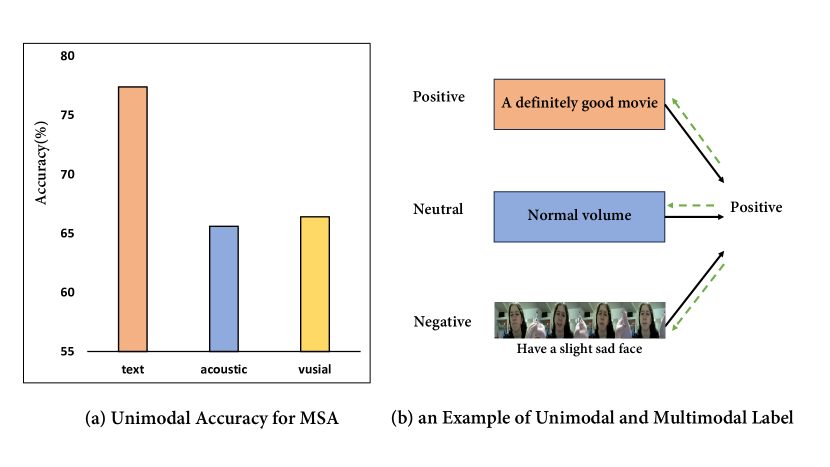
Multimodal Sentiment Analysis (MSA) endeavors to understand human sentiment by leveraging language, visual, and acoustic modalities. Despite the remarkable performance exhibited by previous MSA approaches, the presence of inherent multimodal heterogeneities poses a challenge, with the contribution of different modalities varying considerably. Past research predominantly focused on improving representation learning techniques and feature fusion strategies. However, many of these efforts overlooked the variation in semantic richness among different modalities, treating each modality uniformly. This approach may lead to underestimating the significance of strong modalities while overemphasizing the importance of weak ones. Motivated by these insights, we introduce a Text-oriented Cross-Attention Network (TCAN), emphasizing the predominant role of the text modality in MSA. Specifically, for each multimodal sample, by taking unaligned sequences of the three modalities as inputs, we initially allocate the extracted unimodal features into a visual-text and an acoustic-text pair. Subsequently, we implement self-attention on the text modality and apply text-queried cross-attention to the visual and acoustic modalities. To mitigate the influence of noise signals and redundant features, we incorporate a gated control mechanism into the framework. Additionally, we introduce unimodal joint learning to gain a deeper understanding of homogeneous emotional tendencies across diverse modalities through backpropagation. Experimental results demonstrate that TCAN consistently outperforms state-of-the-art MSA methods on two datasets (CMU-MOSI and CMU-MOSEI).
Motivation & Objective
- To address the imbalance in modality contributions in multimodal sentiment analysis, where strong modalities like text are often underweighted.
- To mitigate noise and redundancy in unaligned visual and acoustic sequences during multimodal fusion.
- To improve representation learning by enabling bidirectional, interactive learning between text and other modalities.
- To develop a flexible framework that dynamically balances contributions of different modalities based on semantic richness.
- To outperform existing state-of-the-art methods on benchmark multimodal sentiment analysis datasets.
Proposed method
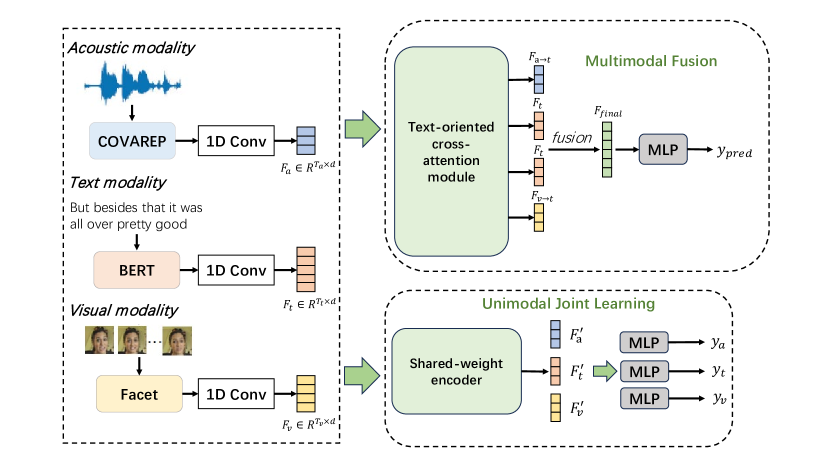
- The model uses two bi-modal fusion modules: text-visual (TV) and text-acoustic (TA), where text modality acts as a query for cross-attention on other modalities.
- Self-attention is applied to the text modality to enhance its internal representation before cross-attention with visual and acoustic features.
- A gated control mechanism is introduced to suppress noisy and redundant features in visual and acoustic modalities.
- Unimodal joint learning is employed to align representations across modalities by backpropagating shared sentiment signals.
- The architecture is built on stacked transformers with a text-oriented cross-attention mechanism, allowing iterative refinement of multimodal representations.
- The number of Text-oriented Cross-attention modules (N) is tuned, with optimal performance achieved at N=5 on CMU-MOSI.
Experimental results
Research questions
- RQ1How can a multimodal sentiment analysis model effectively prioritize the text modality, which exhibits higher semantic richness and lower noise?
- RQ2To what extent can text-queried cross-attention improve fusion performance compared to symmetric ternary fusion in unaligned multimodal sequences?
- RQ3How does the inclusion of a gated mechanism affect noise suppression and performance stability in multimodal fusion?
- RQ4What is the optimal number of cross-attention layers (N) for balancing representational depth and modality guidance in TCAN?
- RQ5Can joint unimodal and multimodal training improve consistency and generalization across different modalities?
Key findings
- TCAN achieves state-of-the-art performance on both CMU-MOSI and CMU-MOSEI datasets, outperforming existing SOTA methods in F1 scores.
- The ablation study confirms that removing the gated mechanism or unimodal joint training leads to significant performance degradation, proving their effectiveness.
- When the text modality is replaced as the dominant modality, the model's performance drops substantially, confirming text's semantic dominance.
- The optimal number of Text-oriented Cross-attention modules is N=5 on CMU-MOSI, as increasing N beyond this point reduces performance due to overfitting or guidance degradation.
- Visualization results show TCAN correctly assigns higher weight to strong modalities (e.g., text) and compensates for weak or conflicting signals in visual and acoustic modalities.
- The model successfully handles ambiguous cases where unimodal predictions conflict, producing predictions closer to the multimodal ground truth.
Read this paper
Open the full text in the Nubint reader and ask about any passage as you read.
Read this paper on NubintThis review was generated by AI from the original paper. Please check the paper before citing it.