
[Paper Review] TDN: Temporal Difference Networks for Efficient Action Recognition
This paper proposes Temporal Difference Networks (TDN), a lightweight, efficient video action recognition framework that uses a temporal difference module (TDM) to capture multi-scale motion patterns. By applying temporal differences at both local (consecutive frames) and global (segment-level) scales, TDN improves action recognition accuracy with minimal computational overhead, achieving new state-of-the-art results on Something-Something V1/V2 and competitive performance on Kinetics-400.
Temporal modeling still remains challenging for action recognition in videos. To mitigate this issue, this paper presents a new video architecture, termed as Temporal Difference Network (TDN), with a focus on capturing multi-scale temporal information for efficient action recognition. The core of our TDN is to devise an efficient temporal module (TDM) by explicitly leveraging a temporal difference operator, and systematically assess its effect on short-term and long-term motion modeling. To fully capture temporal information over the entire video, our TDN is established with a two-level difference modeling paradigm. Specifically, for local motion modeling, temporal difference over consecutive frames is used to supply 2D CNNs with finer motion pattern, while for global motion modeling, temporal difference across segments is incorporated to capture long-range structure for motion feature excitation. TDN provides a simple and principled temporal modeling framework and could be instantiated with the existing CNNs at a small extra computational cost. Our TDN presents a new state of the art on the Something-Something V1 & V2 datasets and is on par with the best performance on the Kinetics-400 dataset. In addition, we conduct in-depth ablation studies and plot the visualization results of our TDN, hopefully providing insightful analysis on temporal difference modeling. We release the code at https://github.com/MCG-NJU/TDN.
Motivation & Objective
- To address the challenge of efficient and effective temporal modeling in video action recognition.
- To design a unified, end-to-end trainable framework that jointly captures appearance and motion using temporal differences, avoiding reliance on optical flow or expensive 3D convolutions.
- To systematically study short-term and long-term motion modeling through a two-level difference modeling paradigm.
- To achieve high accuracy with low computational cost by integrating a lightweight temporal difference module into standard 2D CNNs.
- To provide insights into temporal difference-based motion modeling via ablation and visualization studies.
Proposed method
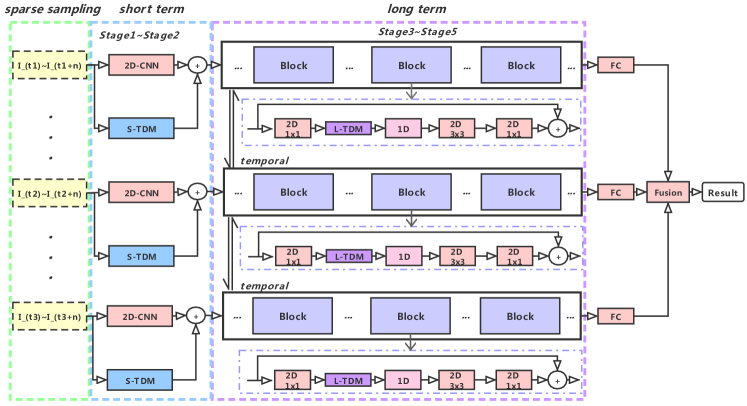
- Introduces a Temporal Difference Module (TDM) that computes differences between consecutive frames to extract fine-grained motion patterns for short-term modeling.
- Employs a multi-scale, bidirectional difference module across segments to capture long-range temporal structures for global motion excitation.
- Uses a two-level difference modeling strategy: local differences for frame-level motion and global differences for segment-level motion.
- Applies lateral connections to inject temporal difference features into 2D CNNs, enabling end-to-end training with minimal parameter increase.
- Utilizes holistic and sparse sampling to efficiently extract temporal information across the video.
- Employs Grad-CAM for visualization to analyze and validate the attention mechanisms of the TDM.
Experimental results
Research questions
- RQ1Can temporal difference operations effectively replace optical flow or 3D convolutions for motion modeling in video recognition?
- RQ2How does local vs. global temporal difference modeling impact action recognition performance?
- RQ3What is the contribution of the two-level difference modeling framework to capturing multi-scale motion patterns?
- RQ4How does the TDM affect feature activation maps and model interpretability?
- RQ5What is the computational efficiency of TDN compared to existing state-of-the-art methods?
Key findings
- TDN achieves a new state-of-the-art Top-1 accuracy of 97.4% on UCF101 and 76.3% on HMDB51, outperforming previous methods including TSM, I3D, and S3D.
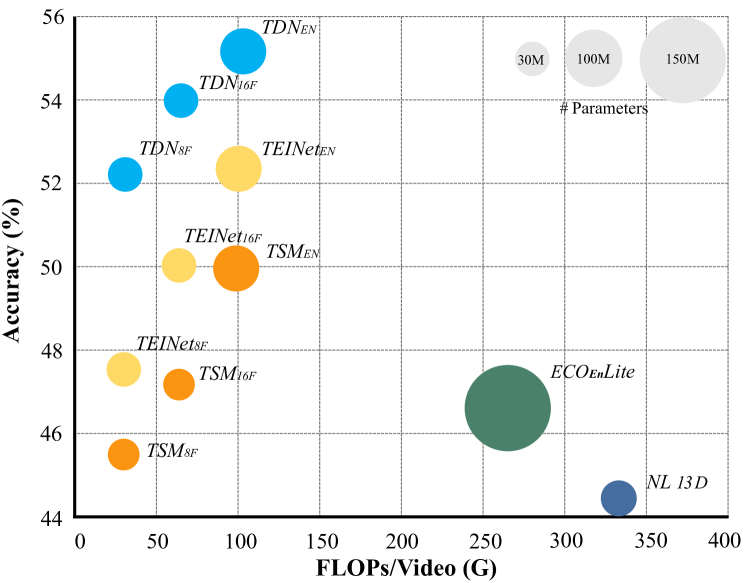
- On the Something-Something V1 dataset, TDN achieves the best trade-off between accuracy and efficiency, outperforming methods like NL I3D, ECO, and TSM.
- The model runs at 22.1 ms per video (≈45.2 FPS) on a Tesla V100, achieving real-time inference despite higher latency than some baselines.
- Ablation studies confirm that the temporal difference operation significantly improves performance, with S-TDM and L-TDM contributing to both local and global motion modeling.
- Visualization via Grad-CAM shows that TDN with TDM focuses more on motion-relevant regions than the baseline, indicating improved feature learning.
- The method generalizes well, transferring effectively from Kinetics-400 to smaller datasets like UCF101 and HMDB51, with notable gains on motion-heavy HMDB51.
Read this paper
Open the full text in the Nubint reader and ask about any passage as you read.
Read this paper on NubintThis review was generated by AI from the original paper. Please check the paper before citing it.