
[Paper Review] Teachers Do More Than Teach: Compressing Image-to-Image Models
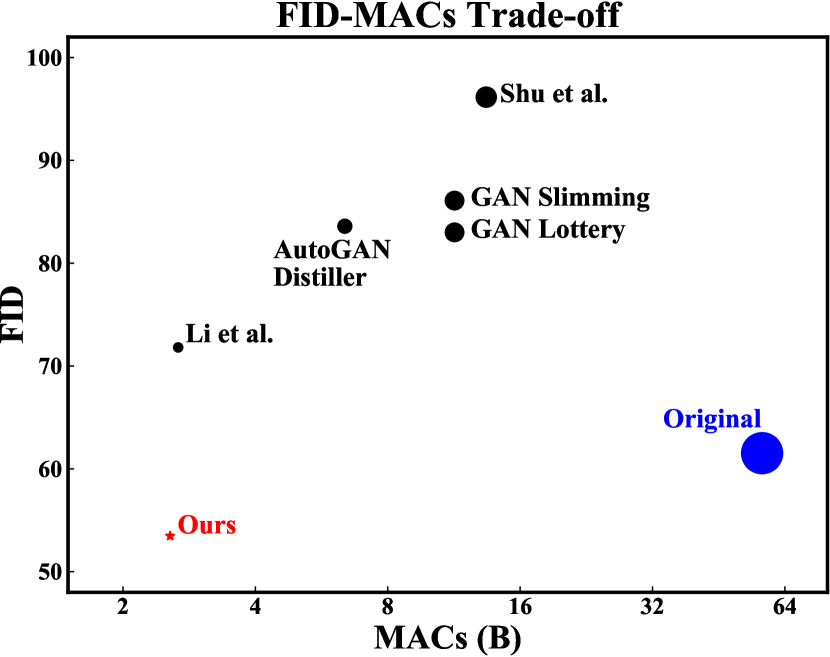
This paper proposes CAT (Compression And Teaching), a method that uses a single teacher model to jointly perform architecture search and knowledge distillation for compressing image-to-image GANs. By introducing an inception-based residual block and a one-step pruning strategy, the approach achieves state-of-the-art performance-efficiency trade-offs, with compressed models matching or exceeding original FID and mIoU scores while reducing MACs by orders of magnitude.
Generative Adversarial Networks (GANs) have achieved huge success in generating high-fidelity images, however, they suffer from low efficiency due to tremendous computational cost and bulky memory usage. Recent efforts on compression GANs show noticeable progress in obtaining smaller generators by sacrificing image quality or involving a time-consuming searching process. In this work, we aim to address these issues by introducing a teacher network that provides a search space in which efficient network architectures can be found, in addition to performing knowledge distillation. First, we revisit the search space of generative models, introducing an inception-based residual block into generators. Second, to achieve target computation cost, we propose a one-step pruning algorithm that searches a student architecture from the teacher model and substantially reduces searching cost. It requires no l1 sparsity regularization and its associated hyper-parameters, simplifying the training procedure. Finally, we propose to distill knowledge through maximizing feature similarity between teacher and student via an index named Global Kernel Alignment (GKA). Our compressed networks achieve similar or even better image fidelity (FID, mIoU) than the original models with much-reduced computational cost, e.g., MACs. Code will be released at https://github.com/snap-research/CAT.
Motivation & Objective
- To address the high computational cost and memory usage of image-to-image GANs, especially on resource-constrained devices.
- To overcome the limitations of existing GAN compression methods that degrade image quality or require expensive search processes.
- To enable efficient, high-fidelity model compression by leveraging a teacher network for both architecture search and knowledge distillation.
- To reduce the computational cost of architecture search by eliminating the need for a separate supernet and avoiding hyperparameter-heavy regularization.
- To improve distillation quality by directly aligning feature representations between teacher and student networks using kernel alignment.
Proposed method
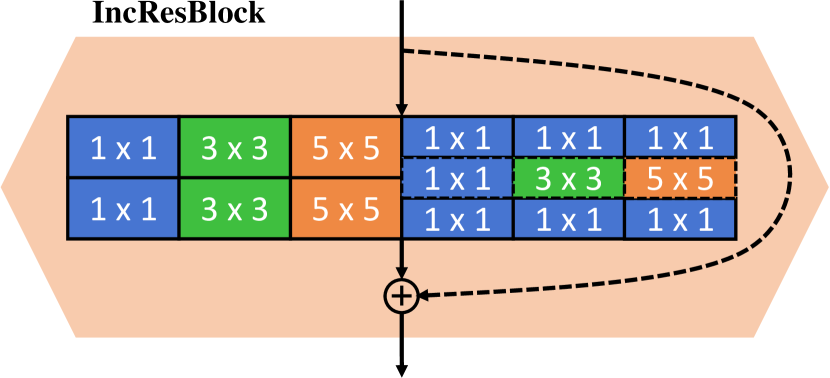
- Introduces an inception-based residual block (IncResBlock) as the core building block for the teacher generator, enabling a rich search space for efficient student architectures.
- Proposes a one-step pruning algorithm that directly removes channels from the trained teacher network to meet a target MACs budget, eliminating the need for iterative or sparsity-based search.
- Designs a knowledge distillation technique based on Kernel Alignment (KA), which maximizes feature similarity between teacher and student features without additional learnable layers.
- Uses the same teacher model as both the search space and the knowledge distillation source, eliminating the need for a separate supernet and reducing training complexity.
- Employs a single hyper-parameter in pruning (pruning ratio), simplifying the training pipeline and reducing tuning overhead.
- Trains the student network end-to-end using KA-based distillation, ensuring the student learns high-level semantic representations from the teacher.
Experimental results
Research questions
- RQ1Can a single teacher model effectively serve as both a search space and a knowledge distillation source for compressing image-to-image GANs?
- RQ2Can one-step pruning achieve efficient architecture search without requiring iterative training or ℓ¹ regularization?
- RQ3Can feature-space similarity via Kernel Alignment outperform conventional distillation methods that rely on additional projection layers?
- RQ4Does the proposed method achieve better performance-efficiency trade-offs than existing GAN compression techniques?
- RQ5Can compressed models surpass the original models in image fidelity while reducing computational cost?
Key findings
- The proposed CAT method reduces architecture search cost by at least 10,000× compared to prior work, with search times under 5 seconds on a single GPU.
- On the Horse→Zebra CycleGAN benchmark, the compressed model achieves a lower FID (18.4) than the original model (19.1) with 3.5× fewer MACs.
- For Pix2pix on the Map→Aerial photo task, the compressed model produces sharper images of rivers and buildings than the original, with 4.2× fewer MACs.
- On GauGAN, the compressed model achieves a FID of 12.6 compared to the original’s 13.8, despite using 3.8× fewer MACs.
- The method consistently improves or matches original model performance (FID, mIoU) across all benchmarks while drastically reducing computational cost.
- Visual results show that the compressed models generate more realistic and detailed images, especially on challenging inputs where the original models fail.
Read this paper
Open the full text in the Nubint reader and ask about any passage as you read.
Read this paper on NubintThis review was generated by AI from the original paper. Please check the paper before citing it.