
[Paper Review] Teaching GANs to Sketch in Vector Format
This paper proposes SkeGAN, a novel GAN architecture for generating high-quality vector-format sketches using policy gradients to handle mixed continuous (offsets) and discrete (pen-states) outputs, and VASkeGAN, a VAE-GAN hybrid. The key contribution is the introduction of the Ske-score metric and the demonstration that combining adversarial loss with policy gradient loss (weight 1.0) eliminates the 'scribble effect' and produces visually superior, natural-looking sketches with faster training than VAE-GAN baselines.
Sketching is more fundamental to human cognition than speech. Deep Neural Networks (DNNs) have achieved the state-of-the-art in speech-related tasks but have not made significant development in generating stroke-based sketches a.k.a sketches in vector format. Though there are Variational Auto Encoders (VAEs) for generating sketches in vector format, there is no Generative Adversarial Network (GAN) architecture for the same. In this paper, we propose a standalone GAN architecture SkeGAN and a VAE-GAN architecture VASkeGAN, for sketch generation in vector format. SkeGAN is a stochastic policy in Reinforcement Learning (RL), capable of generating both multidimensional continuous and discrete outputs. VASkeGAN hybridizes a VAE and a GAN, in order to couple the efficient representation of data by VAE with the powerful generating capabilities of a GAN, to produce visually appealing sketches. We also propose a new metric called the Ske-score which quantifies the quality of vector sketches. We have validated that SkeGAN and VASkeGAN generate visually appealing sketches by using Human Turing Test and Ske-score.
Motivation & Objective
- Address the lack of GAN-based architectures for generating stroke-based vector sketches, which are fundamental to human cognition and require mixed continuous and discrete outputs.
- Overcome the challenge of backpropagating gradients through discrete pen-states in vector sketch generation using policy gradient methods.
- Propose a new evaluation metric, Ske-score, to quantitatively assess the quality of generated vector sketches.
- Demonstrate that combining adversarial loss with policy gradient loss leads to visually superior sketches with reduced 'scribble effect' compared to prior VAE-based models.
- Achieve faster training convergence than VAE-GAN baselines while maintaining or improving visual quality.
Proposed method
- Propose SkeGAN, a standalone GAN that uses policy gradients to model the stochastic generation of 2D continuous offsets and 3D discrete pen-states in vector sketches.
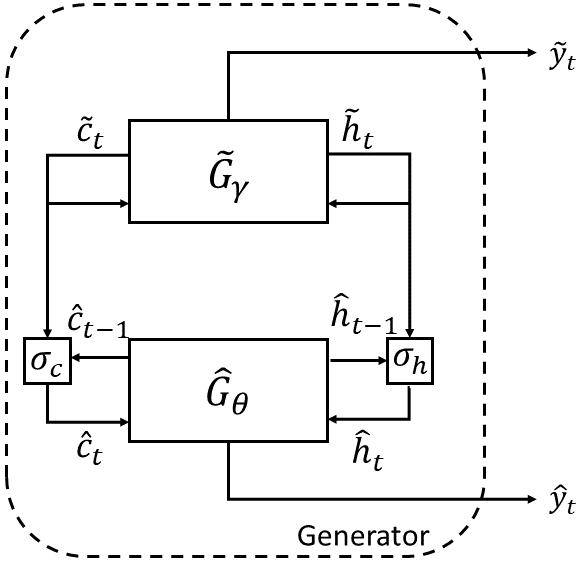
- Introduce a novel coupling mechanism in SkeGAN to model the influence of offsets on pen-state transitions during sketching.
- Design VASkeGAN as a hybrid VAE-GAN architecture, combining the VAE’s efficient latent representation with the GAN’s discriminative power for improved sample quality.
- Develop the Ske-score metric to quantify the perceptual quality of vector sketches, based on human evaluation and structural similarity to real sketches.
- Train SkeGAN with a balanced loss function combining adversarial loss and policy gradient loss, with hyperparameter ablation to determine optimal weighting.
- Use GRU and LSTM-based discriminators in both models, with ablation studies to select the best discriminator architecture per sketch category.
Experimental results
Research questions
- RQ1Can a GAN-based architecture effectively generate high-quality vector sketches with mixed continuous and discrete outputs (offsets and pen-states) without relying on VAEs?
- RQ2How does the integration of policy gradient loss with adversarial training affect the visual quality and structural coherence of generated vector sketches?
- RQ3To what extent does the proposed Ske-score metric correlate with human perception of sketch quality?
- RQ4What hyperparameter settings (e.g., loss weighting) yield the best trade-off between visual quality and training stability in vector sketch generation?
- RQ5Does SkeGAN outperform VASkeGAN in terms of both sample quality and training efficiency?
Key findings
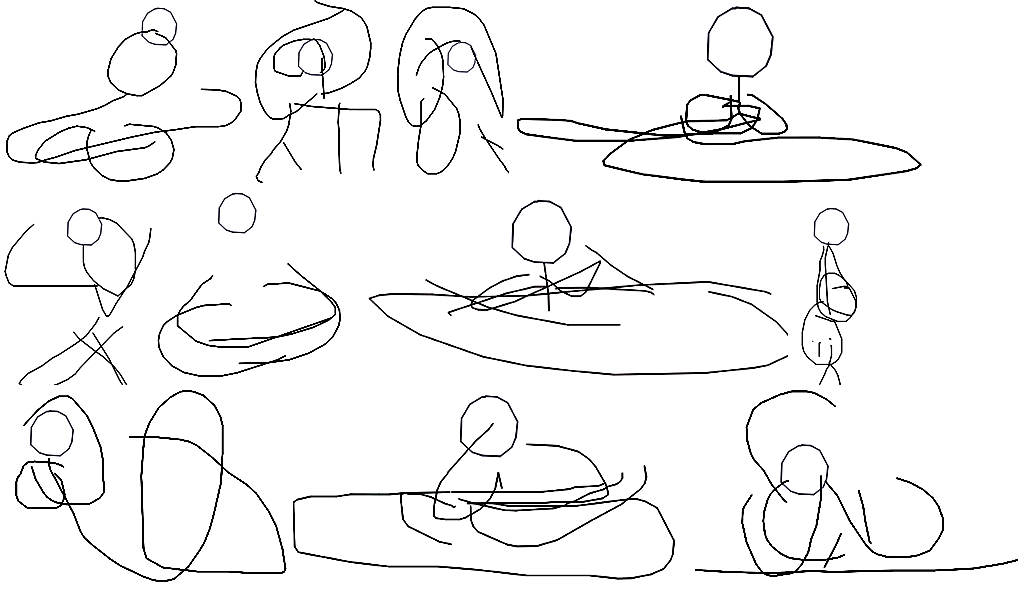
- SkeGAN generates visually superior sketches compared to VASkeGAN, with clearer, more natural, and artistic strokes that closely resemble real human-drawn sketches.
- The optimal weighting of policy gradient loss and adversarial loss is 1.0 for both, as this configuration maximizes the Ske-score and minimizes the 'scribble effect'.
- The Ske-score increases with higher policy gradient loss weighting, and a Ske-score close to that of the real dataset (0.18 ± 0.07 for cats, 0.12 ± 0.05 for firetrucks) indicates effective reduction of the scribble effect.
- VASkeGAN shows no significant improvement in Ske-score with varying KL divergence loss weights (w_KL = 0.25, 0.5, 1.0), indicating no correlation between w_KL and sketch quality.
- SkeGAN achieves faster training convergence than VASkeGAN, requiring only 9.88 to 19.77 hours (vs. 33.33 hours) for 200,000 iterations, due to more efficient gradient updates.
- The LSTM discriminator outperforms GRU in most categories, except for 'firetruck' where GRU performs better, highlighting the sensitivity of discriminator choice to sketch class.
Read this paper
Open the full text in the Nubint reader and ask about any passage as you read.
Read this paper on NubintThis review was generated by AI from the original paper. Please check the paper before citing it.