
[Paper Review] Tele-Aloha: A Low-budget and High-authenticity Telepresence System Using Sparse RGB Cameras
Tele-Aloha presents a low-cost, real-time telepresence system using only four RGB cameras, a consumer GPU, and an autostereoscopic display to enable high-fidelity, 30 fps, 2K novel view synthesis with under 150ms latency. The system achieves high authenticity through a cascaded disparity estimator, neural rasterization via Gaussian Splatting, and weighted blending, enabling immersive co-presence without depth sensors or head-mounted displays.
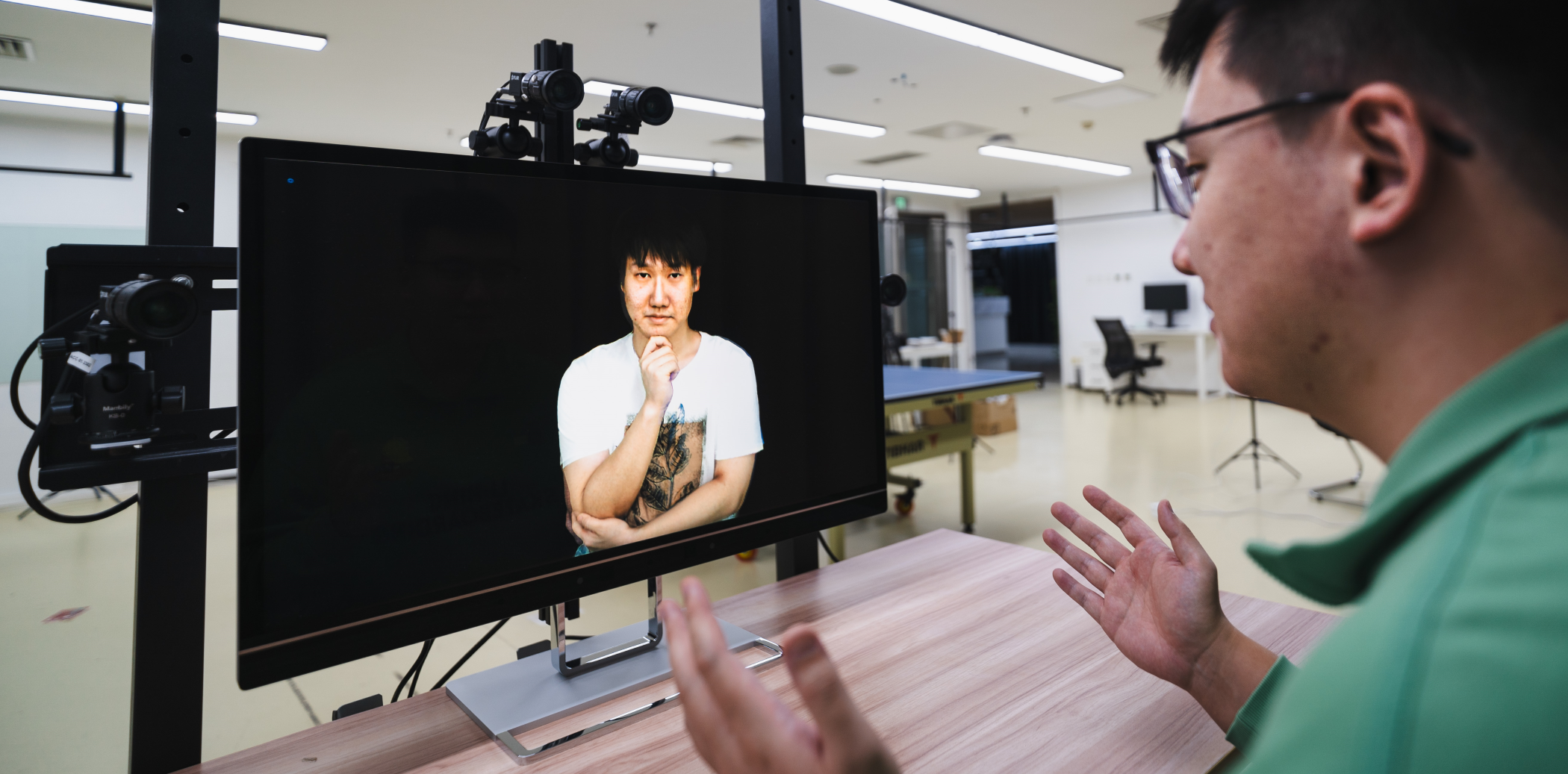
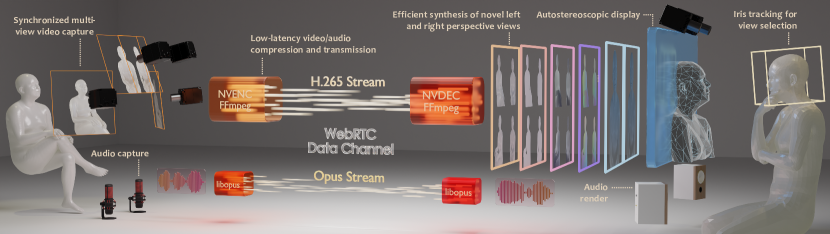
In this paper, we present a low-budget and high-authenticity bidirectional telepresence system, Tele-Aloha, targeting peer-to-peer communication scenarios. Compared to previous systems, Tele-Aloha utilizes only four sparse RGB cameras, one consumer-grade GPU, and one autostereoscopic screen to achieve high-resolution (2048x2048), real-time (30 fps), low-latency (less than 150ms) and robust distant communication. As the core of Tele-Aloha, we propose an efficient novel view synthesis algorithm for upper-body. Firstly, we design a cascaded disparity estimator for obtaining a robust geometry cue. Additionally a neural rasterizer via Gaussian Splatting is introduced to project latent features onto target view and to decode them into a reduced resolution. Further, given the high-quality captured data, we leverage weighted blending mechanism to refine the decoded image into the final resolution of 2K. Exploiting world-leading autostereoscopic display and low-latency iris tracking, users are able to experience a strong three-dimensional sense even without any wearable head-mounted display device. Altogether, our telepresence system demonstrates the sense of co-presence in real-life experiments, inspiring the next generation of communication.
Motivation & Objective
- To develop a low-budget, high-authenticity telepresence system for peer-to-peer upper-body communication.
- To eliminate reliance on expensive depth sensors by using only sparse RGB cameras for robust, real-time 3D rendering.
- To achieve real-time, high-resolution (2048×2048) novel view synthesis with minimal latency (<150ms) on consumer-grade hardware.
- To enable immersive co-presence experience using autostereoscopic displays without requiring wearable devices.
- To design a system that is both affordable (~$15,000) and scalable for consumer deployment.
Proposed method
- A cascaded disparity estimator is used to generate robust depth cues from sparse RGB inputs, improving accuracy on large-baseline camera pairs.
- Neural rasterization via 3D Gaussian Splatting projects encoded latent features onto the target view for reduced-resolution image decoding.
- A weighted blending mechanism refines the decoded image to full 2K resolution, enhancing visual fidelity and reducing artifacts.
- The system leverages real-time eye tracking to select optimal source views for novel view synthesis, ensuring natural perspective rendering.
- All components are optimized with CUDA and TensorRT (fp16), and CUDA Graphs are used to minimize end-to-end system latency.
- The autostereoscopic display provides a 3D perception experience without head-mounted devices, enhancing co-presence.
Experimental results
Research questions
- RQ1Can a high-fidelity, real-time telepresence system be built using only four consumer-grade RGB cameras and no depth sensors?
- RQ2How can robust and accurate depth estimation be achieved from sparse RGB inputs alone in a real-time system?
- RQ3Can 3D Gaussian Splatting be adapted for instant, low-latency novel view synthesis in a telepresence context?
- RQ4What is the achievable latency and image quality when combining neural rasterization and weighted blending for 2K rendering?
- RQ5To what extent can autostereoscopic displays enable immersive co-presence without wearable devices?
Key findings
- The proposed system achieves 26.543 PSNR, 0.928 SSIM, and 0.095 LPIPS on a synthetic dataset, outperforming prior efficient novel view synthesis methods.
- The cascaded disparity estimator reduces end point error (EPE) by 19.4% on large-baseline setups compared to non-initialized baselines, improving depth estimation robustness.
- With cascaded initialization, only 3 iterative flow updates achieve comparable accuracy to 16 updates without initialization, significantly reducing computation time.
- End-to-end system latency is measured at 149ms in a LAN setup, meeting the threshold for acceptable real-time telepresence (≤150ms).
- The system demonstrates strong co-presence perception in real-life experiments, with users reporting immersive 3D experience on the autostereoscopic display.
- Failure cases occur on specular objects (e.g., eyeglasses) due to anisotropic reflections, which disrupt disparity estimation.
Read this paper
Open the full text in the Nubint reader and ask about any passage as you read.
Read this paper on NubintThis review was generated by AI from the original paper. Please check the paper before citing it.