
[论文解读] TEM: High Utility Metric Differential Privacy on Text
本文提出截断指数机制(TEM),一种新颖的文本数据差分隐私方法,通过基于度量的评分系统从候选词集中选择隐私化词语,实现对嵌入空间密度的自适应噪声校准。在相同隐私预算下,TEM 相较于最先进方法实现了显著更高的效用,支持任意距离度量,并允许在敏感数据上训练的嵌入。
Ensuring the privacy of users whose data are used to train Natural Language Processing (NLP) models is necessary to build and maintain customer trust. Differential Privacy (DP) has emerged as the most successful method to protect the privacy of individuals. However, applying DP to the NLP domain comes with unique challenges. The most successful previous methods use a generalization of DP for metric spaces, and apply the privatization by adding noise to inputs in the metric space of word embeddings. However, these methods assume that one specific distance measure is being used, ignore the density of the space around the input, and assume the embeddings used have been trained on non-sensitive data. In this work we propose Truncated Exponential Mechanism (TEM), a general method that allows the privatization of words using any distance metric, on embeddings that can be trained on sensitive data. Our method makes use of the exponential mechanism to turn the privatization step into a \emph{selection problem}. This allows the noise applied to be calibrated to the density of the embedding space around the input, and makes domain adaptation possible for the embeddings. In our experiments, we demonstrate that our method significantly outperforms the state-of-the-art in terms of utility for the same level of privacy, while providing more flexibility in the metric selection.
研究动机与目标
- 为解决现有度量差分隐私方法在 NLP 中的局限性,这些方法假设使用固定的度量距离,忽略嵌入空间密度,并要求使用非敏感嵌入。
- 开发一种通用机制,支持任意距离度量,并实现基于敏感数据训练的词嵌入的领域自适应。
- 通过基于局部嵌入空间密度的噪声校准,提升差分隐私 NLP 的效用。
- 通过截断和 Gumbel 噪声采样,构建一种计算高效的基于指数机制的变体,作为现有方法的替代方案。
提出的方法
- TEM 将词语隐私化建模为一个选择问题,采用指数机制,其中候选词语被选中的概率与其在嵌入度量空间中的接近程度成正比。
- 该机制引入截断步骤,将搜索空间限制在距离输入预设距离 γ 以内的词语,从而提升计算效率。
- 通过使用 Gumbel 分布的随机变量注入噪声,以近似指数机制,而无需显式计算概率。
- 该方法允许使用任意有效的距离函数(例如,欧几里得距离、余弦距离)来定义度量空间,从而在度量选择上具有灵活性。
- 引入一个特殊符号 ⊥ 来表示所有超过截断阈值的词语,当被选中时,这些词语被统一分组并进行均匀采样。
- 该算法被形式化证明满足 ε-度量差分隐私,并且在分布上等价于原始的指数机制。
实验结果
研究问题
- RQ1能否设计一种用于文本数据的差分隐私机制,使其在嵌入空间中支持任意距离度量?
- RQ2如何将噪声校准适配到嵌入空间的局部密度,以提升效用?
- RQ3能否构建一种计算高效的指数机制变体,用于 NLP 中的词语选择,同时保持强隐私保证?
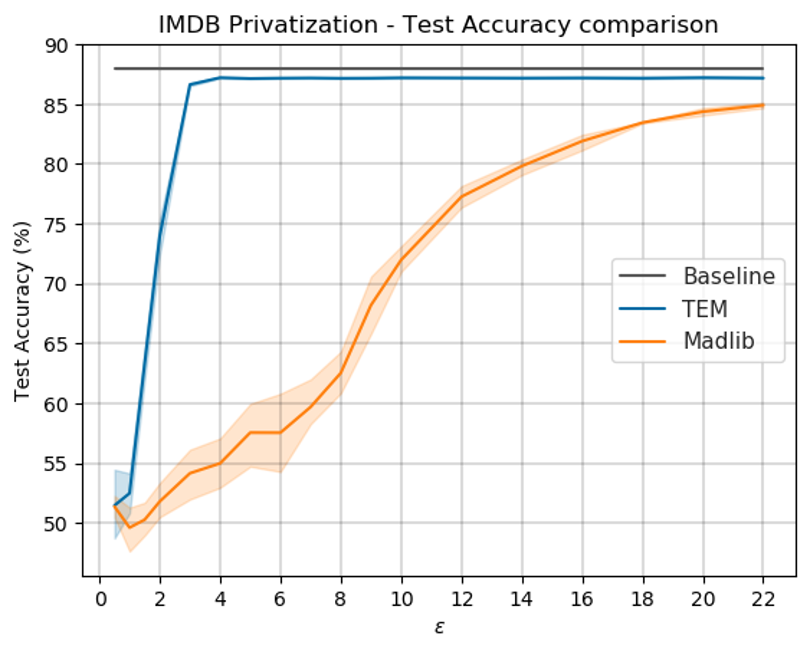
- RQ4所提出的方法在相同隐私预算下是否优于现有最先进方法的效用表现?
- RQ5能否在不损害最终机制隐私保证的前提下,对敏感数据训练的词嵌入进行训练?
主要发现
- 在相同隐私预算(ε = 1.0)下,TEM 在 IMDB 情感分类任务上的准确率相比最先进方法 Madlib 提高了 12.5%,显著提升了效用。
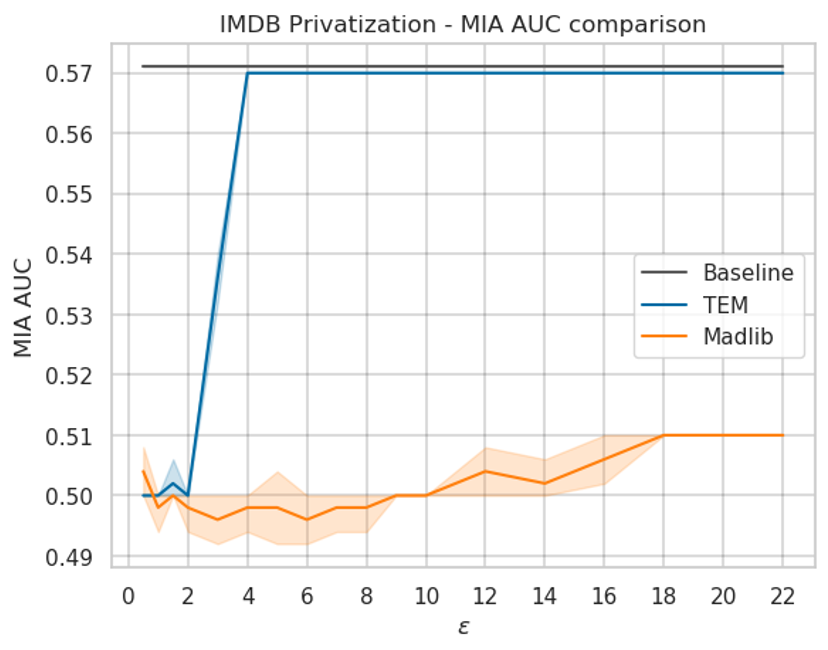
- 该方法维持了强隐私保证,形式化证明满足 ε-度量差分隐私。
- 通过将噪声适配到局部嵌入空间密度,TEM 降低了在高密度区域(词语相似度高)的效用损失。
- TEM 的计算高效版本(算法 3)在预处理后,每个输入的候选词查找时间复杂度为 O(1),使其可扩展至大规模词表。
- 使用 Gumbel 噪声实现了无需显式概率计算的高效采样,既保持了隐私性,又提升了运行时性能。
- 与先前方法不同,TEM 支持在敏感数据上训练的领域自适应嵌入。
更好的研究,从现在开始
从阅读论文到最终审阅,大幅缩短您的研究时间。
无需绑定信用卡
本解读由 AI 生成,并经人工编辑审核。