
[Paper Review] Temporal Feature Alignment and Mutual Information Maximization for Video-Based Human Pose Estimation
This paper proposes FAMI-Pose, a novel framework for video-based human pose estimation that uses coarse-to-fine feature alignment to synchronize temporal features across frames and maximizes task-relevant mutual information via an information-theoretic loss. The method achieves state-of-the-art performance, ranking first on PoseTrack2017 and setting new SOTA on Sub-JHMDB and PoseTrack2018 by effectively handling fast motion and occlusion through improved feature alignment and complementary cue extraction.
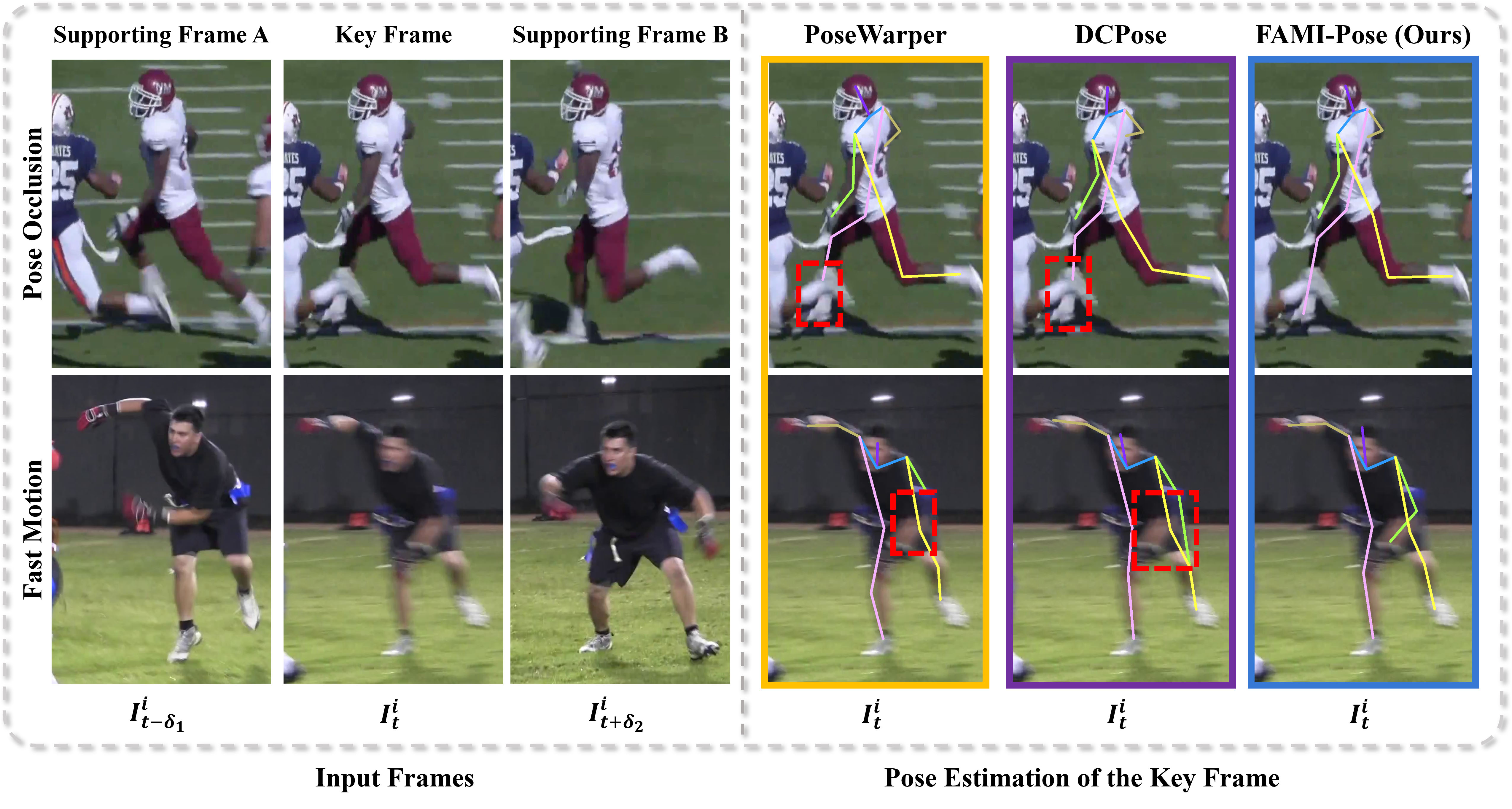
Multi-frame human pose estimation has long been a compelling and fundamental problem in computer vision. This task is challenging due to fast motion and pose occlusion that frequently occur in videos. State-of-the-art methods strive to incorporate additional visual evidences from neighboring frames (supporting frames) to facilitate the pose estimation of the current frame (key frame). One aspect that has been obviated so far, is the fact that current methods directly aggregate unaligned contexts across frames. The spatial-misalignment between pose features of the current frame and neighboring frames might lead to unsatisfactory results. More importantly, existing approaches build upon the straightforward pose estimation loss, which unfortunately cannot constrain the network to fully leverage useful information from neighboring frames. To tackle these problems, we present a novel hierarchical alignment framework, which leverages coarse-to-fine deformations to progressively update a neighboring frame to align with the current frame at the feature level. We further propose to explicitly supervise the knowledge extraction from neighboring frames, guaranteeing that useful complementary cues are extracted. To achieve this goal, we theoretically analyzed the mutual information between the frames and arrived at a loss that maximizes the task-relevant mutual information. These allow us to rank No.1 in the Multi-frame Person Pose Estimation Challenge on benchmark dataset PoseTrack2017, and obtain state-of-the-art performance on benchmarks Sub-JHMDB and Pose-Track2018. Our code is released at https://github. com/Pose-Group/FAMI-Pose, hoping that it will be useful to the community.
Motivation & Objective
- To address the challenge of spatial misalignment between key frame and supporting frame features in video-based human pose estimation.
- To overcome the limitation of existing methods that rely on unaligned context aggregation and simple MSE supervision, which fails to exploit useful temporal cues.
- To explicitly supervise the extraction of task-relevant information from neighboring frames using an information-theoretic objective.
- To improve robustness in challenging scenarios such as fast motion and pose occlusion through principled feature alignment and knowledge distillation.
- To establish a new SOTA benchmark for multi-frame human pose estimation using a unified, theoretically grounded framework.
Proposed method
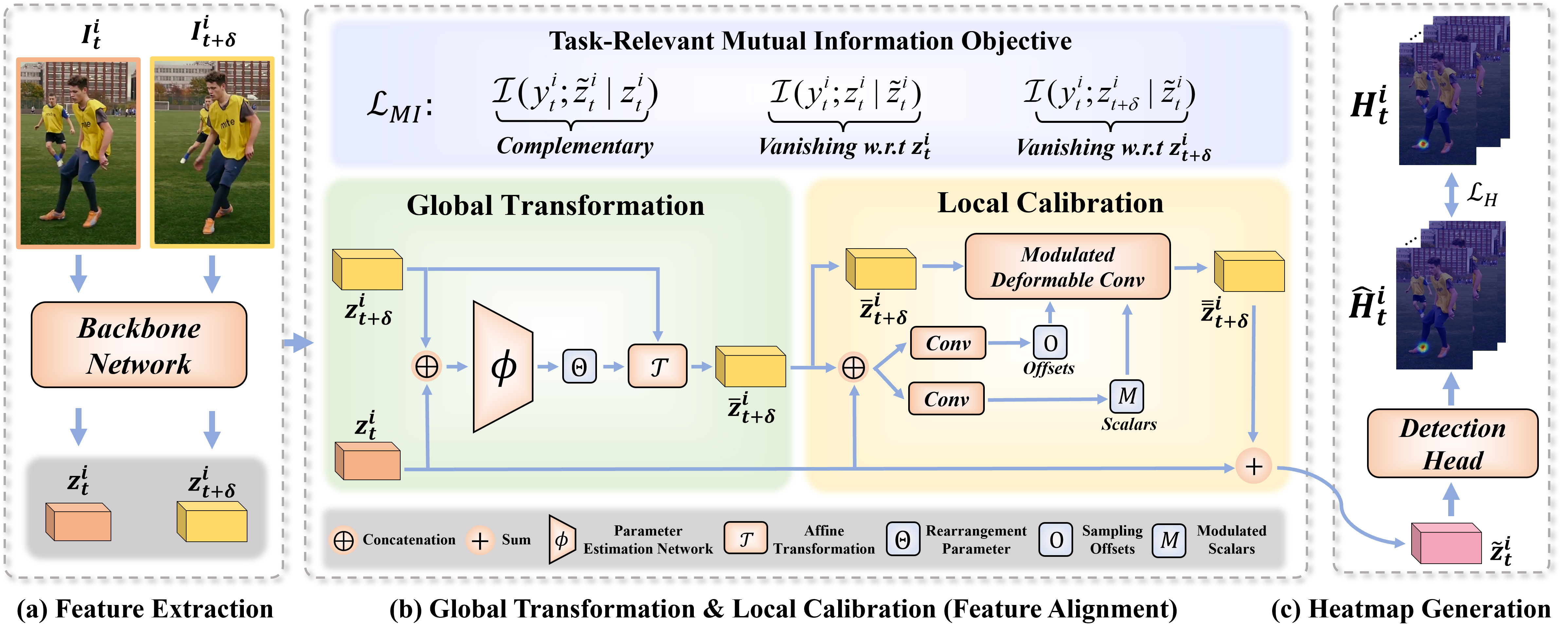
- The framework employs a coarse-to-fine deformation strategy: first applying a global transformation module (GTM) to correct large-scale spatial shifts between key and supporting frame features.
- Then, a local calibration module (LCM) performs adaptive, pixel-wise feature modulation to refine alignment at the local level.
- An information-theoretic loss is introduced to maximize the mutual information between key frame features and aligned supporting frame features, ensuring effective extraction of complementary temporal cues.
- The mutual information objective is derived from theoretical analysis, serving as an intermediate supervision to guide the network in learning task-relevant representations.
- The method is trained end-to-end with a combination of standard pose estimation loss and the proposed MI-based loss, enabling joint optimization of alignment and feature learning.
- The framework supports variable-sized temporal windows of supporting frames, allowing flexible context modeling.
Experimental results
Research questions
- RQ1Can coarse-to-fine feature alignment significantly improve pose estimation accuracy in video-based human pose estimation?
- RQ2Does explicitly supervising information gain from neighboring frames via mutual information maximization lead to better performance than standard MSE supervision?
- RQ3How does feature misalignment between key and supporting frames affect pose estimation in fast motion or occlusion scenarios?
- RQ4To what extent does increasing the number of supporting frames improve performance, and how is this enhanced by alignment and MI supervision?
- RQ5Can a theoretically grounded information-theoretic objective outperform heuristic or implicit motion modeling in temporal feature aggregation?
Key findings
- FAMI-Pose achieves a mAP of 84.8 on the PoseTrack2017 validation set, ranking first in the Multi-frame Person Pose Estimation Challenge.
- The global transformation module alone improves mAP by 5.6 points over HRNet-W48 and matches the previous SOTA (82.8 mAP) of DCPose.
- Adding the local calibration module increases mAP to 84.0, demonstrating the benefit of fine-grained alignment.
- Integrating the mutual information loss further boosts mAP by 0.8 points, confirming its effectiveness as an auxiliary supervision.
- Performance improves monotonically with more supporting frames: mAP increases from 82.8 (N={-1}) to 84.8 (N={-2,-1,1,2}), showing the value of extended temporal context.
- Visual comparisons confirm that FAMI-Pose outperforms HRNet-W48, PoseWarper, and DCPose in handling motion blur and pose occlusion, with fewer errors in wrist and ankle keypoint detection.
Read this paper
Open the full text in the Nubint reader and ask about any passage as you read.
Read this paper on NubintThis review was generated by AI from the original paper. Please check the paper before citing it.