
[Paper Review] Temporal Memory Attention for Video Semantic Segmentation
This paper proposes Temporal Memory Attention Network (TMANet), a novel non-optical-flow-based method for video semantic segmentation that uses a memory of past frames and a self-attention mechanism to model long-range temporal dependencies. By adaptively aggregating relevant features from previous frames, TMANet achieves state-of-the-art performance with 80.3% mIoU on Cityscapes and 76.5% mIoU on CamVid using ResNet-50, outperforming prior methods with lower computational cost.
Video semantic segmentation requires to utilize the complex temporal relations between frames of the video sequence. Previous works usually exploit accurate optical flow to leverage the temporal relations, which suffer much from heavy computational cost. In this paper, we propose a Temporal Memory Attention Network (TMANet) to adaptively integrate the long-range temporal relations over the video sequence based on the self-attention mechanism without exhaustive optical flow prediction. Specially, we construct a memory using several past frames to store the temporal information of the current frame. We then propose a temporal memory attention module to capture the relation between the current frame and the memory to enhance the representation of the current frame. Our method achieves new state-of-the-art performances on two challenging video semantic segmentation datasets, particularly 80.3% mIoU on Cityscapes and 76.5% mIoU on CamVid with ResNet-50.
Motivation & Objective
- To address the challenge of modeling long-range temporal dependencies in video semantic segmentation without relying on expensive optical flow prediction.
- To improve segmentation accuracy by leveraging temporal context from multiple past frames through an adaptive attention mechanism.
- To reduce computational overhead compared to optical flow-based methods while maintaining or improving performance.
- To introduce memory networks and self-attention into video semantic segmentation, a novel application in this domain.
Proposed method
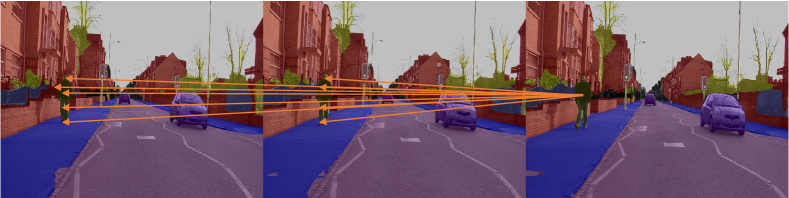
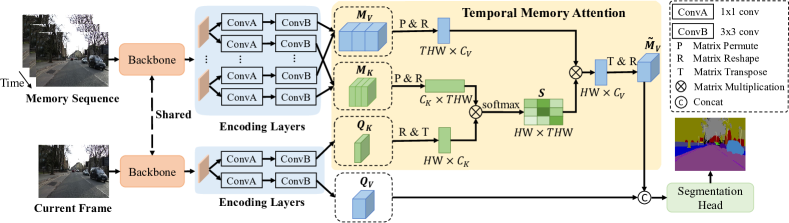
- The method constructs a memory bank from multiple past unannotated frames to store temporal context for the current query frame.
- A shared backbone network extracts features from both the current frame and the memory frames.
- The Temporal Memory Attention module computes cross-attention between query features and memory keys/values to enhance the current frame representation.
- The module uses query-key-value attention mechanism to dynamically attend to relevant spatial-temporal features in the memory.
- Features from the current frame and the enhanced memory are concatenated and passed through a segmentation head for pixel-wise classification.
- The model is trained with cross-entropy loss and uses a multi-scale feature aggregation strategy with 1x1 and 3x3 convolutions for encoding layers.
Experimental results
Research questions
- RQ1Can a memory-augmented self-attention mechanism effectively model long-range temporal dependencies in video semantic segmentation without optical flow?
- RQ2How does the selection strategy (random vs. continuous) of past frames affect performance and feature representation?
- RQ3What is the optimal number of past frames to include in the memory for balancing performance and computational cost?
- RQ4How does the choice of feature aggregation (concatenation vs. summation) impact segmentation accuracy?
- RQ5Can a memory-based attention mechanism outperform existing optical flow-based and non-optical-flow-based methods in terms of accuracy and efficiency?
Key findings
- TMANet achieves 80.3% mIoU on the Cityscapes validation set, setting a new state-of-the-art performance with ResNet-50.
- On the CamVid dataset, the method achieves 76.5% mIoU, also surpassing previous methods.
- The continuous frame selection strategy outperforms random selection, likely due to stronger local temporal coherence in the memory.
- Feature concatenation yields better performance than summation, as it preserves more channel-wise information.
- A combination of 1x1 and 3x3 convolutional layers in the encoding module produces the best results, outperforming single-layer configurations.
- The model achieves superior performance with only 754 GFLOPs, significantly lower than many prior optical flow-based methods.
Read this paper
Open the full text in the Nubint reader and ask about any passage as you read.
Read this paper on NubintThis review was generated by AI from the original paper. Please check the paper before citing it.