
[Paper Review] Ternary Spike: Learning Ternary Spikes for Spiking Neural Networks
This paper proposes Ternary Spike, a novel spiking neural network (SNN) neuron that uses {-1, 0, 1} spike activations to increase information capacity over binary spikes, while preserving multiplication-free and event-driven inference. A learnable amplitude factor allows layer-specific spike magnitudes, which are reparameterized into standard ternary spikes at inference, achieving state-of-the-art accuracy with minimal energy overhead—e.g., 70.74% top-1 accuracy on ImageNet with ResNet34 and only 4 timesteps.
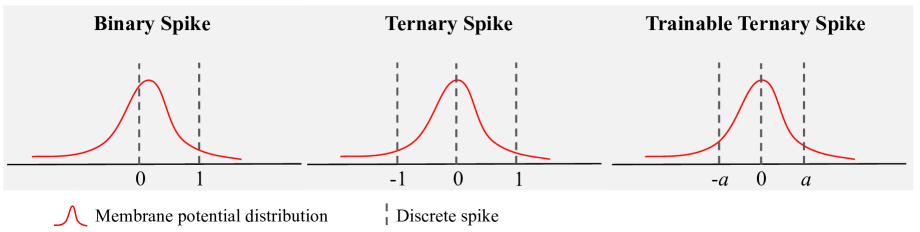
The Spiking Neural Network (SNN), as one of the biologically inspired neural network infrastructures, has drawn increasing attention recently. It adopts binary spike activations to transmit information, thus the multiplications of activations and weights can be substituted by additions, which brings high energy efficiency. However, in the paper, we theoretically and experimentally prove that the binary spike activation map cannot carry enough information, thus causing information loss and resulting in accuracy decreasing. To handle the problem, we propose a ternary spike neuron to transmit information. The ternary spike neuron can also enjoy the event-driven and multiplication-free operation advantages of the binary spike neuron but will boost the information capacity. Furthermore, we also embed a trainable factor in the ternary spike neuron to learn the suitable spike amplitude, thus our SNN will adopt different spike amplitudes along layers, which can better suit the phenomenon that the membrane potential distributions are different along layers. To retain the efficiency of the vanilla ternary spike, the trainable ternary spike SNN will be converted to a standard one again via a re-parameterization technique in the inference. Extensive experiments with several popular network structures over static and dynamic datasets show that the ternary spike can consistently outperform state-of-the-art methods. Our code is open-sourced at https://github.com/yfguo91/Ternary-Spike.
Motivation & Objective
- To address the information loss caused by binary spike activation maps in SNNs, which limits accuracy due to insufficient information capacity.
- To improve the representational capacity of SNNs while preserving their energy efficiency through multiplication-free and event-driven computation.
- To adapt spike amplitude to varying membrane potential distributions across network layers by introducing a learnable amplitude factor.
- To maintain inference efficiency by reparameterizing trainable spike amplitudes into standard ternary spikes during deployment.
Proposed method
- Proposes a ternary spike neuron that quantizes membrane potentials to {-1, 0, 1} instead of {0, 1}, increasing information capacity without sacrificing multiplication-free inference.
- Introduces a trainable ternary spike variant where spike amplitude α is learned per layer, enabling adaptive spike magnitudes that match layer-specific membrane potential distributions.
- Employs a reparameterization technique during inference to fold the learned α factor into the network weights, restoring standard ternary spike operation and preserving addition-only computation.
- Uses standard SNN training with surrogate gradient backpropagation, with the ternary spike function approximated via a differentiable hard-tanh-like activation.
- Applies the method across multiple backbone architectures (ResNet18, ResNet34, VGG11, etc.) on static and dynamic datasets, including CIFAR-10, CIFAR-100, ImageNet, and CIFAR10-DVS.
- Evaluates energy efficiency by comparing FLOPs and SOPs, showing only a 2.11% increase in energy cost for ternary spikes over binary spikes.
Experimental results
Research questions
- RQ1Can ternary spike activations ({-1, 0, 1}) significantly improve information capacity in SNNs compared to binary spikes ({0, 1}) without sacrificing energy efficiency?
- RQ2Does learning layer-wise spike amplitudes (α) lead to better performance by adapting to varying membrane potential distributions across layers?
- RQ3Can the trainable amplitude factor be effectively reparameterized into weights at inference, preserving the multiplication-free and event-driven advantages of SNNs?
- RQ4How does the proposed method compare to state-of-the-art SNNs in terms of accuracy and energy efficiency on diverse benchmarks?
Key findings
- The proposed Ternary Spike method achieves 70.74% top-1 accuracy on ImageNet using ResNet34 with only 4 timesteps, representing a ~3% improvement over prior state-of-the-art methods.
- On CIFAR10-DVS, the trainable Ternary Spike reaches 79.80% accuracy with ResNet20, outperforming previous SoTA methods by over 2% and approaching 80% accuracy.
- With only 2 timesteps, the trainable Ternary Spike achieves 94.46% accuracy on CIFAR-10 using ResNet20, surpassing prior SoTA results on the same setting.
- The energy cost of ternary spikes increases by only 2.11% compared to binary spikes, demonstrating minimal overhead despite higher information capacity.
- The method consistently outperforms state-of-the-art SNNs across multiple datasets and network architectures, including static (CIFAR-10, CIFAR-100, ImageNet) and dynamic (CIFAR10-DVS) benchmarks.
Read this paper
Open the full text in the Nubint reader and ask about any passage as you read.
Read this paper on NubintThis review was generated by AI from the original paper. Please check the paper before citing it.