
[Paper Review] TernausNetV2: Fully Convolutional Network for Instance Segmentation
TernausNetV2 is a fully convolutional network that extends semantic segmentation models to perform instance segmentation in high-resolution satellite imagery by adding a binary output for touching object borders. Using a WideResNet-38 encoder with multispectral input extension and a watershed-based post-processing step, it achieves state-of-the-art performance (F1 score 0.74) on the DeepGlobe-CVPR 2018 building detection challenge without ensembling or test-time augmentation.
The most common approaches to instance segmentation are complex and use two-stage networks with object proposals, conditional random-fields, template matching or recurrent neural networks. In this work we present TernausNetV2 - a simple fully convolutional network that allows extracting objects from a high-resolution satellite imagery on an instance level. The network has popular encoder-decoder type of architecture with skip connections but has a few essential modifications that allows using for semantic as well as for instance segmentation tasks. This approach is universal and allows to extend any network that has been successfully applied for semantic segmentation to perform instance segmentation task. In addition, we generalize network encoder that was pre-trained for RGB images to use additional input channels. It makes possible to use transfer learning from visual to a wider spectral range. For DeepGlobe-CVPR 2018 building detection sub-challenge, based on public leaderboard score, our approach shows superior performance in comparison to other methods. The source code corresponding pre-trained weights are publicly available at https://github.com/ternaus/TernausNetV2
Motivation & Objective
- To develop a method that enables instance segmentation in high-resolution satellite imagery using a fully convolutional architecture.
- To extend pre-trained RGB-based models to multispectral inputs for transfer learning across spectral ranges.
- To enable precise separation of closely packed or touching objects of the same class in semantic segmentation outputs.
- To achieve state-of-the-art performance on the DeepGlobe-CVPR 2018 building detection challenge without ensembling or test-time augmentation.
Proposed method
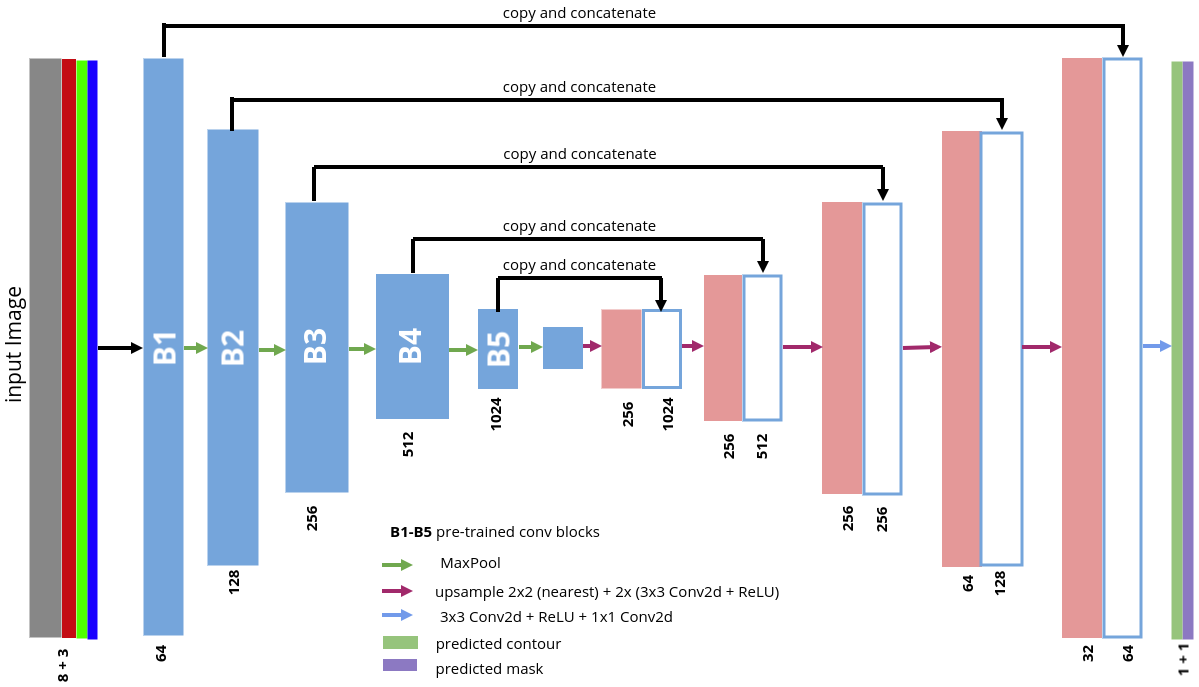
- The network uses an encoder-decoder architecture with skip connections, based on a pre-trained WideResNet-38 with in-place batch normalization.
- It extends the input from 3 RGB channels to 11 multispectral channels, enabling transfer learning from RGB to broader spectral ranges.
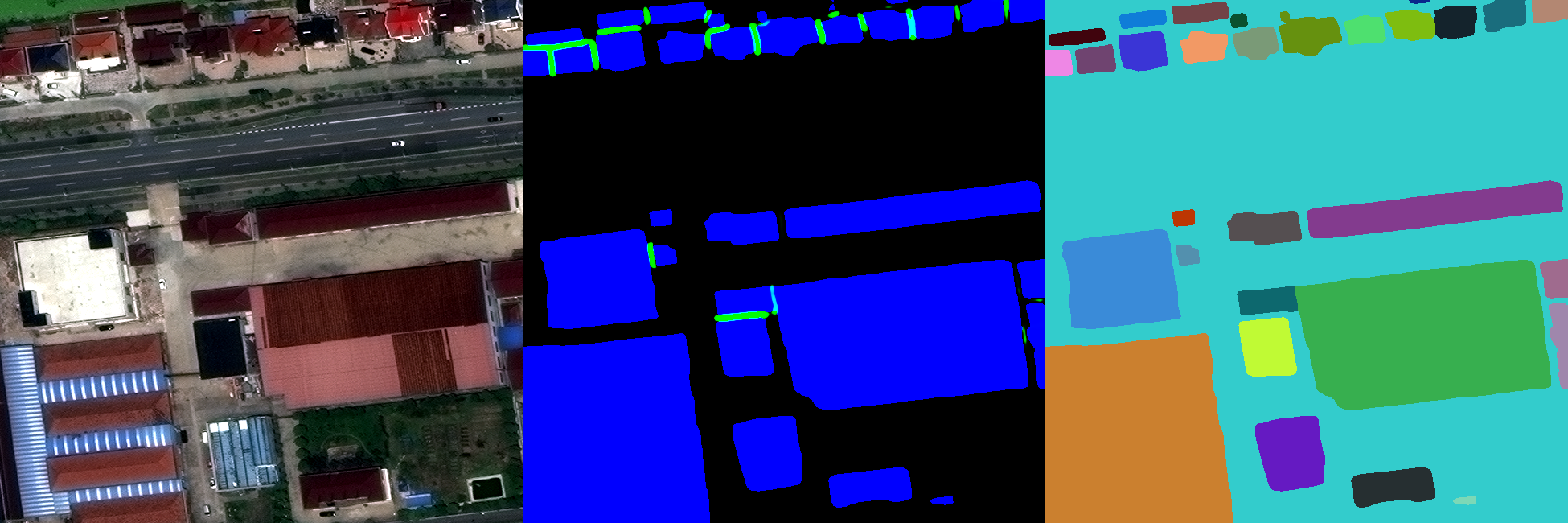
- The model outputs two binary masks: one for building footprints and one for touching or adjacent object borders.
- A hybrid loss function combines binary cross-entropy and differentiable soft Jaccard loss (1 - J) to optimize both pixel-wise classification and IoU.
- The soft Jaccard loss is defined as $ J = \frac{1}{n} \sum_{c=1}^{2} w_c \sum_{i=1}^{n} \left( \frac{y_i^c \hat{y}_i^c}{y_i^c + \hat{y}_i^c - y_i^c \hat{y}_i^c} \right) $, with $ w_1 = w_2 = 1 $.
- Post-processing applies watershed transformation using the binary mask and the touching border mask as seeds to split overlapping instances.
Experimental results
Research questions
- RQ1Can a fully convolutional network trained for semantic segmentation be adapted to perform instance segmentation in satellite imagery?
- RQ2How can transfer learning be effectively extended from RGB to multispectral satellite data?
- RQ3Can a simple, differentiable loss function improve both pixel-wise accuracy and intersection-over-union in instance segmentation?
- RQ4Does a post-processing step using watershed transformation with a border prediction head outperform end-to-end learning for instance separation?
Key findings
- The model achieved a public leaderboard F1 score of 0.74 on the DeepGlobe-CVPR 2018 building detection challenge, outperforming other methods.
- The network successfully generalized from pre-trained RGB weights to 11-channel multispectral inputs, enabling transfer learning across spectral ranges.
- The addition of a touching border prediction head allowed effective instance separation via watershed transformation without requiring ensembling or test-time augmentation.
- The model processes 10 samples per second on a single GTX 1080 Ti, demonstrating real-time inference capability.
- The hybrid loss function with $ \alpha = 0.7 $ balanced binary cross-entropy and soft Jaccard loss, improving both classification and IoU performance.
Read this paper
Open the full text in the Nubint reader and ask about any passage as you read.
Read this paper on NubintThis review was generated by AI from the original paper. Please check the paper before citing it.