
[Paper Review] Testing the General Deductive Reasoning Capacity of Large Language Models Using OOD Examples
This paper introduces PrOntoQA-OOD, a programmable synthetic dataset to test LLMs’ general deductive reasoning across rule diversity, proof depth, width, and compositionality, evaluating OOD generalization beyond in-context demonstrations.
Given the intractably large size of the space of proofs, any model that is capable of general deductive reasoning must generalize to proofs of greater complexity. Recent studies have shown that large language models (LLMs) possess some abstract deductive reasoning ability given chain-of-thought prompts. However, they have primarily been tested on proofs using modus ponens or of a specific size, and from the same distribution as the in-context examples. To measure the general deductive reasoning ability of LLMs, we test on a broad set of deduction rules and measure their ability to generalize to more complex proofs from simpler demonstrations from multiple angles: depth-, width-, and compositional generalization. To facilitate systematic exploration, we construct a new synthetic and programmable reasoning dataset that enables control over deduction rules and proof complexity. Our experiments on four LLMs of various sizes and training objectives show that they are able to generalize to compositional proofs. However, they have difficulty generalizing to longer proofs, and they require explicit demonstrations to produce hypothetical subproofs, specifically in proof by cases and proof by contradiction.
Motivation & Objective
- Assess whether LLMs generalize to proofs of greater complexity beyond their demonstrations.
- Evaluate generalization across multiple deduction rules beyond modus ponens.
- Examine depth, width, and compositional generalization in proofs generated from synthetic world models.
- Determine the impact of in-context learning versus supervision on generalization in deductive tasks.
Proposed method
- Create PrOntoQA-OOD, a programmable synthetic dataset extending PrOntoQA with multiple deduction rules and controllable proof depth and width.
- Represent proofs as tree structures to quantify depth (length of proof chain) and width (number of premises per step).
- Generate compositional proofs via a recursive procedure that combines different deduction rules into subproofs.
- Include distractors to prevent shortcut heuristics and enable robust evaluation of reasoning steps.
- Semantically parse CoT outputs into first-order logic to verify each deduction step and ensure validity and proximity to premises.
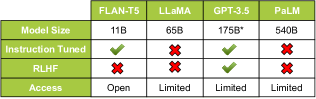
- Evaluate eight-shot Chain-of-Thought prompting across GPT-3.5, PaLM, LLaMA, and FLAN-T5 under in-distribution and out-of-distribution conditions.
Experimental results
Research questions
- RQ1Can LLMs learn a complete set of deduction rules beyond modus ponens when prompted with CoT demonstrations?
- RQ2Do LLMs generalize to deeper and wider proofs than those seen in demonstrations (depth/width generalization) and to compositional proofs (multiple rules in one proof)?
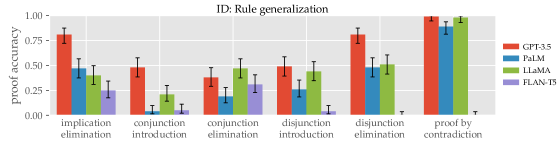
- RQ3To what extent can LLMs generalize to unseen deduction rules (OOD rule generalization) without explicit demonstrations?
- RQ4How does in-context learning compare to supervised learning in enabling general deductive reasoning?
- RQ5What is the impact of distractors on OOD generalization and avoidance of shortcut solutions?
Key findings
- LLMs can generalize to compositional proofs using CoT prompting, though longer proofs remain challenging.
- Model performance does not strongly correlate with size; smaller models with instruction tuning can perform comparably to larger ones.
- LLMs can use several deduction rules even without explicit demonstrations, but some rules (e.g., disjunction elimination and proof by contradiction) require demonstrations in some cases.
- In some scenarios, in-context demonstrations from a different distribution than the test example can yield better compositional generalization than ID demonstrations.
- Distractors can mitigate copying heuristics in some models, but effects vary by rule and model.
Read this paper
Open the full text in the Nubint reader and ask about any passage as you read.
Read this paper on NubintThis review was generated by AI from the original paper. Please check the paper before citing it.