
[Paper Review] Text Promptable Surgical Instrument Segmentation with Vision-Language Models
Introduces a text-promptable surgical instrument segmentation framework that uses CLIP-based image and text encoders with a text-promptable mask decoder, a mixture of prompts mechanism, and a hard area reinforcement module to improve segmentation across instrument types and generalize to new categories.
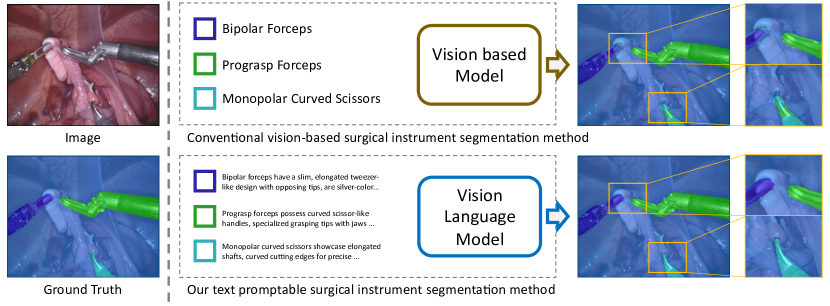
In this paper, we propose a novel text promptable surgical instrument segmentation approach to overcome challenges associated with diversity and differentiation of surgical instruments in minimally invasive surgeries. We redefine the task as text promptable, thereby enabling a more nuanced comprehension of surgical instruments and adaptability to new instrument types. Inspired by recent advancements in vision-language models, we leverage pretrained image and text encoders as our model backbone and design a text promptable mask decoder consisting of attention- and convolution-based prompting schemes for surgical instrument segmentation prediction. Our model leverages multiple text prompts for each surgical instrument through a new mixture of prompts mechanism, resulting in enhanced segmentation performance. Additionally, we introduce a hard instrument area reinforcement module to improve image feature comprehension and segmentation precision. Extensive experiments on several surgical instrument segmentation datasets demonstrate our model's superior performance and promising generalization capability. To our knowledge, this is the first implementation of a promptable approach to surgical instrument segmentation, offering significant potential for practical application in the field of robotic-assisted surgery. Code is available at https://github.com/franciszzj/TP-SIS.
Motivation & Objective
- Address the limited generalization of surgical instrument segmentation to new and diverse instrument types without re-labelling and re-training.
- Leverage vision-language pretraining to align image regions with textual instrument prompts for flexible, open-set segmentation.
- Develop a text promptable mask decoder with attention- and convolution-based prompting to progressively refine instrument localization.
- Introduce a mixture of prompts mechanism to fuse multiple textual prompts for robust segmentation across variants.
- Enhance feature learning in hard instrument areas via a hard instrument area reinforcement module integrated with a MAE-like reconstruction objective.
Proposed method
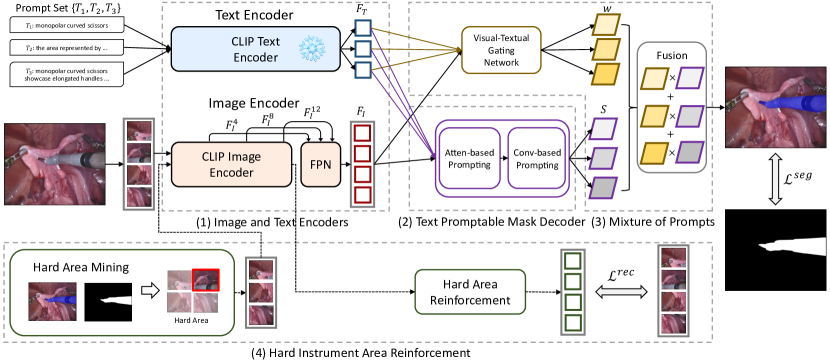
- Use CLIP image and text encoders as backbone to extract visual and textual features from endoscopic images and instrument descriptions.
- Implement a text promptable mask decoder with two prompting schemes: attention-based prompting (self- and cross-attention with F_T) and convolution-based prompting (dynamic kernel parameters derived from F_T).
- Adopt a mixture of prompts (MoP) with a visual-textual gating network to fuse multiple prompt-induced score maps pixel-wise.
- Introduce a hard instrument area reinforcement module that mines hard regions and applies a MAE-like reconstruction objective to reinforce feature learning in difficult areas.
- Train with segmentation loss (binary cross-entropy) and a reconstruction loss (L2) for the MAE-based module; freeze the text encoder and fine-tune the image encoder.
Experimental results
Research questions
- RQ1Can a text-promptable segmentation framework generalize to unseen surgical instrument types without re-labelling or retraining?
- RQ2Does fusing multiple text prompts via a visual-textual gating network improve segmentation accuracy across instrument categories?
- RQ3Does hard area reinforcement improve edge precision and category discrimination in challenging surgical scenes?
- RQ4How does multi-scale image feature fusion and text guidance impact segmentation performance on EndoVis datasets?
Key findings
- Achieves state-of-the-art performance on EndoVis2017 and EndoVis2018 datasets, outperforming traditional predefined-category methods and other text-promptable methods.
- On EndoVis2017, Ours (896) attains Ch_IoU 79.90, ISI_IoU 77.83, mc_IoU 56.22, surpassing prior methods across multiple metrics.
- On EndoVis2018, Ours (896) attains Ch_IoU 84.92, ISI_IoU 83.61, mc_IoU 65.44, indicating strong cross-dataset generalization.
- Cross-dataset (train on EndoVis2018, test on EndoVis2017) yields competitive results, demonstrating generalization to open-set instrument categories.
- Ablation studies show multi-scale feature augmentation, CLS-based text features, and the combination of attention- and convolution-based prompting substantially boost performance.
- GPT-4 generated prompts within the MoP framework provide the best gains among prompt types.
Read this paper
Open the full text in the Nubint reader and ask about any passage as you read.
Read this paper on NubintThis review was generated by AI from the original paper. Please check the paper before citing it.