
[Paper Review] Text-to-3D using Gaussian Splatting
Gsgen uses 3D Gaussian Splatting with a two-stage optimization (geometry then appearance) guided by 3D point-cloud diffusion priors to generate high-quality, 3D-consistent assets from text prompts.
Automatic text-to-3D generation that combines Score Distillation Sampling (SDS) with the optimization of volume rendering has achieved remarkable progress in synthesizing realistic 3D objects. Yet most existing text-to-3D methods by SDS and volume rendering suffer from inaccurate geometry, e.g., the Janus issue, since it is hard to explicitly integrate 3D priors into implicit 3D representations. Besides, it is usually time-consuming for them to generate elaborate 3D models with rich colors. In response, this paper proposes GSGEN, a novel method that adopts Gaussian Splatting, a recent state-of-the-art representation, to text-to-3D generation. GSGEN aims at generating high-quality 3D objects and addressing existing shortcomings by exploiting the explicit nature of Gaussian Splatting that enables the incorporation of 3D prior. Specifically, our method adopts a progressive optimization strategy, which includes a geometry optimization stage and an appearance refinement stage. In geometry optimization, a coarse representation is established under 3D point cloud diffusion prior along with the ordinary 2D SDS optimization, ensuring a sensible and 3D-consistent rough shape. Subsequently, the obtained Gaussians undergo an iterative appearance refinement to enrich texture details. In this stage, we increase the number of Gaussians by compactness-based densification to enhance continuity and improve fidelity. With these designs, our approach can generate 3D assets with delicate details and accurate geometry. Extensive evaluations demonstrate the effectiveness of our method, especially for capturing high-frequency components. Our code is available at https://github.com/gsgen3d/gsgen
Motivation & Objective
- Motivate improved text-to-3D generation by leveraging an explicit 3D representation that can incorporate priors.
- Achieve accurate geometry and high-fidelity appearance through a two-stage optimization.
- Present a practical initialization and densification strategy to enhance 3D consistency and detail.
Proposed method
- Represent the 3D scene with a set of 3D Gaussians and optimize them progressively.
- Use a geometry optimization stage guided by a 3D point-cloud diffusion prior and a 2D SDS loss to obtain a rough, 3D-consistent shape.
- Refine appearance in a second stage with iterative densification based on a compactness criterion to enrich details.
- Initialize Gaussians with a 3D shape from Point-E or user-provided geometry to avoid degeneration.
- Apply a 3D SDS loss to Gaussian positions during geometry optimization to incorporate 3D priors.
- During refinement, rely on 2D SDS guidance and introduce compactness-based densification to improve continuity and fidelity.
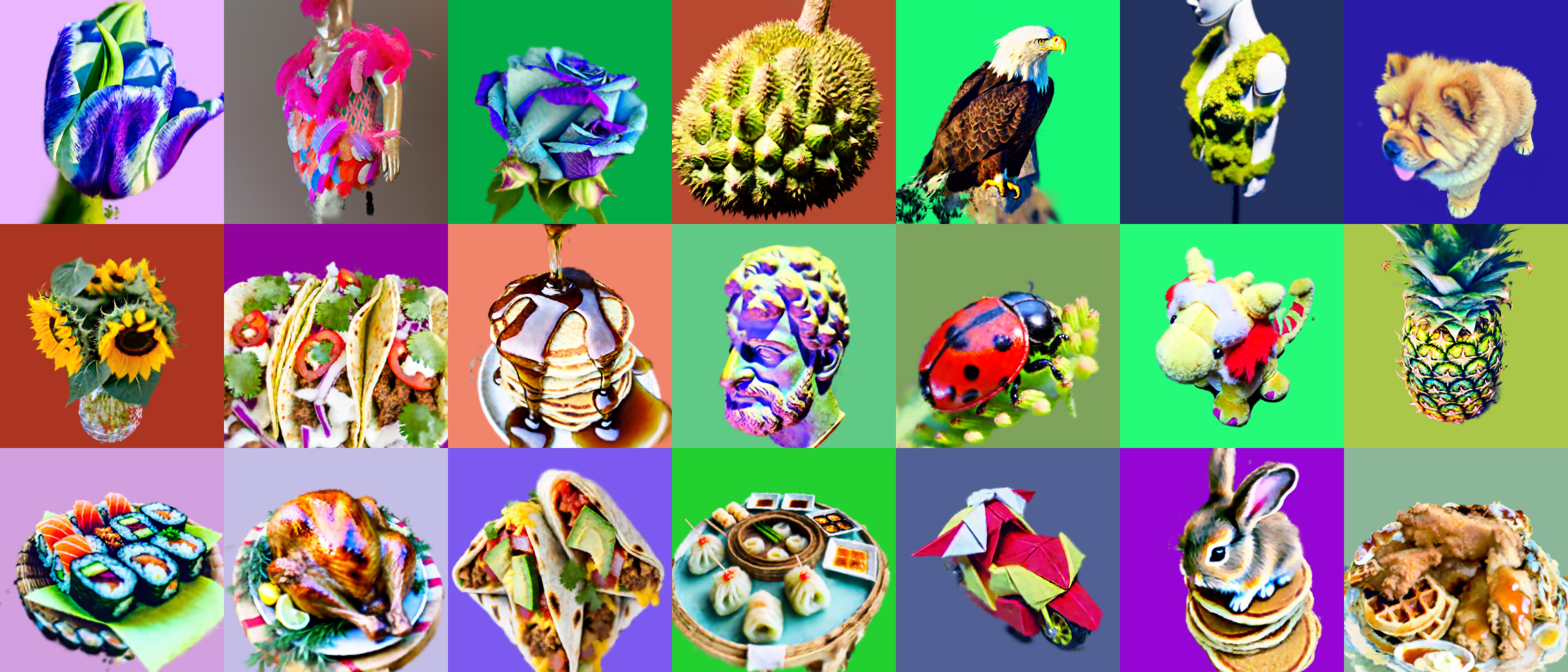
Experimental results
Research questions
- RQ1Can 3D Gaussian Splatting serve as an effective representation for text-to-3D generation when guided by explicit 3D priors?
- RQ2Does a two-stage optimization (geometry with 3D priors followed by appearance refinement with densification) yield superior geometry and detail compared to 2D-only guidance?
- RQ3What initialization and densification strategies best mitigate the Janus problem and over-smoothing in text-to-3D generation?
- RQ4How does incorporating Point-E prior affect geometry coherence and final visual fidelity?
Key findings
- Gsgen produces 3D assets with more accurate geometry and delicate details compared to prior methods.
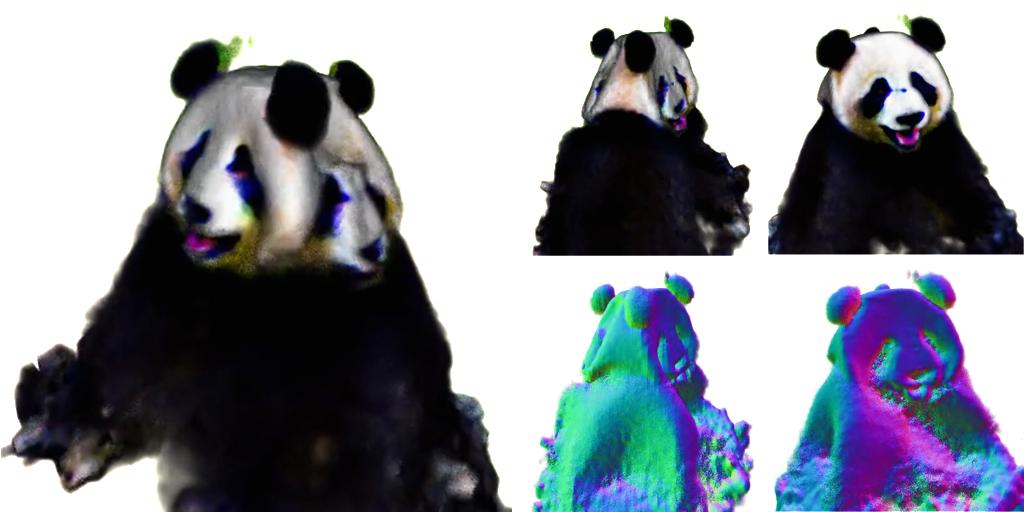
- Incorporating 3D priors via Point-E guidance helps mitigate geometry collapse and improves multi-view consistency.
- Compactness-based densification enhances geometry continuity and detail during appearance refinement.
- Initialization with Point-E priors and 3D guidance yields superiores results over random initialization or 2D guidance alone.
- The method captures high-frequency components better, such as textures and fur, than several baselines.
Read this paper
Open the full text in the Nubint reader and ask about any passage as you read.
Read this paper on NubintThis review was generated by AI from the original paper. Please check the paper before citing it.