
[Paper Review] Text-to-Audio Generation using Instruction-Tuned LLM and Latent Diffusion Model
Tango uses a frozen instruction-tuned LLM (Flan-T5) as text encoder with a latent diffusion model to generate audio from text, achieving state-of-the-art results on AudioCaps with a much smaller training dataset than prior methods.
The immense scale of the recent large language models (LLM) allows many interesting properties, such as, instruction- and chain-of-thought-based fine-tuning, that has significantly improved zero- and few-shot performance in many natural language processing (NLP) tasks. Inspired by such successes, we adopt such an instruction-tuned LLM Flan-T5 as the text encoder for text-to-audio (TTA) generation -- a task where the goal is to generate an audio from its textual description. The prior works on TTA either pre-trained a joint text-audio encoder or used a non-instruction-tuned model, such as, T5. Consequently, our latent diffusion model (LDM)-based approach TANGO outperforms the state-of-the-art AudioLDM on most metrics and stays comparable on the rest on AudioCaps test set, despite training the LDM on a 63 times smaller dataset and keeping the text encoder frozen. This improvement might also be attributed to the adoption of audio pressure level-based sound mixing for training set augmentation, whereas the prior methods take a random mix.
Motivation & Objective
- Motivate text-to-audio generation with minimal fine-tuning of the text encoder.
- Explore the effectiveness of an instruction-tuned LLM as a frozen text encoder for TTA.
- Evaluate Tango against state-of-the-art baselines on AudioCaps.
- Show data-efficient training via dataset size reduction and targeted augmentation.
Proposed method
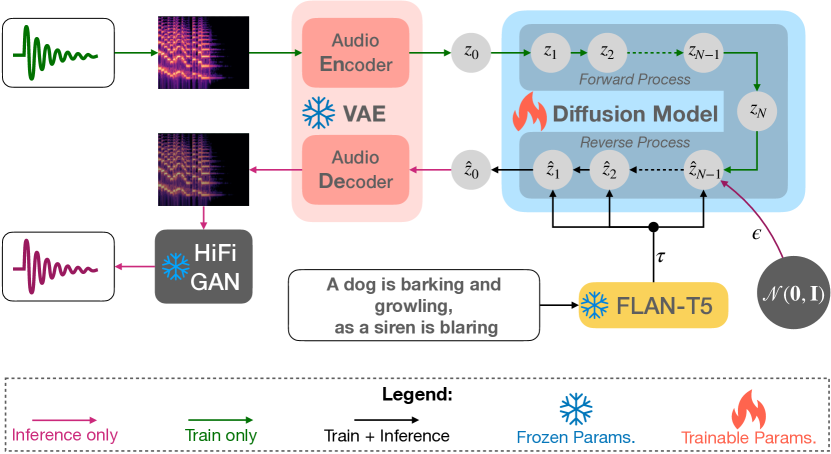
- Use Flan-T5-Large as frozen text encoder to obtain text representations.
- Adopt a latent diffusion model to generate an audio prior conditioned on text embeddings.
- Train an audio VAE and HiFi-GAN vocoder to reconstruct waveform from mel-spectrogram latent representations.
- Augment training data with pressure-level based audio mixtures to better preserve both source sounds.
- Apply classifier-free guidance to steer diffusion sampling with text prompts.
- Train on a significantly smaller AudioCaps dataset (63x smaller) while maintaining competitive performance.
Experimental results
Research questions
- RQ1Can an instruction-tuned LLM, kept frozen, provide enough cross-modal guidance to a diffusion-based audio generator?
- RQ2Does pressure-level based data augmentation improve cross-modal concept composition for TTA?
- RQ3How does Tango compare to AudioLDM and other baselines in objective and subjective metrics when trained on AudioCaps?
- RQ4What is the impact of inference steps and guidance scale on audio quality and relevance?
Key findings
- Tango achieves state-of-the-art FD (24.52), KL (1.37), and FAD (1.59) on AudioCaps with only AudioCaps supervision and a frozen Flan-T5 encoder.
- Tango attains high subjective scores (OVL 85.94, REL 80.36), indicating superior audio quality and text relevance.
- Tango outperforms AudioLDM-L and closely matches or exceeds several AudioLDM-FT variants despite using a 63x smaller training dataset.
- Relative pressure-based augmentation yields better objective metrics than random augmentation (FD 24.52 vs 25.84; KL 1.37 vs 1.38; FAD 1.59 vs 2.72).
- Increased inference steps and appropriate classifier-free guidance (scale ~3) improve Tango’s performance, with notable gains from 100 to 200 steps.
Read this paper
Open the full text in the Nubint reader and ask about any passage as you read.
Read this paper on NubintThis review was generated by AI from the original paper. Please check the paper before citing it.