
[Paper Review] Text-To-Concept (and Back) via Cross-Model Alignment
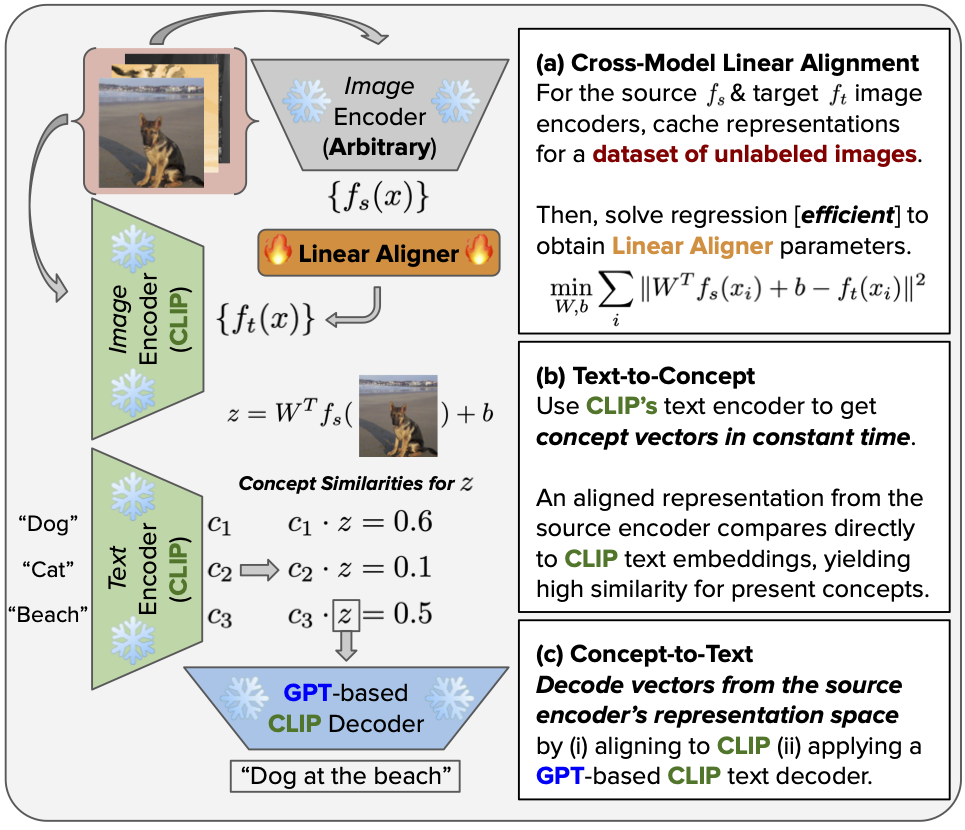
This paper proposes Text-to-Concept, a method that aligns off-the-shelf vision models to CLIP's representation space via a single linear layer, enabling direct comparison between image features and text-derived concept vectors. The approach enables zero-shot classification with state-of-the-art performance on some tasks, even surpassing CLIP in specific cases like color recognition, and supports concept interpretation, distribution shift diagnosis, and concept-to-text generation with minimal computation.
We observe that the mapping between an image's representation in one model to its representation in another can be learned surprisingly well with just a linear layer, even across diverse models. Building on this observation, we propose $ extit{text-to-concept}$, where features from a fixed pretrained model are aligned linearly to the CLIP space, so that text embeddings from CLIP's text encoder become directly comparable to the aligned features. With text-to-concept, we convert fixed off-the-shelf vision encoders to surprisingly strong zero-shot classifiers for free, with accuracy at times even surpassing that of CLIP, despite being much smaller models and trained on a small fraction of the data compared to CLIP. We show other immediate use-cases of text-to-concept, like building concept bottleneck models with no concept supervision, diagnosing distribution shifts in terms of human concepts, and retrieving images satisfying a set of text-based constraints. Lastly, we demonstrate the feasibility of $ extit{concept-to-text}$, where vectors in a model's feature space are decoded by first aligning to the CLIP before being fed to a GPT-based generative model. Our work suggests existing deep models, with presumably diverse architectures and training, represent input samples relatively similarly, and a two-way communication across model representation spaces and to humans (through language) is viable.
Motivation & Objective
- To enable zero-shot classification using fixed, off-the-shelf vision encoders without retraining or concept supervision.
- To interpret the semantic content of pre-trained vision models by mapping their features to CLIP’s text-aligned space.
- To enable two-way communication between model representations and human language via text-to-concept and concept-to-text mapping.
- To diagnose distribution shifts and build concept bottleneck models using only text prompts and pre-trained features.
- To demonstrate that diverse vision models encode similar semantic structures, making linear alignment effective across architectures.
Proposed method
- Train a single linear layer to map features from a source vision encoder (e.g., DINO ResNet) to the CLIP image feature space.
- Use CLIP’s text encoder to generate concept vectors from natural language prompts (e.g., 'in a tree'), which are then compared to aligned image features.
- Perform zero-shot classification by computing cosine similarity between aligned image features and text-derived concept vectors.
- Enable concept-to-text generation by first aligning arbitrary vectors to CLIP space, then decoding them into natural language using a GPT-based model.
- Use the aligned representation space to build concept bottleneck models without requiring concept annotations, relying only on text prompts.
- Refine concept vectors by filtering top and bottom similar images and averaging their representations to improve accuracy.
Experimental results
Research questions
- RQ1Can a simple linear projection effectively align the representation space of a diverse vision model to CLIP’s space, enabling direct semantic comparison with text?
- RQ2To what extent can off-the-shelf vision models achieve high zero-shot accuracy using only text-to-concept alignment, without any retraining or concept supervision?
- RQ3Can text-to-concept be used to interpret model behavior, such as diagnosing distribution shifts or constructing interpretable concept bottleneck models?
- RQ4Is it feasible to reconstruct natural language descriptions from arbitrary feature vectors in a vision model’s representation space via concept-to-text mapping?
- RQ5How does the performance of text-to-concept and concept-to-text depend on the quality of the underlying models (e.g., CLIP, vision encoders, generative models)?
Key findings
- Text-to-concept enables zero-shot classification on ImageNet with accuracy competitive to or exceeding CLIP, even when using smaller models trained on a fraction of CLIP’s data.
- In some cases, particularly for color recognition, off-the-shelf models outperform CLIP in zero-shot accuracy, suggesting richer semantic representations in smaller models.
- The method achieves an AUROC of 0.8 for zero-shot attribute prediction on RIVAL10, enabling highly accurate (93.8%) concept bottleneck models with full interpretability.
- Concept-to-text generation successfully decodes feature vectors into meaningful, semantically relevant text, with most decoded words being broadly consistent with the target class.
- The approach is robust to model diversity: linear alignment works effectively across models with different architectures and training procedures.
- Performance improves with better components—higher-quality CLIP models, stronger vision encoders, and more capable generative models—demonstrating scalability.

Read this paper
Open the full text in the Nubint reader and ask about any passage as you read.
Read this paper on NubintThis review was generated by AI from the original paper. Please check the paper before citing it.