
[Paper Review] Text-to-Image Cross-Modal Generation: A Systematic Review
This systematic review synthesizes research on text-to-image cross-modal generation from 2016–2022, categorizing methods into text-to-image, text-to-video, image editing, self-supervised, graph-based, and other approaches. It identifies diffusion models as dominant, highlights rising interest despite limited publication volume, and reveals key research gaps in self-supervised and structured generation methods.
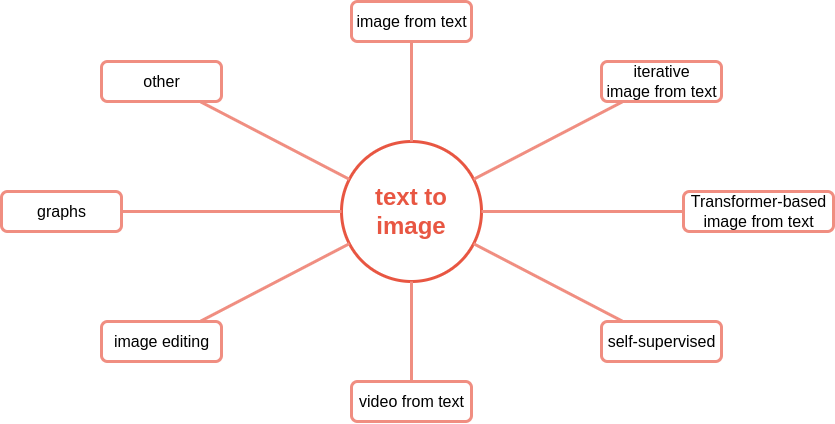
We review research on generating visual data from text from the angle of "cross-modal generation." This point of view allows us to draw parallels between various methods geared towards working on input text and producing visual output, without limiting the analysis to narrow sub-areas. It also results in the identification of common templates in the field, which are then compared and contrasted both within pools of similar methods and across lines of research. We provide a breakdown of text-to-image generation into various flavors of image-from-text methods, video-from-text methods, image editing, self-supervised and graph-based approaches. In this discussion, we focus on research papers published at 8 leading machine learning conferences in the years 2016-2022, also incorporating a number of relevant papers not matching the outlined search criteria. The conducted review suggests a significant increase in the number of papers published in the area and highlights research gaps and potential lines of investigation. To our knowledge, this is the first review to systematically look at text-to-image generation from the perspective of "cross-modal generation."
Motivation & Objective
- To provide a comprehensive, cross-modal perspective on text-to-image generation, moving beyond narrow sub-areas to identify shared methodological templates.
- To categorize and compare diverse approaches, including text-to-image, text-to-video, image editing, self-supervised, and graph-based methods.
- To identify research gaps and emerging opportunities, particularly in non-contrastive self-supervised learning and structured output representations.
- To analyze the evolution and current state of the field using papers from 8 leading machine learning conferences (2016–2022), with additional relevant works.
- To position text-to-image generation as a high-potential, underexplored domain with growing momentum and significant practical impact.
Proposed method
- The review systematically analyzes 200+ papers from 8 top-tier machine learning conferences (2016–2022), supplemented by key non-conference papers.
- Methods are grouped into six categories: vanilla text-to-image, iterative/Transformer-based extensions, self-supervised approaches, text-to-video, image editing, and graph-based methods.
- The analysis focuses on architectural choices, conditioning mechanisms, and the use of generative models—especially VAEs, GANs, and diffusion models—as core components.
- Cross-modal alignment is examined through the lens of encoder-decoder frameworks, where text and image encoders process input modality and features are fused before decoding.
- Diffusion models are highlighted as the dominant paradigm due to their high-quality sample generation and increasing adoption in recent years.
- The review evaluates the role of random noise, class labels, and semantic features as conditioning signals, and explores the potential of intermediate representations (e.g., graphs) for structured image generation.
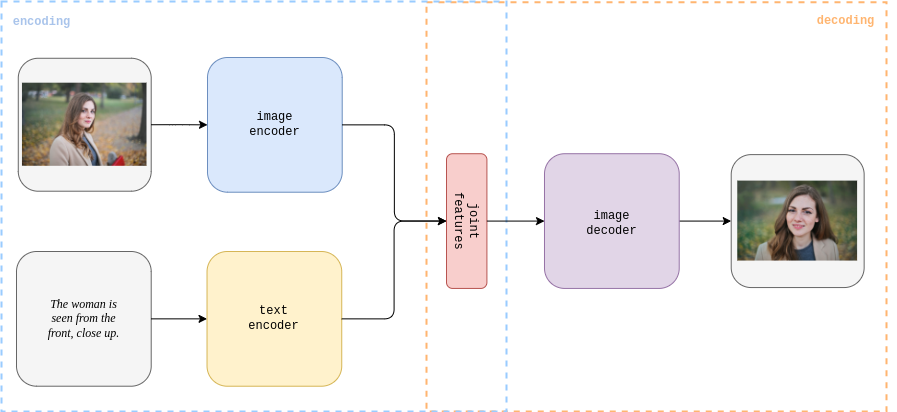
Experimental results
Research questions
- RQ1How do different methodological flavors—such as iterative, Transformer-based, or self-supervised approaches—compare in performance and design across text-to-image generation?
- RQ2What are the dominant generative architectures (e.g., VAEs, GANs, diffusion) in text-to-image generation, and how have they evolved over time?
- RQ3Why is text-to-image generation less represented in the literature compared to image-to-text, despite its higher complexity and practical value?
- RQ4What are the key research gaps in self-supervised and non-contrastive learning for text-to-image generation, and how might they be addressed?
- RQ5Can structured representations (e.g., graphs or semantic maps) improve image generation quality or data efficiency compared to direct pixel-level generation?
Key findings
- The number of publications in text-to-image generation has increased significantly since 2016, indicating growing research interest despite still being less developed than image-to-text.
- Diffusion models have emerged as the dominant generative framework due to their ability to produce high-fidelity, diverse images, outperforming earlier VAE and GAN-based methods.
- Self-supervised and non-contrastive self-supervised learning remain underexplored in text-to-image generation, representing a major research gap with high potential.
- Graph-based and structured representation methods are nascent but promising, suggesting a viable path to improve data efficiency and semantic control in image generation.
- Image editing and text-to-video generation are active but less mature subfields, with limited methodological standardization and fewer high-impact results compared to text-to-image.
- The field remains underexplored relative to image-to-text, primarily due to the vastly larger and more complex output space of images compared to text, which favors generative models over discriminative ones.
Read this paper
Open the full text in the Nubint reader and ask about any passage as you read.
Read this paper on NubintThis review was generated by AI from the original paper. Please check the paper before citing it.