
[Paper Review] Text2CAD: Text to 3D CAD Generation via Technical Drawings
Text2CAD proposes a novel framework that generates accurate 3D CAD models from textual descriptions by first producing detailed isometric images via a fine-tuned stable diffusion model, then converting these into consistent orthographic technical drawings using a view generation model, resulting in high-fidelity CAD models with strong geometric and dimensional accuracy.
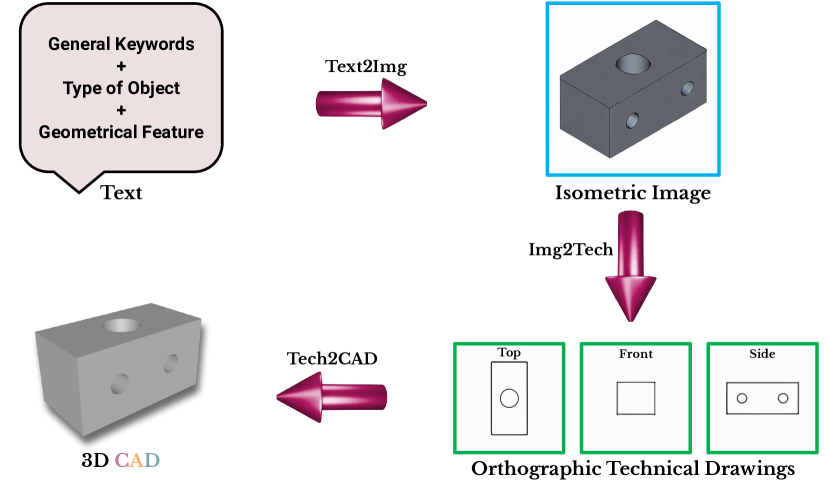
The generation of industrial Computer-Aided Design (CAD) models from user requests and specifications is crucial to enhancing efficiency in modern manufacturing. Traditional methods of CAD generation rely heavily on manual inputs and struggle with complex or non-standard designs, making them less suited for dynamic industrial needs. To overcome these challenges, we introduce Text2CAD, a novel framework that employs stable diffusion models tailored to automate the generation process and efficiently bridge the gap between user specifications in text and functional CAD models. This approach directly translates the user's textural descriptions into detailed isometric images, which are then precisely converted into orthographic views, e.g., top, front, and side, providing sufficient information to reconstruct 3D CAD models. This process not only streamlines the creation of CAD models from textual descriptions but also ensures that the resulting models uphold physical and dimensional consistency essential for practical engineering applications. Our experimental results show that Text2CAD effectively generates technical drawings that are accurately translated into high-quality 3D CAD models, showing substantial potential to revolutionize CAD automation in response to user demands.
Motivation & Objective
- Address the challenge of automating 3D CAD model generation from natural language descriptions in industrial design.
- Overcome limitations of existing diffusion models that fail to maintain 3D consistency and dimensional accuracy in engineering applications.
- Bridge the gap between textual user specifications and functional, manufacturable CAD models through intermediate technical drawings.
- Develop a new dataset of paired textual descriptions and technical drawings to support training and evaluation of the framework.
- Ensure physical and dimensional consistency across orthographic projections to enable direct use in engineering workflows.
Proposed method
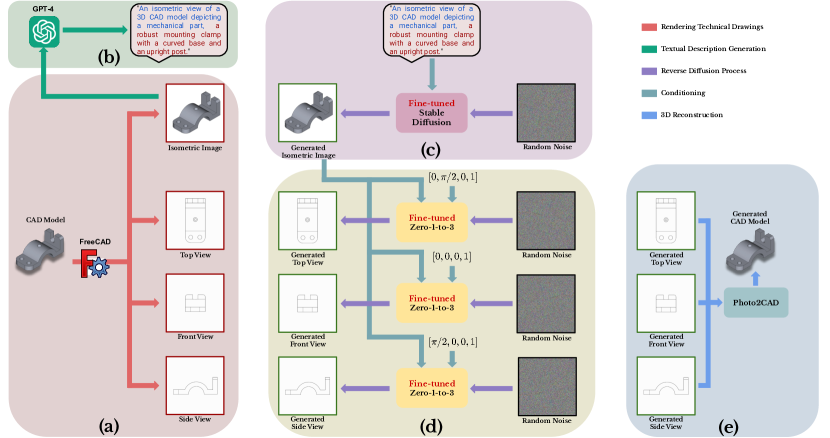
- Fine-tune a stable diffusion model on a newly created dataset of 100 CAD object descriptions and corresponding isometric images to generate detailed 3D object views from text.
- Use a novel view generation model (Zero-1-to-3) to convert the generated isometric images into consistent orthographic projections (top, front, side views).
- Apply a multi-stage pipeline: text → isometric image → orthographic technical drawings → 3D CAD model, ensuring geometric fidelity.
- Leverage the orthographic drawings as a foundation for reconstructing precise 3D CAD models using standard CAD reconstruction techniques.
- Utilize GPT-4 and human evaluation to validate alignment between generated images and input descriptions, ensuring semantic and visual accuracy.
- Conduct ablation studies to evaluate the impact of keywords, object orientation, and model fine-tuning on output quality and diversity.
Experimental results
Research questions
- RQ1Can a fine-tuned stable diffusion model generate isometric images that accurately reflect complex 3D CAD object descriptions?
- RQ2To what extent can a view generation model reliably convert isometric images into consistent, dimensionally accurate orthographic technical drawings?
- RQ3How does the inclusion of specific keywords (e.g., 'An isometric view of a 3D CAD model depicting a mechanical part') affect the quality and consistency of generated isometric images?
- RQ4How robust is the method to variations in object orientation during isometric-to-orthographic transformation?
- RQ5Can the generated technical drawings be accurately reconstructed into high-quality 3D CAD models with physical and dimensional consistency?
Key findings
- The fine-tuned stable diffusion model achieved high alignment between text prompts and generated isometric images, with a GPT-4 evaluation score of 8.375 out of 10, indicating strong semantic and visual fidelity.
- The orthographic technical drawings generated from isometric inputs showed low Chamfer distance to ground truth (mean CD: 2.853), demonstrating high geometric accuracy.
- The method maintained consistent and correct orthographic projections across different object orientations, with side views correctly mapping to front views upon mirroring.
- The inclusion of standardized keywords significantly improved the quality and consistency of isometric image generation, confirming their importance in prompt engineering for CAD tasks.
- The framework generated diverse 3D CAD models from general prompts despite fine-tuning on only a small subset of the dataset, indicating strong generalization capability.
- Human evaluation confirmed that the generated technical drawings were visually detailed and suitable for downstream CAD reconstruction, validating the pipeline’s practical utility.
Read this paper
Open the full text in the Nubint reader and ask about any passage as you read.
Read this paper on NubintThis review was generated by AI from the original paper. Please check the paper before citing it.