
[Paper Review] The 10 parsec sample in the Gaia era: first update
This paper updates the 10 parsec sample using Gaia DR3 data, compiling a volume-complete census of 541 stars, brown dwarfs, and exoplanets in 336 systems within 10 pc of the Sun. It integrates high-precision astrometry, radial velocities, and new astrophysical parameters, highlighting significant updates in close binaries, brown dwarfs, and exoplanets, with 85 confirmed exoplanets and improved kinematic and chemical diagnostics for benchmark stars.
The nearest stars provide a fundamental constraint for our understanding of stellar physics and the Galaxy. The nearby sample serves as an anchor where all objects can be studied and understood with precise data. This work is an update of the 10 pc sample published by Reylé et al. (2021) that used the unprecedented high precision parallax measurements from the early third data release of the astrometric space mission Gaia. We review this census, all updates being related to close binaries, brown dwarfs and exoplanets. We provide a new catalogue of 541 stars, brown dwarfs, and exoplanets in 336 systems within 10 pc from the Sun. This list is as volume-complete as possible from current knowledge and it provides a list of benchmark stars. We also explore the new products made available in the most recent third Gaia data release.
Motivation & Objective
- To provide a volume-complete, up-to-date census of all stellar, brown dwarf, and exoplanet systems within 10 pc of the Sun.
- To leverage Gaia DR3's improved astrometry, radial velocities, and astrophysical parameters for enhanced accuracy in object classification and kinematic analysis.
- To identify and correct prior misclassifications, such as misattributed companions and distant background objects, using refined parallax and orbital solutions.
- To establish a comprehensive, benchmark-quality list for future high-precision studies of nearby stellar systems.
- To explore the implications of new Gaia DR3 products—such as variability, binarity, and chemical abundance indicators—on the nearby stellar population.
Proposed method
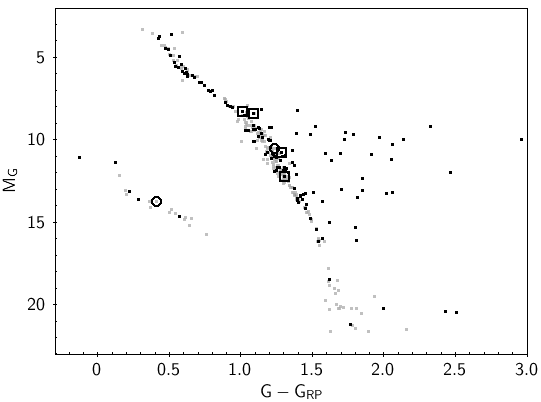
- Compiled a new catalogue of 541 objects (371 stars, 85 brown dwarfs, 85 exoplanets) in 336 systems within 10 pc using Gaia DR3 astrometry, photometry, radial velocities, and spectral types.
- Applied updated parallax measurements from Gaia DR3 and external sources (e.g., Hubble, adaptive optics) to re-evaluate distances and exclude objects beyond 10 pc.
- Used astrometric orbital solutions from Gaia DR3 to correct misattributed companions, such as the reassignment of a companion from GJ 666 A to GJ 666 B.
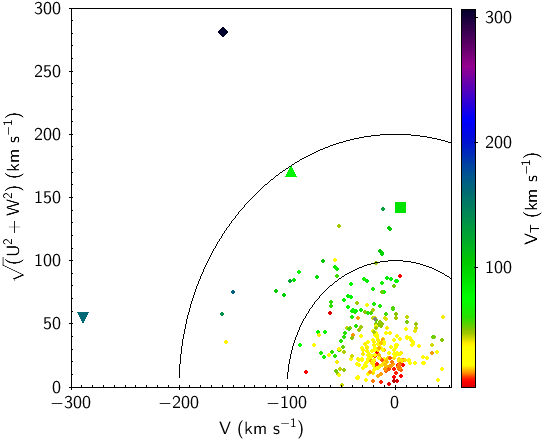
- Evaluated radial velocity data from Gaia DR3 for 309 stars, excluding unreliable measurements (e.g., EGGR 290) to compute corrected space velocities in the Galactic rest frame.
- Analyzed [α/Fe] vs. [M/H] diagrams using Gaia DR3’s calibrated astrophysical parameters (quality flags ≤1) to classify stellar populations.
- Identified and listed 21 star and brown dwarf candidates with parallax uncertainties still compatible with the 10 pc limit at 1σ, and exoplanet candidates in the COMMENT field.
Experimental results
Research questions
- RQ1How has the inclusion of Gaia DR3 data improved the completeness and accuracy of the 10 parsec stellar census?
- RQ2Which previously misclassified objects—especially binaries and brown dwarfs—have been corrected using Gaia DR3 astrometry and radial velocities?
- RQ3What is the distribution of kinematic properties (e.g., transverse and total velocities) among nearby stars, and how do they relate to Galactic structure?
- RQ4How do the new Gaia DR3-derived astrophysical parameters (e.g., [α/Fe], [M/H]) inform the chemical and dynamical classification of nearby stars?
- RQ5To what extent do exoplanets now outnumber stars and brown dwarfs in the 10 pc volume, and how does this affect the sample's composition?
Key findings
- The updated 10 pc sample contains 541 objects in 336 systems, including 371 stars (21 white dwarfs), 85 brown dwarfs, and 85 confirmed exoplanets, with the list as volume-complete as current data allow.
- Eight new exoplanets were added, including Earth-mass planets in habitable zones (e.g., Wolf 1069 b) and transiting rocky planets (e.g., HD 260655 b and c), while two Y-dwarfs (CWISEP J2256+4002 and CWISEP J1810–1010) were newly identified.
- Nine low-mass objects were removed from the sample due to improved parallax measurements placing them beyond 10 pc or due to misclassification as binaries (e.g., GJ 666 Ab, UPM J0815–2344 B, WISE J0811–8051).
- Gaia DR3 enabled radial velocity measurements for 23 stars and improved values for 24 more, resulting in 309 stars with full 3D kinematics; HD 103095 showed the highest total velocity (312 km/s) and secular acceleration (10.51 m s⁻¹ a⁻¹).
- The Toomre diagram revealed that most nearby stars lie in the thin disc, but a few (e.g., Kapteyn’s star, HD 103095) are halo stars with high velocities, and HD 103095 is metal-poor and α-rich, consistent with an old population.
- The [α/Fe] vs. [M/H] diagram for 248 high-quality stars showed that HD 103095 lies in the α-rich, metal-poor region, supporting its classification as an old halo star with extreme kinematics.
Read this paper
Open the full text in the Nubint reader and ask about any passage as you read.
Read this paper on NubintThis review was generated by AI from the original paper. Please check the paper before citing it.