
[Paper Review] The ab initio amorphous materials database: Empowering machine learning to decode diffusivity
This paper builds the largest computed amorphous materials database (5120 compositions, 79 elements) using AIMD, and demonstrates ML models (RF, XGBoost, SISSO) to predict Li+ diffusivity, with surrogate structure generation via M3GNet.
Amorphous materials exhibit unique properties that make them suitable for various applications in science and technology, ranging from optical and electronic devices and solid-state batteries to protective coatings. However, data-driven exploration and design of amorphous materials is hampered by the absence of a comprehensive database covering a broad chemical space. In this work, we present the largest computed amorphous materials database to date, generated from systematic and accurate extit{ab initio} molecular dynamics (AIMD) calculations. We also show how the database can be used in simple machine-learning models to connect properties to composition and structure, here specifically targeting ionic conductivity. These models predict the Li-ion diffusivity with speed and accuracy, offering a cost-effective alternative to expensive density functional theory (DFT) calculations. Furthermore, the process of computational quenching amorphous materials provides a unique sampling of out-of-equilibrium structures, energies, and force landscape, and we anticipate that the corresponding trajectories will inform future work in universal machine learning potentials, impacting design beyond that of non-crystalline materials.
Motivation & Objective
- Motivate the need for a comprehensive amorphous materials database to accelerate data-driven discovery of ionic conductors.
- Generate a large, varied AIMD-derived amorphous database spanning broad compositions and temperatures.
- Enable rapid prediction of Li-ion diffusivity using machine-learning models trained on composition- and structure-related features.
Proposed method
- Generate amorphous structures for 5,120 compositions by melting at 5000 K using the MPMorph workflow.
- Create a second multi-temperature database by annealing last snapshot structures at 1000–2500 K for selected compositions.
- Compute Li diffusivity and activation energy from AIMD-based trajectories and extract a rich feature set for ML.
- Train Random Forest and XGBoost models to predict temperature-dependent diffusivity and assess generalization via five-fold cross-validation.
- Develop SISSO descriptors to predict Li diffusivity and compare performance across model complexities.
- Integrate M3GNet as a surrogate to generate amorphous structures and compute structure features for ML inputs, assessing speedups and applicability.

Experimental results
Research questions
- RQ1Can a large, diverse ab initio amorphous materials database enable accurate ML predictions of Li+ diffusivity across compositions and temperatures?
- RQ2Which compositional and structural features most strongly correlate with Li diffusivity and activation energy in amorphous systems?
- RQ3How do ensemble models (RF, XGBoost) and SISSO descriptors compare in predicting Li diffusivity from the amorphous data?
- RQ4Can universal ML potentials (M3GNet/CHGNet) reliably generate amorphous structures and provide useful inputs for diffusivity prediction?
Key findings
- The database covers 5120 compositions and 79 elements, with 3,533 Li-containing compounds in the 5000 K amorphous set.
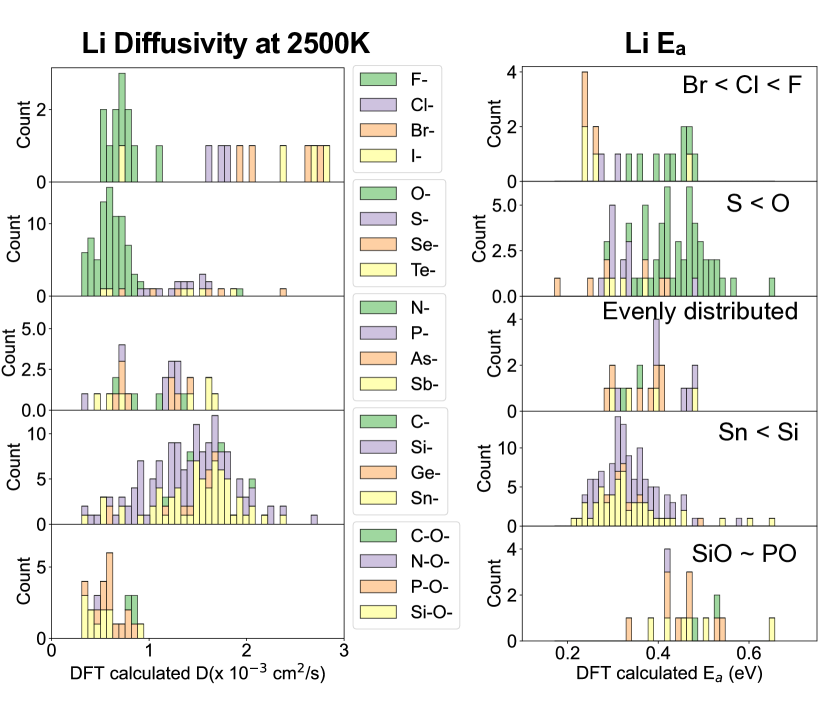
- Li diffusivity and activation energy distributions reveal clear trends with anion type, cation size, and electronegativity differences.
- RF and XGBoost achieve near-perfect fits (R^2 close to 1) for diffusivity predictions with low MAE and RMSE, validated by cross-validation.
- Top predictive features include Li% and features describing the non-Li environment and bonding, such as average cohesive energy, packing fractions, and Li neighbor counts.
- SISSO models can predict diffusivity with an optimal 3-descriptor descriptor, highlighting interpretable relationships between temperature, composition, and structure.
- M3GNet can reproduce AIMD-derived structures with high fidelity (R^2 up to 0.99 for RDFs) and accelerates structure generation by ~2000x, though less accurate for high-temperature (5000 K) diffusivity.
Read this paper
Open the full text in the Nubint reader and ask about any passage as you read.
Read this paper on NubintThis review was generated by AI from the original paper. Please check the paper before citing it.