
[Paper Review] The Accented English Speech Recognition Challenge 2020: Open Datasets, Tracks, Baselines, Results and Methods
This paper presents the Accented English Speech Recognition Challenge 2020, introducing a 180-hour open dataset with 10 English accents for accent recognition (track 1) and accented speech recognition (track 2). It evaluates end-to-end ASR models using self-supervised pretraining (e.g., wav2vec2.0), data augmentation, and hybrid decoding, achieving up to 26.4% WER reduction with two-pass decoding and 3% relative WER gain via multi-task accent training.
The variety of accents has posed a big challenge to speech recognition. The Accented English Speech Recognition Challenge (AESRC2020) is designed for providing a common testbed and promoting accent-related research. Two tracks are set in the challenge -- English accent recognition (track 1) and accented English speech recognition (track 2). A set of 160 hours of accented English speech collected from 8 countries is released with labels as the training set. Another 20 hours of speech without labels is later released as the test set, including two unseen accents from another two countries used to test the model generalization ability in track 2. We also provide baseline systems for the participants. This paper first reviews the released dataset, track setups, baselines and then summarizes the challenge results and major techniques used in the submissions.
Motivation & Objective
- To establish a common testbed for advancing research in accented English speech recognition and accent identification.
- To address the challenge of model generalization to unseen accents through a large-scale, diverse dataset of 10 English accents.
- To evaluate the effectiveness of self-supervised pretraining, data augmentation, and end-to-end modeling in low-resource accented ASR.
- To compare performance across diverse architectures, including Transformers, Conformers, and hybrid systems, under standardized evaluation protocols.
Proposed method
- The challenge uses a 160-hour training set with 8 accents (Chinese, American, British, Korean, Japanese, Russian, Indian, Portuguese) and a 20-hour test set with 2 additional unseen accents (Spanish, Canadian).
- Baseline systems employ Wav2Vec2.0-style self-supervised pretraining with contrastive and diversity losses to learn contextualized acoustic representations.
- Data augmentation techniques such as volume and speed perturbation reduce WER by 5–10% in top-performing systems.
- End-to-end models, especially Transformer-based and Conformer architectures, outperform traditional hybrid systems by leveraging full-sequence modeling and attention mechanisms.
- Two-pass decoding with language model rescoring (e.g., using word-piece-level Transformer LM) reduces WER by up to 26.4%.
- Multi-task training with accent recognition head yields 3% relative WER reduction in accented ASR, indicating benefit from explicit accent modeling.
Experimental results
Research questions
- RQ1How effective is self-supervised pretraining (e.g., wav2vec2.0) for improving ASR performance on low-resource accented English speech?
- RQ2To what extent do data augmentation techniques such as speed perturbation and noise injection improve generalization in accented speech recognition?
- RQ3Can end-to-end models with attention mechanisms outperform traditional hybrid HMM-GMM systems in multilingual accent recognition?
- RQ4How does two-pass decoding with neural language model rescoring impact WER reduction in accented speech recognition?
- RQ5Does multi-task training with an auxiliary accent recognition head improve performance on unseen accents?
Key findings
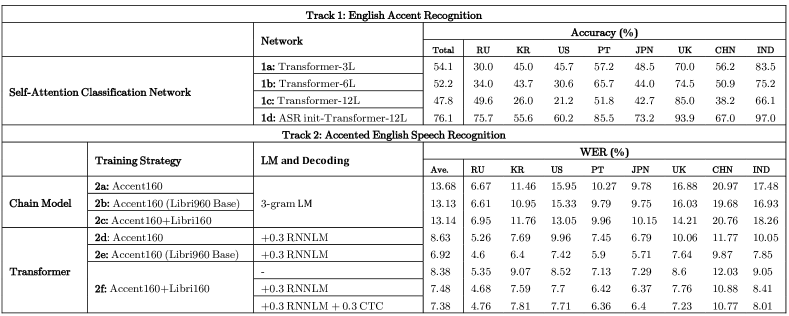
- Self-supervised pretraining using contrastive and diversity losses significantly improves ASR performance, with Wav2Vec2.0-based models achieving state-of-the-art results.
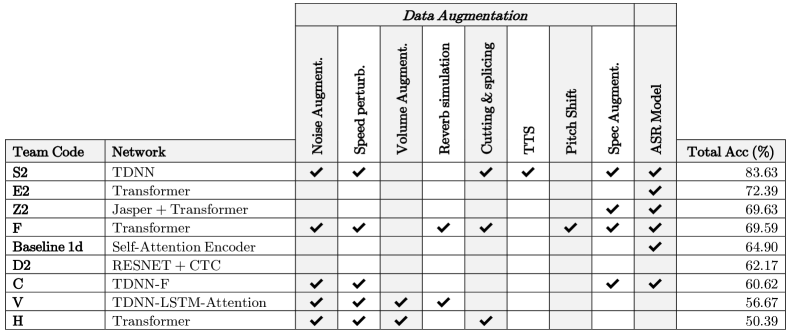
- Data augmentation via volume and speed perturbation reduced WER by 5–10% in top systems, while noise and reverberation augmentation showed no clear benefit.
- Two-pass decoding with language model rescoring reduced WER by up to 26.4% in the best-performing system (team S2).
- A word-piece-level Transformer LM combined with a 4-gram LM via fusion reduced WER by 2.4% relative on the CV set (3.73% to 3.64%).
- Multi-task training with an accent recognition head yielded a 3% relative WER reduction, indicating value in explicit accent modeling.
- Conformer and lite Transformer variants outperformed standard Transformers, suggesting improved local context modeling enhances performance.
Read this paper
Open the full text in the Nubint reader and ask about any passage as you read.
Read this paper on NubintThis review was generated by AI from the original paper. Please check the paper before citing it.