
[Paper Review] The assessment of replicability using the sum of p-values
This paper proposes using the sum of p-values as a replicability assessment method, offering a valid combined p-value that controls Type-I error while allowing replication success even when the original study is non-significant. It outperforms the two-trials rule by enabling sample size reductions of up to 10% and accommodating bias through weighted versions, with empirical validation across four large-scale replication projects.
Statistical significance of both the original and the replication study is a commonly used criterion to assess replication attempts, also known as the two-trials rule in drug development. However, replication studies are sometimes conducted although the original study is non-significant, in which case Type-I error rate control across both studies is no longer guaranteed. We propose an alternative method to assess replicability using the sum of p-values from the two studies. The approach provides a combined p-value and can be calibrated to control the overall Type-I error rate at the same level as the two-trials rule but allows for replication success even if the original study is non-significant. The unweighted version requires a less restrictive level of significance at replication if the original study is already convincing which facilitates sample size reductions of up to 10%. Downweighting the original study accounts for possible bias and requires a more stringent significance level and larger samples sizes at replication. Data from four large-scale replication projects are used to illustrate and compare the proposed method with the two-trials rule, meta-analysis and Fisher's combination method.
Motivation & Objective
- To address the limitations of the two-trials rule, which requires both original and replication studies to be significant, even when the original study is non-significant.
- To develop a unified, valid p-value combination method that maintains overall Type-I error rate control at α² = 0.000625.
- To enable replication success when the original study is non-significant but the replication is highly significant, improving statistical power and interpretability.
- To provide a flexible framework with unweighted and weighted versions to account for potential bias in original studies.
- To compare the proposed method with existing approaches—two-trials rule, Fisher’s method, meta-analysis—using real data from four large-scale replication projects.
Proposed method
- The method uses the sum of p-values from the original and replication studies as a test statistic, with the combined p-value derived from the distribution of this sum under the intersection null hypothesis.
- The unweighted version assumes equal contribution from both studies, with the sum of two independent uniform random variables (q_o ~ U(0,1), q_r ~ U(0,1)) under the null.
- The distribution of the sum is trapezoidal, and the cumulative distribution function (CDF) is used to compute a valid combined p-value.
- The weighted version assigns different weights (w_o ≤ w_r) to the original and replication p-values, allowing for downweighting of potentially biased original studies.
- The method is calibrated to control the overall Type-I error rate at α² = 0.000625, matching the two-trials rule, but avoids the 'double dichotomization' problem.
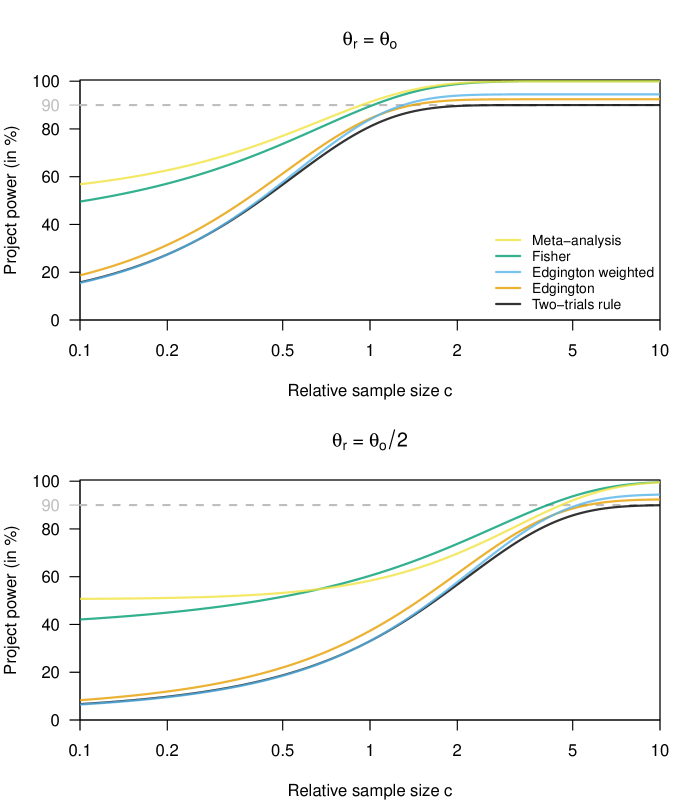
- Sample size planning is informed by project power calculations based on non-central normal distributions for test statistics under the alternative hypothesis.
Experimental results
Research questions
- RQ1Can a p-value sum method provide a valid, unified criterion for replicability that avoids the counterintuitive outcomes of the two-trials rule?
- RQ2How does the performance of the sum-of-p-values method compare to the two-trials rule, Fisher’s method, and meta-analysis in terms of statistical power and Type-I error control?
- RQ3To what extent can sample size be reduced when using the sum-of-p-values method compared to the two-trials rule, particularly when the original study is already significant?
- RQ4How does downweighting the original study affect the required significance level and sample size at replication, and what is the trade-off in terms of robustness to bias?
- RQ5What is the empirical performance of the proposed method across real-world replication projects such as the Reproducibility Project: Psychology and the Experimental Economics Replication Project?
Key findings
- The sum-of-p-values method provides a valid combined p-value that controls the overall Type-I error rate at α² = 0.000625, matching the two-trials rule, while avoiding its counterintuitive behavior.
- The unweighted version allows for up to 10% sample size reduction in replication studies when the original study is already convincing, due to a less restrictive significance threshold at replication.
- Downweighting the original study increases the required significance level at replication and increases sample size, but improves robustness to potential bias in the original study.
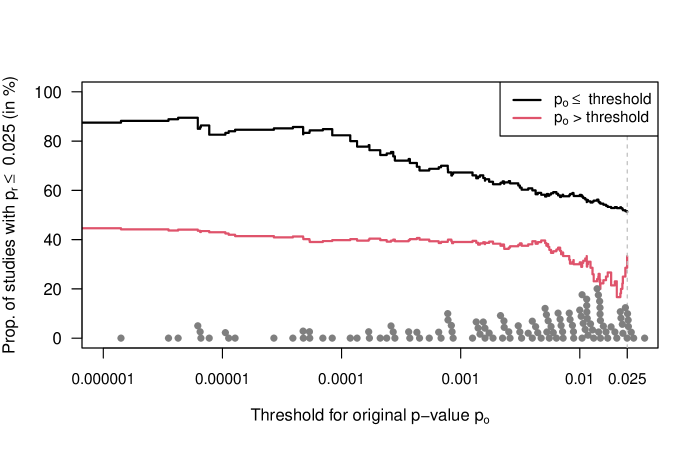
- Empirical comparisons using data from four large-scale replication projects show that the sum-of-p-values method performs comparably or better than Fisher’s method and meta-analysis in terms of replicability detection.
- The method’s project power converges to 1 − Φ(Φ⁻¹(1−b) − Φ⁻¹(1−α) − Φ⁻¹(1−β)) as sample size increases, indicating strong asymptotic performance under the alternative.
- The weighted version maintains valid error control and offers a principled way to incorporate prior skepticism about original study quality, with power depending on the weight ratio w_o/w_r.
Read this paper
Open the full text in the Nubint reader and ask about any passage as you read.
Read this paper on NubintThis review was generated by AI from the original paper. Please check the paper before citing it.