
[Paper Review] The BACCO simulation project: biased tracers in real space
This paper presents a neural network-based emulator for the two-point clustering of biased tracers in real space, trained on over 400 cosmological simulations spanning an 8D parameter space including massive neutrinos and dynamical dark energy. Using a cosmology-rescaling algorithm and Lagrangian perturbation theory up to second order, the emulator achieves 1–2% accuracy in predicting galaxy power spectra up to $k \sim 0.7h\,\mathrm{Mpc}^{-1}$, enabling precise cosmological inference from large-scale structure surveys.
We present an emulator for the two-point clustering of biased tracers in real space. We construct this emulator using neural networks calibrated with more than $400$ cosmological models in a 8-dimensional cosmological parameter space that includes massive neutrinos an dynamical dark energy. The properties of biased tracers are described via a Lagrangian perturbative bias expansion which is advected to Eulerian space using the displacement field of numerical simulations. The cosmology-dependence is captured thanks to a cosmology-rescaling algorithm. We show that our emulator is capable of describing the power spectrum of galaxy formation simulations for a sample mimicking that of a typical Emission-Line survey at $z \sim 1$ with an accuracy of $1-2\%$ up to nonlinear scales $k \sim 0.7 h \mathrm{Mpc}^{-1}$.
Motivation & Objective
- To develop a fast, accurate emulator for the clustering of biased tracers in real space across a broad cosmological parameter space.
- To model the nonlinear clustering of galaxy tracers using Lagrangian perturbation theory and cosmology-rescaling to reduce computational cost.
- To enable precise cosmological constraints from upcoming large-scale structure surveys like Euclid and DESI by accurately modeling galaxy power spectra across nonlinear scales.
- To validate the emulator on mock galaxy samples with realistic selection functions and cosmic variance errors.
- To provide a publicly available tool for modeling galaxy clustering, including applications to galaxy-galaxy lensing and future redshift-space extensions.
Proposed method
- The emulator is trained using a dataset of over 400 cosmological simulations in an 8D parameter space, including massive neutrinos and dynamical dark energy.
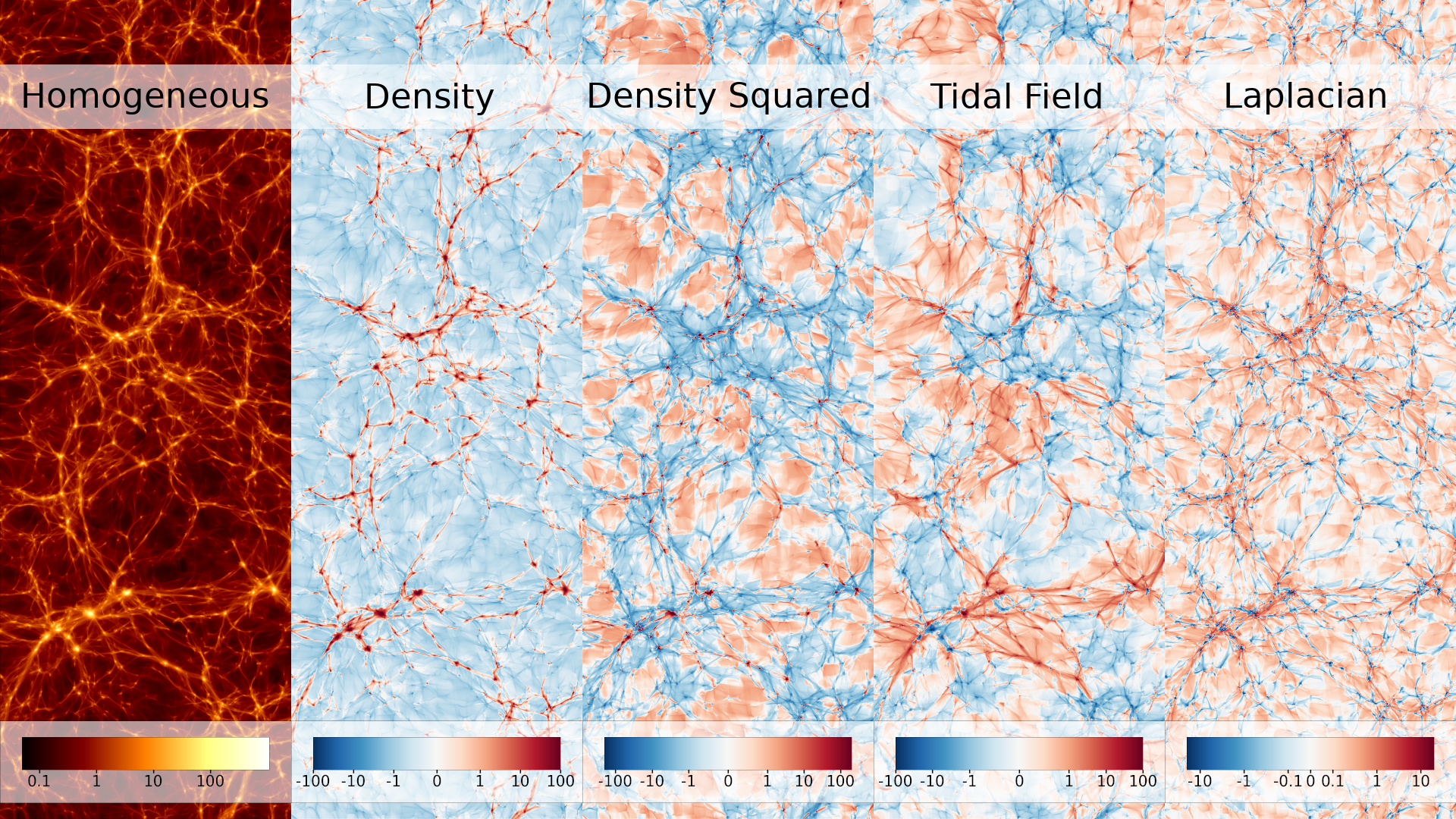
- Lagrangian bias expansion terms up to second order in density, tidal field, and Laplacian of density are computed from simulations and evolved to Eulerian space using the displacement field.
- A cosmology-rescaling algorithm is applied to reproduce Lagrangian fields from a small set of reference simulations across the full cosmological parameter space.
- Neural networks are used to emulate the power spectra of bias terms, with predictions validated against independent simulation outputs.
- The method reduces the dynamical range of the quantities to be emulated by combining theoretical LPT predictions with simulation outputs.
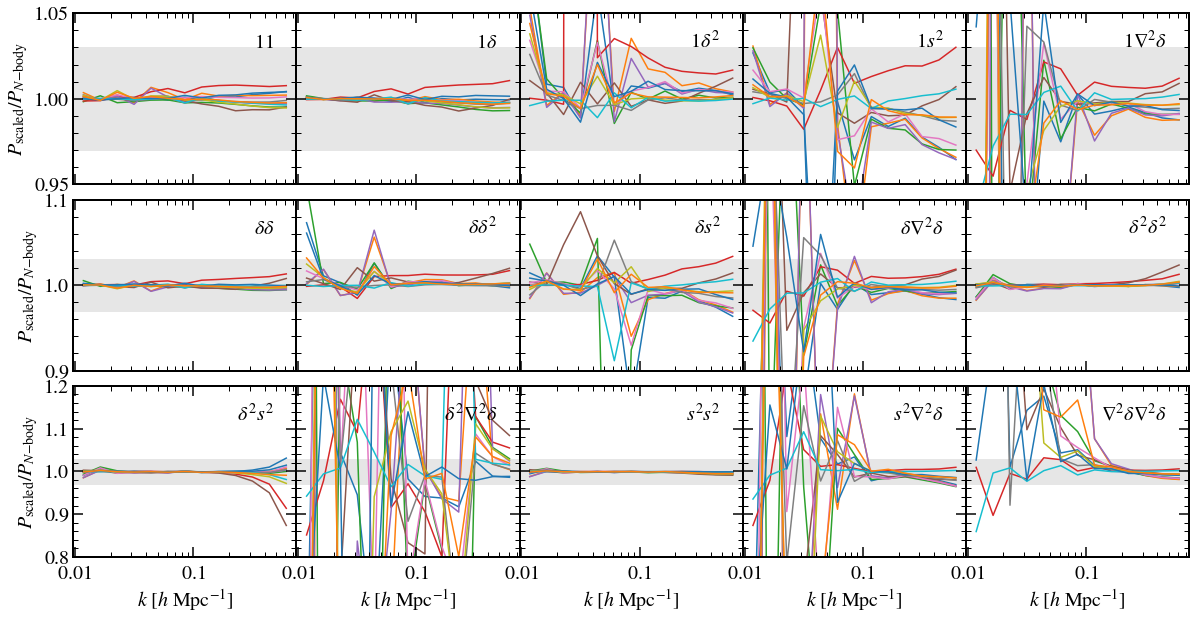
- The emulator is validated on 200 independent cosmology-redshift combinations, with performance assessed on terms involving $1$, $\delta$, $\delta^2$, $s^2$, and $\nabla^2\delta$.
Experimental results
Research questions
- RQ1Can a neural network emulator accurately predict the power spectrum of biased tracers across a wide cosmological parameter space, including extensions to $\Lambda$CDM?
- RQ2To what extent can cosmology-rescaling accurately reproduce Lagrangian fields from a limited set of simulations across diverse cosmologies?
- RQ3How accurately can Lagrangian perturbation theory terms be combined with simulations to model nonlinear clustering up to $k \sim 0.7h\,\mathrm{Mpc}^{-1}$?
- RQ4Can the emulator achieve sub-percent accuracy on key bias terms like $1$ and $\delta$ while maintaining acceptable accuracy on higher-order terms?
- RQ5Can the emulator be used to constrain bias parameters from a realistic mock galaxy sample with cosmic variance errors, including nonlinear scales?
Key findings
- The emulator achieves 1–2% accuracy in predicting the power spectrum of a mock galaxy sample mimicking an emission-line survey at $z \sim 1$ up to $k \sim 0.7h\,\mathrm{Mpc}^{-1}$.
- Terms involving the homogeneous field ($1$) and linear density field ($\delta$) are emulated with percent-level accuracy across the full scale range.
- Higher-order terms such as $\delta^2$, $s^2$, and $\nabla^2\delta$ are reproduced with a few percent accuracy, except for specific combinations like $\delta^2 s^2$ and $\delta^2 \nabla^2\delta$ that show degraded performance at zero-crossing scales.
- The cosmology-rescaling technique successfully reproduces Lagrangian fields from a small set of reference simulations across the full 8D cosmological parameter space with high fidelity.
- The emulator enables self-consistent fitting of galaxy clustering across a wide dynamic range, including nonlinear scales, when applied to a mock galaxy sample with realistic number density and cosmic variance.
- The method demonstrates strong potential for modeling galaxy-galaxy lensing and future extensions to redshift space clustering.
Read this paper
Open the full text in the Nubint reader and ask about any passage as you read.
Read this paper on NubintThis review was generated by AI from the original paper. Please check the paper before citing it.