
[Paper Review] The Curious Case of Nonverbal Abstract Reasoning with Multi-Modal Large Language Models
This paper evaluates the nonverbal abstract reasoning capabilities of 24 open-source and closed-source multi-modal large language models (MLLMs) using Raven’s Progressive Matrices benchmarks. It reveals significant performance gaps between open-source and closed-source models, identifies critical limitations in visual and textual perception, and demonstrates that chain-of-thought prompting can boost performance by up to 100%.
While large language models (LLMs) are still being adopted to new domains and utilized in novel applications, we are experiencing an influx of the new generation of foundation models, namely multi-modal large language models (MLLMs). These models integrate verbal and visual information, opening new possibilities to demonstrate more complex reasoning abilities at the intersection of the two modalities. However, despite the revolutionizing prospect of MLLMs, our understanding of their reasoning abilities is limited. In this study, we assess the nonverbal abstract reasoning abilities of open-source and closed-source MLLMs using variations of Raven's Progressive Matrices. Our experiments reveal the challenging nature of such problems for MLLMs while showcasing the immense gap between open-source and closed-source models. We also uncover critical shortcomings of visual and textual perceptions, subjecting the models to low-performance ceilings. Finally, to improve MLLMs' performance, we experiment with different methods, such as Chain-of-Thought prompting, leading to a significant (up to 100%) boost in performance. Our code and datasets are available at https://github.com/usc-isi-i2/isi-mmlm-rpm.
Motivation & Objective
- To assess the nonverbal abstract reasoning abilities of open-source and closed-source multi-modal large language models (MLLMs) using Raven’s Progressive Matrices.
- To isolate and evaluate the textual and visual perception capabilities of MLLMs in pseudo-isolated settings to determine performance ceilings.
- To investigate the alignment between verbal and visual perceptions in MLLMs and its impact on reasoning performance.
- To explore prompting strategies such as chain-of-thought and few-shot prompting to improve MLLM performance on abstract reasoning tasks.
Proposed method
- Benchmarked 24 MLLMs on three variations of Raven’s Progressive Matrices (RPM) datasets: IQ50, IQ100, and IQ1000.
- Designed controlled prompt templates to evaluate zero-shot and few-shot reasoning, including symmetrical and asymmetrical few-shot prompting.
- Implemented chain-of-thought (CoT) prompting to guide models through step-by-step reasoning during inference.
- Used guided prompting with corrective hints to improve model reasoning accuracy.
- Evaluated model performance under isolated visual and textual conditions to identify modality-specific weaknesses.
- Collected and released code and datasets to support reproducibility and further research in MLLM reasoning evaluation.

Experimental results
Research questions
- RQ1Do multi-modal large language models demonstrate faithful nonverbal abstract reasoning abilities?
- RQ2How do open-source and closed-source MLLMs compare in performance on nonverbal abstract reasoning tasks?
- RQ3What are the performance ceilings of MLLMs’ visual and textual perception capabilities when isolated from cross-modal interference?
- RQ4To what extent does alignment between verbal and visual perception affect MLLM reasoning performance?
- RQ5Can prompting strategies such as chain-of-thought or few-shot prompting significantly improve MLLM performance on abstract reasoning tasks?
Key findings
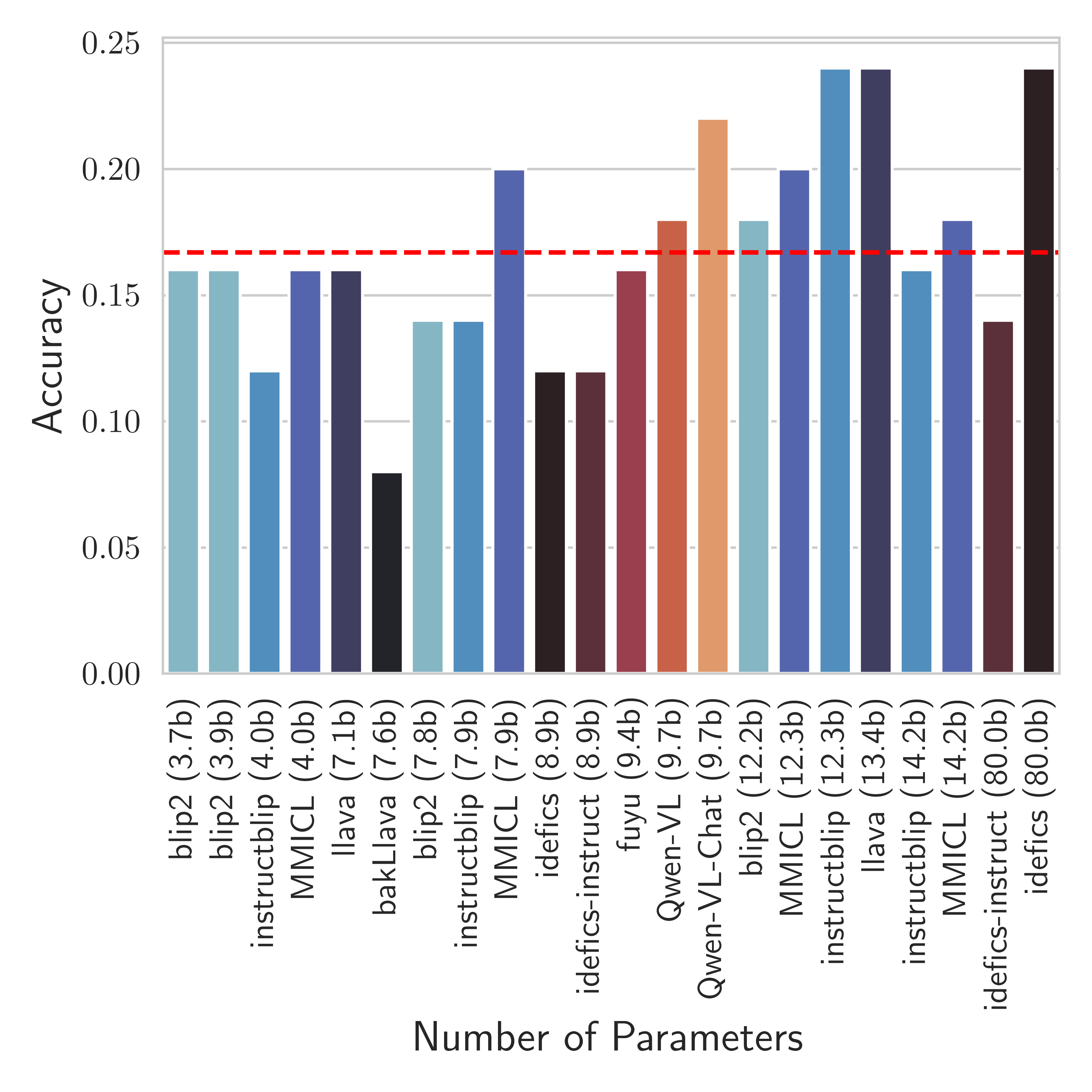
- Closed-source MLLMs like GPT-4V demonstrate non-trivial nonverbal abstract reasoning abilities, while open-source models perform poorly on Raven’s Progressive Matrices benchmarks.
- Open-source MLLMs exhibit a significant performance gap, with accuracy levels far below those of closed-source models on the same tasks.
- Critical shortcomings in both visual and textual perception capabilities limit the performance ceiling of MLLMs, even when modalities are isolated.
- Chain-of-thought prompting leads to a performance boost of up to 100% on some MLLMs, indicating that reasoning guidance significantly enhances reasoning accuracy.
- Closed-source models show relatively better alignment between verbal and visual perceptions, enabling more effective few-shot and guided prompting strategies.
- Symmetrical few-shot prompting with chain-of-thought reasoning outperforms other prompting configurations, especially when combined with corrective hints.
Read this paper
Open the full text in the Nubint reader and ask about any passage as you read.
Read this paper on NubintThis review was generated by AI from the original paper. Please check the paper before citing it.