
[Paper Review] The Data Lakehouse: Data Warehousing and More
This paper proposes the data lakehouse architecture as a unified solution that combines the ACID transactional capabilities, structured data management, and analytical performance of traditional data warehouses with the scalability, open formats, and cost-efficiency of cloud data lakes. By leveraging open table formats like Apache Iceberg and a multi-engine compute layer, the lakehouse enables concurrent business intelligence and machine learning workloads on a single, unified data platform without data duplication or vendor lock-in.
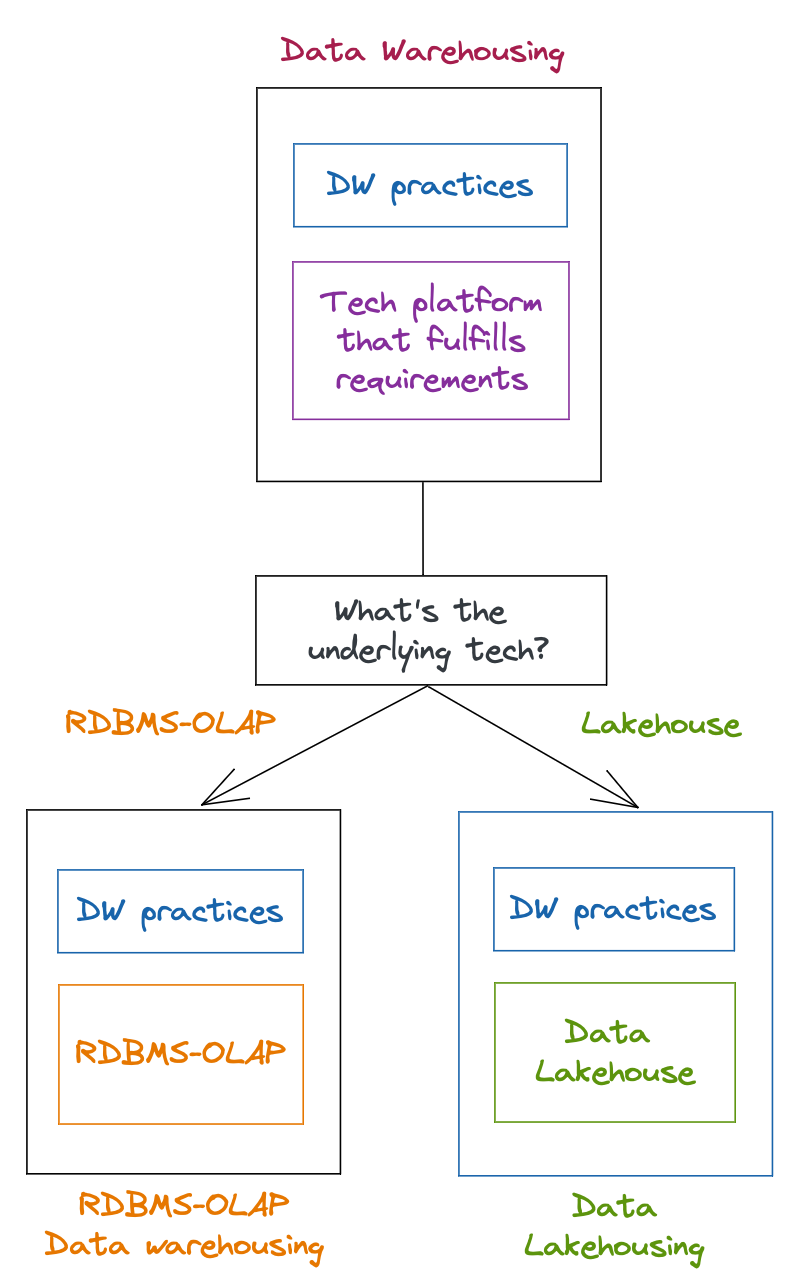
Relational Database Management Systems designed for Online Analytical Processing (RDBMS-OLAP) have been foundational to democratizing data and enabling analytical use cases such as business intelligence and reporting for many years. However, RDBMS-OLAP systems present some well-known challenges. They are primarily optimized only for relational workloads, lead to proliferation of data copies which can become unmanageable, and since the data is stored in proprietary formats, it can lead to vendor lock-in, restricting access to engines, tools, and capabilities beyond what the vendor offers. As the demand for data-driven decision making surges, the need for a more robust data architecture to address these challenges becomes ever more critical. Cloud data lakes have addressed some of the shortcomings of RDBMS-OLAP systems, but they present their own set of challenges. More recently, organizations have often followed a two-tier architectural approach to take advantage of both these platforms, leveraging both cloud data lakes and RDBMS-OLAP systems. However, this approach brings additional challenges, complexities, and overhead. This paper discusses how a data lakehouse, a new architectural approach, achieves the same benefits of an RDBMS-OLAP and cloud data lake combined, while also providing additional advantages. We take today's data warehousing and break it down into implementation independent components, capabilities, and practices. We then take these aspects and show how a lakehouse architecture satisfies them. Then, we go a step further and discuss what additional capabilities and benefits a lakehouse architecture provides over an RDBMS-OLAP.
Motivation & Objective
- Address the limitations of traditional RDBMS-OLAP systems, such as vendor lock-in, data duplication, and proprietary formats.
- Overcome the shortcomings of cloud data lakes, including lack of ACID transactions, inconsistent data governance, and limited support for complex analytical workloads.
- Unify the capabilities of data warehousing (e.g., data modeling, ETL/ELT, data quality) with the scalability and open nature of data lakes.
- Enable a single, open, and future-proof data architecture that supports diverse analytical workloads—BI, machine learning, and real-time analytics—on a single copy of data.
- Demonstrate that a lakehouse architecture can deliver equivalent or superior capabilities to traditional data warehousing while reducing complexity and cost.
Proposed method
- Decompose traditional data warehousing into technology-agnostic components: technical components (e.g., storage, compute), technical capabilities (e.g., ACID, SQL), and technology-independent practices (e.g., data modeling, ETL).
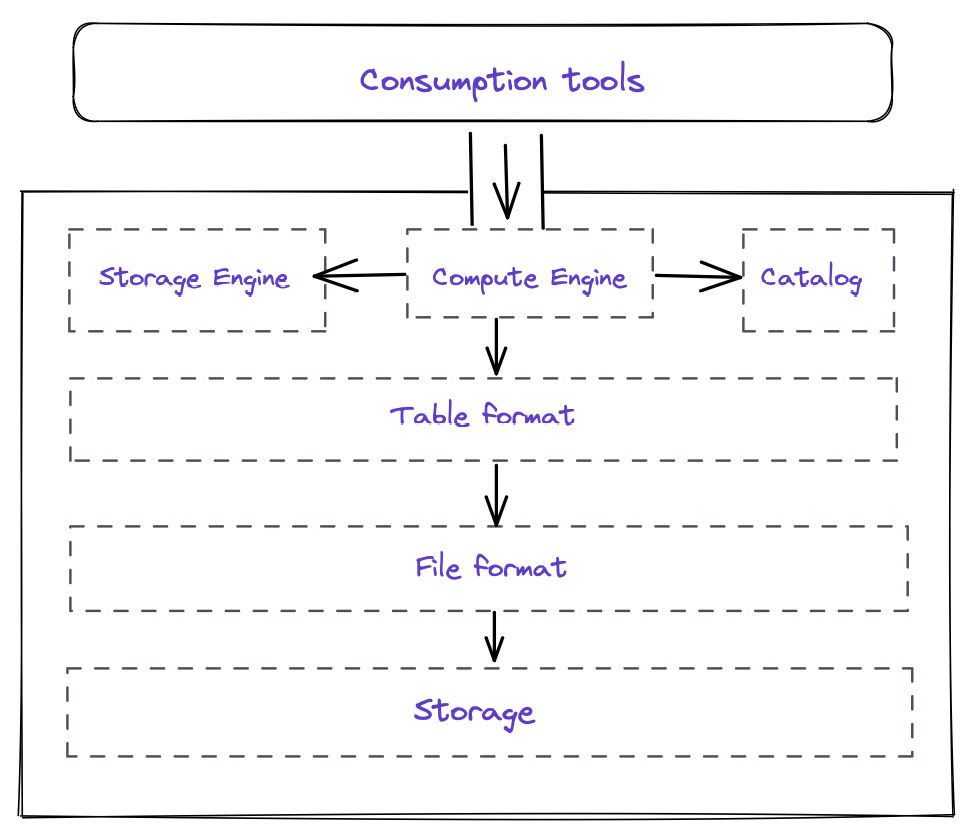
- Implement a lakehouse using open table formats such as Apache Iceberg to provide ACID transactions, schema evolution, and time travel on data stored in cloud object storage (e.g., S3).
- Integrate a catalog system (e.g., Project Nessie) to manage metadata and enable Git-like versioning for data environments (dev, prod), enhancing data governance and isolation.
- Use a SQL-based distributed query engine (e.g., Dremio Sonar) to enable low-latency, interactive analytics directly on Iceberg tables in the data lake.
- Enable machine learning workloads by exposing the same Iceberg table to Apache Spark and scikit-learn, eliminating the need for ETL pipelines or data movement.
- Demonstrate end-to-end analytics using live queries for BI dashboards and model training for churn prediction, both operating on the same data source.
Experimental results
Research questions
- RQ1Can a data lakehouse architecture replicate the core technical and operational capabilities of a traditional RDBMS-OLAP data warehouse?
- RQ2How can a lakehouse support both business intelligence and machine learning workloads on a single, unified data platform without data duplication?
- RQ3To what extent does a lakehouse reduce vendor lock-in and improve data governance compared to traditional data warehousing or raw data lakes?
- RQ4What architectural patterns enable ACID transactions and consistent data access in a cloud-native, open-format data lake?
- RQ5How does the open, extensible nature of a lakehouse support future extensibility and tool interoperability across analytical workloads?
Key findings
- A data lakehouse natively supports ACID transactions, schema evolution, and time travel through open table formats like Apache Iceberg, enabling reliable and consistent data access.
- The integration of a catalog system like Project Nessie enables Git-like versioning and environment isolation, significantly improving data governance and operational agility.
- Business intelligence workloads can be executed directly on Iceberg tables using a SQL engine like Dremio Sonar, achieving low-latency, interactive query performance without data movement.
- Machine learning pipelines can consume data directly from the lakehouse using Apache Spark, eliminating the need for ETL pipelines and reducing latency and engineering overhead.
- The unified architecture enables concurrent execution of BI and ML workloads on the same dataset, reducing data duplication and improving data consistency.
- The open nature of the lakehouse architecture allows multiple analytical engines (e.g., Dremio, Spark) to coexist and interoperate on the same data, reducing vendor lock-in and increasing tool flexibility.
Read this paper
Open the full text in the Nubint reader and ask about any passage as you read.
Read this paper on NubintThis review was generated by AI from the original paper. Please check the paper before citing it.