
[Paper Review] The dilemma of quantum neural networks
This paper investigates the generalization and trainability of quantum neural networks (QNNs) through systematic numerical experiments on real-world datasets. It finds that current QNNs suffer from limited effective model capacity and ineffective regularization, failing to outperform classical deep learning models, which challenges their quantum advantage in practical applications.
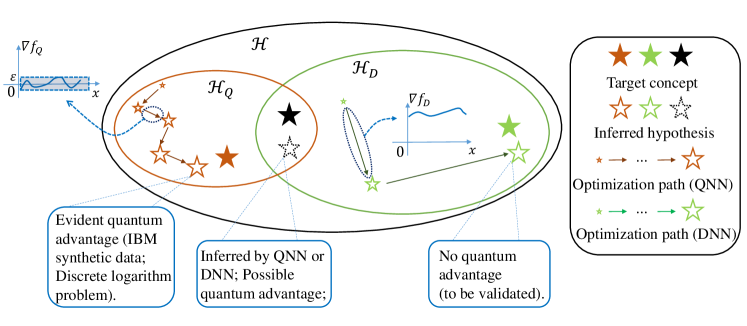
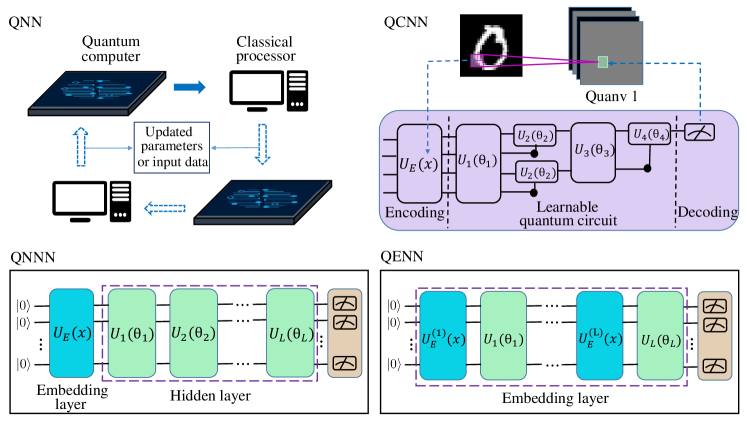
The core of quantum machine learning is to devise quantum models with good trainability and low generalization error bound than their classical counterparts to ensure better reliability and interpretability. Recent studies confirmed that quantum neural networks (QNNs) have the ability to achieve this goal on specific datasets. With this regard, it is of great importance to understand whether these advantages are still preserved on real-world tasks. Through systematic numerical experiments, we empirically observe that current QNNs fail to provide any benefit over classical learning models. Concretely, our results deliver two key messages. First, QNNs suffer from the severely limited effective model capacity, which incurs poor generalization on real-world datasets. Second, the trainability of QNNs is insensitive to regularization techniques, which sharply contrasts with the classical scenario. These empirical results force us to rethink the role of current QNNs and to design novel protocols for solving real-world problems with quantum advantages.
Motivation & Objective
- To evaluate whether current quantum neural networks (QNNs) can achieve computational advantages over classical deep learning models on real-world datasets.
- To investigate the root causes behind QNNs' poor performance, focusing on model capacity and trainability.
- To assess the effectiveness of classical regularization techniques—like weight decay—on QNN optimization.
- To examine the impact of quantum noise on QNN training performance in NISQ-era hardware.
- To provide a standardized open-source benchmark for fair and comprehensive evaluation of QNNs.
Proposed method
- Conduct systematic numerical experiments comparing QNNs and classical deep neural networks (DNNs) on multiple real-world datasets.
- Measure generalization error using the empirical risk difference: $ \left| \hat{\mathcal{R}}_S(\hat{\bm{\theta}}) - \mathcal{R}(\hat{\bm{\theta}}) \right| $, where $ \hat{\mathcal{R}}_S $ is empirical risk and $ \mathcal{R} $ is expected risk.
- Apply standard regularization techniques such as weight decay, defined as $ \arg\min_{\bm{\theta}} \mathcal{L}(\bm{\theta}) = \frac{1}{n}\sum_{i=1}^{n}\ell(y^{(i)},\hat{y}^{(i)}) + \lambda\|\bm{\theta}\| $, to assess their impact on QNN optimization.
- Evaluate QNN performance under noisy NISQ conditions by simulating quantum noise effects on circuit execution.
- Implement a factory method-based software framework to enable extensible model registration and standardized benchmarking.
- Compare training and inference runtime costs between QNNs and classical MLPs across noiseless and noisy settings.
Experimental results
Research questions
- RQ1Do current QNNs generalize better than classical deep learning models on real-world datasets?
- RQ2Why do QNNs fail to outperform classical models despite theoretical advantages on synthetic data?
- RQ3How effective are classical regularization techniques like weight decay in improving QNN trainability?
- RQ4To what extent does quantum noise in NISQ devices degrade QNN performance?
- RQ5Can statistical learning theory be used to identify the fundamental limitations of QNNs in real-world learning tasks?
Key findings
- QNNs exhibit severely limited effective model capacity, leading to poor generalization on real-world datasets, which explains their failure to outperform classical models.
- Regularization techniques such as weight decay have minimal impact on QNN trainability, in stark contrast to their effectiveness in classical deep learning.
- Quantum noise in NISQ devices causes approximately a 10% drop in test accuracy, significantly degrading QNN performance.
- Training QNNs on NISQ hardware is computationally expensive, requiring up to 126 seconds per iteration, compared to 4 seconds for noiseless QNNs and 0.02 seconds for classical MLPs.
- The SGD optimizer with appropriate batch size provides slight improvements in QNN optimization, but overfitting emerges after 40 epochs despite regularization.
- The study provides an open-source benchmark with standardized datasets, models, and evaluation scripts to enable fair and extensible QNN evaluation.
Read this paper
Open the full text in the Nubint reader and ask about any passage as you read.
Read this paper on NubintThis review was generated by AI from the original paper. Please check the paper before citing it.