
[Paper Review] The discrete direct deconvolution model in the large eddy simulation of turbulence
This paper proposes the Discrete Direct Deconvolution Model (D3M) for large eddy simulation (LES) of turbulence, using discrete approximations of the inverse Gaussian filter to reconstruct sub-filter scale (SFS) stresses. D3M-1 and D3M-2 achieve higher correlation coefficients and lower relative errors than dynamic Smagorinsky (DSM) and dynamic mixed models (DMM), accurately predicting turbulence statistics and spatial structures in turbulent mixing layers.
The discrete direct deconvolution model (D3M) is developed for the large-eddy simulation (LES) of turbulence. The D3M is a discrete approximation of previous direct deconvolution model studied by Chang et al. ["The effect of sub-filter scale dynamics in large eddy simulation of turbulence," Phys. Fluids 34, 095104 (2022)]. For the first type model D3M-1, the original Gaussian filter is approximated by local discrete formulation of different orders, and direct inverse of the discrete filter is applied to reconstruct the unfiltered flow field. The inverse of original Gaussian filter can be also approximated by local discrete formulation, leading to a fully local model D3M-2. Compared to traditional models including the dynamic Smagorinsky model (DSM) and the dynamic mixed model (DMM), the D3M-1 and D3M-2 exhibit much larger correlation coefficients and smaller relative errors in the a priori studies. In the a posteriori validations, both D3M-1 and D3M-2 can accurately predict turbulence statistics, including velocity spectra, probability density functions (PDFs) of sub-filter scale (SFS) stresses and SFS energy flux, as well as time-evolving kinetic energy spectra, momentum thickness, and Reynolds stresses in turbulent mixing layer. Moreover, the proposed model can also well capture spatial structures of the Q-criterion iso surfaces. Thus, the D3M holds potential as an effective SFS modeling approach in turbulence simulations.
Motivation & Objective
- To develop a discrete, fully local alternative to continuous direct deconvolution models for large eddy simulation (LES) of turbulence.
- To improve sub-filter scale (SFS) stress reconstruction by approximating the inverse of the Gaussian filter using local discrete formulations.
- To evaluate the performance of the proposed D3M models against established dynamic models (DSM and DMM) in both a priori and a posteriori studies.
- To enable accurate prediction of turbulence statistics, including velocity spectra, SFS energy flux, and Reynolds stresses, in complex flows like turbulent mixing layers.
- To demonstrate the model's ability to capture coherent spatial structures, such as Q-criterion iso-surfaces, in turbulent flows.
Proposed method
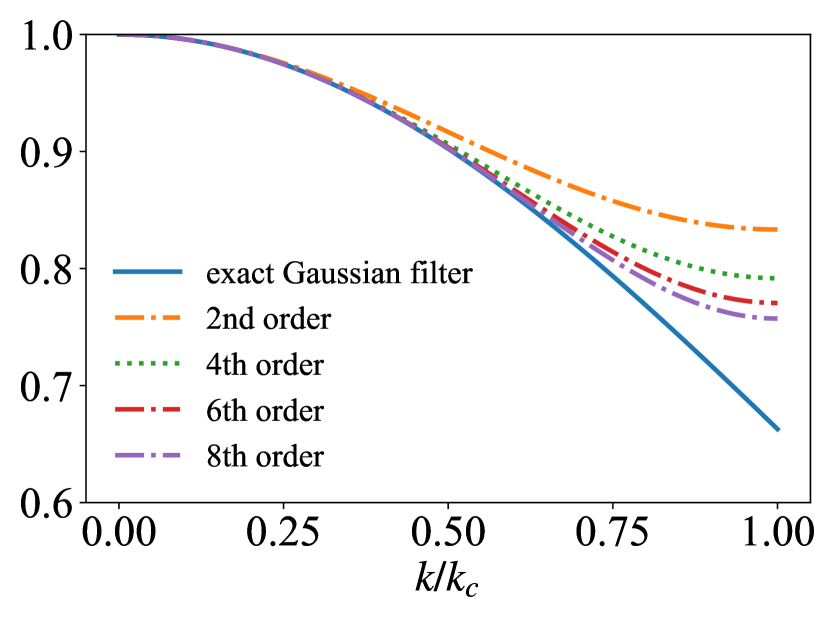
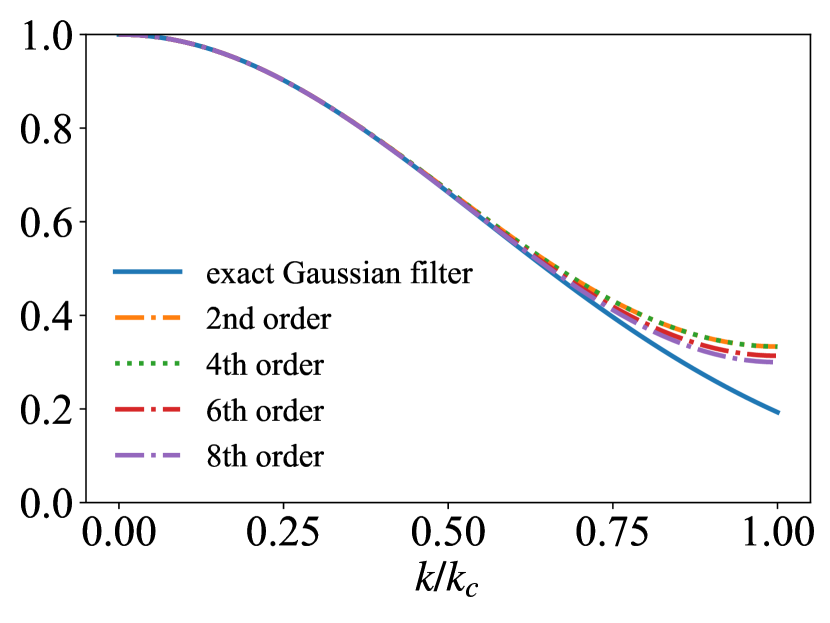
- D3M-1 uses a local discrete formulation to approximate the original Gaussian filter and applies the direct inverse of this discrete filter to reconstruct the unfiltered flow field.
- D3M-2 further approximates the inverse of the original Gaussian filter using a local discrete formulation, resulting in a fully local model without requiring global operations.
- The discrete filter and its inverse are constructed using finite-difference-like stencils, enabling efficient and localized computation in physical space.
- The models are validated using a priori and a posteriori tests on turbulent mixing layer simulations with spectral methods and 2/3 de-aliasing to reduce numerical errors.
- Dynamic model coefficients in DSM and DMM are computed via least-squares minimization using test-filtered fields at multiple scales.
- The framework employs pseudo-spectral methods for efficient computation of convolutions and nonlinear terms, with inverse Fourier transforms used to return to physical space.
Experimental results
Research questions
- RQ1Can a discrete, local approximation of the direct deconvolution model outperform traditional dynamic SFS models in reconstructing sub-filter scale stresses?
- RQ2How do the correlation coefficients and relative errors of D3M-1 and D3M-2 compare to those of DSM and DMM in a priori assessments?
- RQ3To what extent can D3M accurately predict key turbulence statistics such as velocity spectra, PDFs of SFS stresses, and SFS energy flux?
- RQ4Can the D3M models resolve complex spatial structures, such as Q-criterion iso-surfaces, in turbulent mixing layers?
- RQ5Does the fully local formulation of D3M-2 maintain accuracy while improving computational efficiency over non-local or global deconvolution approaches?
Key findings
- D3M-1 and D3M-2 exhibit significantly higher correlation coefficients and lower relative errors than DSM and DMM in a priori studies, indicating superior SFS stress reconstruction.
- In a posteriori simulations, both D3M models accurately predict the velocity spectra, probability density functions (PDFs) of SFS stresses, and SFS energy flux in turbulent mixing layers.
- The models successfully capture time-evolving kinetic energy spectra, momentum thickness, and Reynolds stresses with high fidelity.
- D3M-2 demonstrates the ability to resolve spatial structures of Q-criterion iso-surfaces, indicating accurate representation of coherent turbulent eddies.
- The discrete and fully local nature of D3M-2 enables efficient computation while maintaining accuracy comparable to non-local or continuous deconvolution models.
- The results confirm that D3M is a promising, effective approach for sub-filter scale modeling in large eddy simulations of turbulence.
Read this paper
Open the full text in the Nubint reader and ask about any passage as you read.
Read this paper on NubintThis review was generated by AI from the original paper. Please check the paper before citing it.