
[Paper Review] The Dynamic Radio Sky: An Opportunity for Discovery
This paper advocates for systematic time-domain radio surveys to uncover new transient phenomena, proposing that next-generation telescopes with enhanced sensitivity, wide fields of view, and real-time processing will reveal unknown radio sources—such as rotating radio transients, orphan gamma-ray burst afterglows, and potential extraterrestrial signals—by exploiting dynamic sky parameter space across timescales from nanoseconds to years.
The time domain of the sky has been only sparsely explored. Nevertheless, recent discoveries from limited surveys and serendipitous discoveries indicate that there is much to be found on timescales from nanoseconds to years and at wavelengths from meters to millimeters. These observations have revealed unexpected phenomena such as rotating radio transients and coherent pulses from brown dwarfs. Additionally, archival studies have found not-yet identified radio transients without optical or high-energy hosts. In addition to the known classes of radio transients, possible other classes of objects include extrapolations from known classes and exotica such as orphan gamma-ray burst afterglows, radio supernovae, tidally-disrupted stars, flare stars, magnetars, and transmissions from extraterrestrial civilizations. Over the next decade, meter- and centimeter-wave radio telescopes with improved sensitivity, wider fields of view, and flexible digital signal processing will be able to explore radio transient parameter space more comprehensively and systematically.
Motivation & Objective
- To identify and explore the vast, underexplored parameter space of transient radio phenomena across timescales from nanoseconds to years.
- To address the limitations of traditional radio surveys by emphasizing time-domain processing and dynamic sky monitoring.
- To enable discovery of new astrophysical sources, including exotic classes like orphan gamma-ray burst afterglows and potential extraterrestrial signals.
- To improve transient detection through algorithmic advances and optimized telescope configurations with high sensitivity and wide fields of view.
- To position time-domain radio astronomy as a critical frontier for future transformational discoveries in astrophysics and cosmology.
Proposed method
- Utilize explicit time-domain data processing to detect transient signals, especially single dispersed pulses, in real time or via reanalysis of archival data.
- Implement advanced algorithms for transient identification, classification, and RFI excision to handle the high data volume and interference challenges.
- Leverage telescopes with improved sensitivity (A_eff/T_sys), wider fields of view (Ω), and flexible digital signal processing to maximize transient detection figure of merit (FoM_t).
- Apply the transient detection figure of merit FoM_t = Ω(A_eff/T_sys)^2 K(ηW, τW), where K accounts for detection likelihood based on event rate and duration.
- Integrate interferometric systems (e.g., ASKAP, EVLA, LOFAR, MWA) into time-domain surveys to gain high positional accuracy for multi-wavelength follow-up.
- Employ phased-array feeds and sub-arraying techniques to significantly expand field of view (up to 100 deg²) and sensitivity for transient detection.
Experimental results
Research questions
- RQ1What new classes of radio transients remain undetected due to their sporadic or brief emission, and how can they be systematically discovered?
- RQ2How do transient phenomena such as rotating radio transients and giant pulses from neutron stars challenge existing models of pulsar emission and neutron star physics?
- RQ3To what extent can radio surveys detect orphan gamma-ray burst afterglows or other electromagnetic counterparts to gravitational wave events?
- RQ4Can radio observations detect non-repeating signals consistent with extraterrestrial civilizations, even if the signals are not continuous?
- RQ5What is the optimal balance between sensitivity (A_eff/T_sys) and field of view (Ω) for maximizing detection of diverse transient populations?
Key findings
- Rotating Radio Transients (RRATs) represent a new class of neutron stars detectable only through isolated, dispersed radio pulses, with 30 known sources as of the paper’s writing.
- RRATs exhibit average pulse rates of (3 min)⁻¹ to (3 hr)⁻¹, with periods between 0.7 and 7 seconds, confirming their neutron star origin despite sporadic emission.
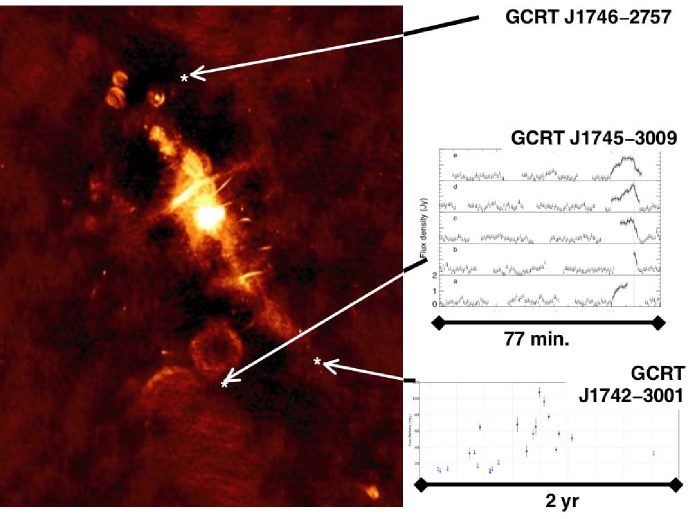
- The sky is significantly more dynamic than previously thought, with serendipitous discoveries of transients in regions like the Galactic center and from brown dwarfs emitting coherent pulses.
- Archival studies have revealed radio transients without optical or high-energy counterparts, indicating the existence of unclassified transient populations.
- Theoretical models suggest that transient phenomena may arise from known physics extrapolated (e.g., radio supernovae, tidal disruption events) or from exotic sources (e.g., annihilating black holes, ET signals).
- Next-generation instruments such as ASKAP, EVLA, LOFAR, and the future SKA are expected to dramatically improve transient detection by combining high sensitivity, wide fields of view, and real-time processing.
Better researchstarts right now
From reading papers to final review, dramatically reduce your research time.
No credit card · Free plan available
This review was created by AI and reviewed by human editors.