
[Paper Review] The Effective Vector Boson Approximation in High-Energy Muon Collisions
This paper establishes the validity of the Effective Vector Boson Approximation (EWVA) in high-energy muon collisions by deriving polarized and unpolarized weak boson parton distribution functions (PDFs) for W and Z bosons in the collinear limit. It implements these PDFs in MadGraph5_aMC@NLO, enabling accurate simulations of 2→n processes at √s = 2–30 TeV, and provides a framework for matching with electroweak parton showers and renormalized PDFs, with explicit corrections for power and logarithmic effects.
Due to the inclination for forward gauge radiation, lepton colliders beyond a few TeV are effectively electroweak (EW) boson colliders, suggesting the treatment of EW bosons as constituents of high-energy leptons. In the context of a muon collider, we revisit the validity of $W$ and $Z$ parton distribution functions (PDFs) at leading order in $2 o n$ process. We systematically investigate universal and quasi-universal power-law and logarithmic corrections that arise when deriving (polarized) weak boson PDFs in the collinear limit. We go on to survey a multitude of $2 o n$ processes at $\sqrt{s}=2-30$ TeV via polarized and unpolarized EW boson fusion/scattering. To conduct this study, we report a public implementation of the Effective $W/Z$ and Weizsäcker-Williams Approximations, which we collectively call the Effective Vector Boson Approximation, into the Monte Carlo event generator exttt{MadGraph5\_aMC@NLO}. This implementation lays the groundwork for developing matrix-element matching prescriptions involving EW parton showers and renormalized EW PDFs. To further with this agenda, we give recommendations on using $W/Z$ PDFs.
Motivation & Objective
- To assess the validity of the Effective Vector Boson Approximation (EWA) in high-energy muon collisions, particularly for W and Z boson parton distribution functions (PDFs) in the collinear limit.
- To systematically analyze universal and quasi-universal power-law and logarithmic corrections arising in the derivation of polarized weak boson PDFs.
- To enable accurate simulation of 2→n electroweak processes at √s = 2–30 TeV via a public implementation in MadGraph5_aMC@NLO.
- To lay the groundwork for future matrix-element matching with electroweak parton showers and renormalized weak boson PDFs.
- To provide practical recommendations for the use of W/Z PDFs in high-energy collider phenomenology.
Proposed method
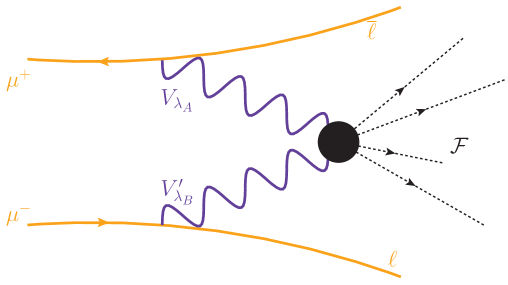
- Derives collinear, polarized weak boson PDFs from matrix elements of μ → Vℓ splitting processes, using momentum fraction z and evolution variables q² and pT².
- Introduces two types of PDFs: q²-dependent PDFs ˜f from virtuality integration and pT²-dependent PDFs ˜h from transverse momentum integration.
- Constructs the total cross section via convolution of weak boson PDFs with partonic cross sections, including explicit power and logarithmic corrections.
- Implements the Effective Vector Boson Approximation (EWA) and Weizsäcker-Williams Approximation in MadGraph5_aMC@NLO as a public tool for high-energy electroweak processes.
- Performs a survey of 2→n processes across √s = 2–30 TeV to validate the EWA framework under polarized and unpolarized conditions.
- Derives evolution integrals over q² and pT² to define physical PDFs at scale μf, with explicit expressions in Eqs. (B.83)–(B.86).
Experimental results
Research questions
- RQ1What are the dominant power-law and logarithmic corrections in the collinear limit when deriving weak boson PDFs from high-energy muons?
- RQ2How accurate is the Effective Vector Boson Approximation for W and Z bosons in 2→n processes at √s = 2–30 TeV in muon colliders?
- RQ3To what extent do polarization, transverse momentum, and interference effects affect the validity of the EWA in high-energy electroweak scattering?
- RQ4Can the EWA be consistently matched with electroweak parton showers using renormalized weak boson PDFs?
- RQ5What are the practical implications and recommendations for using W/Z PDFs in future high-energy collider simulations?
Key findings
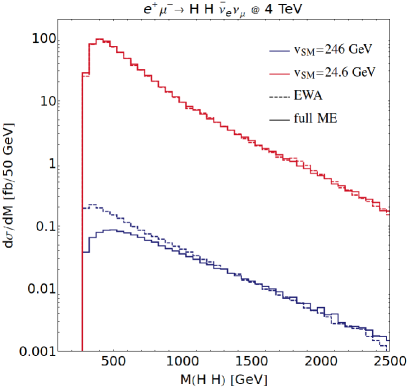
- The Effective Vector Boson Approximation is valid for 2→n processes at √s = 2–30 TeV in muon colliders, with power corrections scaling as O(pT²/Q²) and O(MV²/Q²), and logarithmic corrections as O(log(μf²/MV²)).
- Polarized and unpolarized weak boson PDFs are derived and implemented in MadGraph5_aMC@NLO, enabling accurate simulation of electroweak processes with full control over scale and factorization scale dependence.
- The framework allows for the consistent treatment of collinear factorization in electroweak theory, even though muons carry weak isospin charges, breaking full SU(2)L invariance.
- The derived PDFs are functions of momentum fraction z and evolution scale μf, with explicit expressions for both q²- and pT²-integrated distributions in Eqs. (B.83)–(B.86).
- The study shows that at high energies, the VBF rate dominates, making muon colliders effectively high-luminosity electroweak boson colliders, ideal for probing SM and BSM physics.
- The implementation provides a foundation for future matrix-element matching with electroweak parton showers and for the development of renormalized weak boson PDFs in precision calculations.
Read this paper
Open the full text in the Nubint reader and ask about any passage as you read.
Read this paper on NubintThis review was generated by AI from the original paper. Please check the paper before citing it.