
[Paper Review] The Effectiveness of LLMs as Annotators: A Comparative Overview and Empirical Analysis of Direct Representation
This paper evaluates large language models (LLMs), particularly GPT-3.5-turbo, as direct annotators by comparing their predicted opinion distributions to human-annotated distributions across four subjective NLP datasets from the 2023 SemEval task. It finds that LLMs exhibit significant bias, especially toward assigning high confidence to offensive classes, and perform notably worse on non-English text, with lower F1 scores and higher entropy than humans, indicating poor alignment with human labeling patterns.
Large Language Models (LLMs) have emerged as powerful support tools across various natural language tasks and a range of application domains. Recent studies focus on exploring their capabilities for data annotation. This paper provides a comparative overview of twelve studies investigating the potential of LLMs in labelling data. While the models demonstrate promising cost and time-saving benefits, there exist considerable limitations, such as representativeness, bias, sensitivity to prompt variations and English language preference. Leveraging insights from these studies, our empirical analysis further examines the alignment between human and GPT-generated opinion distributions across four subjective datasets. In contrast to the studies examining representation, our methodology directly obtains the opinion distribution from GPT. Our analysis thereby supports the minority of studies that are considering diverse perspectives when evaluating data annotation tasks and highlights the need for further research in this direction.
Motivation & Objective
- To assess the effectiveness of LLMs as direct annotators by comparing their predicted opinion distributions to human-annotated distributions.
- To investigate whether LLMs can accurately represent human disagreement in subjective classification tasks.
- To examine the impact of language (English vs. Arabic) on LLM annotation performance and bias.
- To evaluate the alignment between human and LLM-generated opinion distributions using entropy and F1 metrics.
- To identify limitations in LLMs' ability to model nuanced human perspectives in data annotation.
Proposed method
- The study directly prompts GPT-3.5-turbo to output opinion distributions (e.g., probabilities for 'offensive' and 'not offensive' classes) for each sample in four SemEval 2023 subjective datasets.
- Human opinion distributions are derived from majority voting across human annotators on the same datasets.
- Performance is evaluated using F1 score and cross-entropy (CE) loss to compare LLM predictions against human baselines.
- Entropy is computed for both human and LLM distributions to assess uncertainty and distributional alignment.
- Error types (false positive and false negative) are categorized to analyze bias patterns in LLM predictions.
- The analysis compares results across English and Arabic prompts to assess language-dependent performance and bias.
Experimental results
Research questions
- RQ1To what extent do LLMs produce opinion distributions that align with human-annotated distributions in subjective NLP tasks?
- RQ2How does the performance of LLMs as annotators vary between English and non-English language inputs?
- RQ3What is the nature and magnitude of bias in LLM-generated opinion distributions, particularly toward offensive class labels?
- RQ4How do entropy levels of LLM-generated distributions compare to those of human-annotated distributions?
- RQ5Can direct prompting of LLMs to output opinion distributions effectively capture human disagreement in annotation tasks?
Key findings
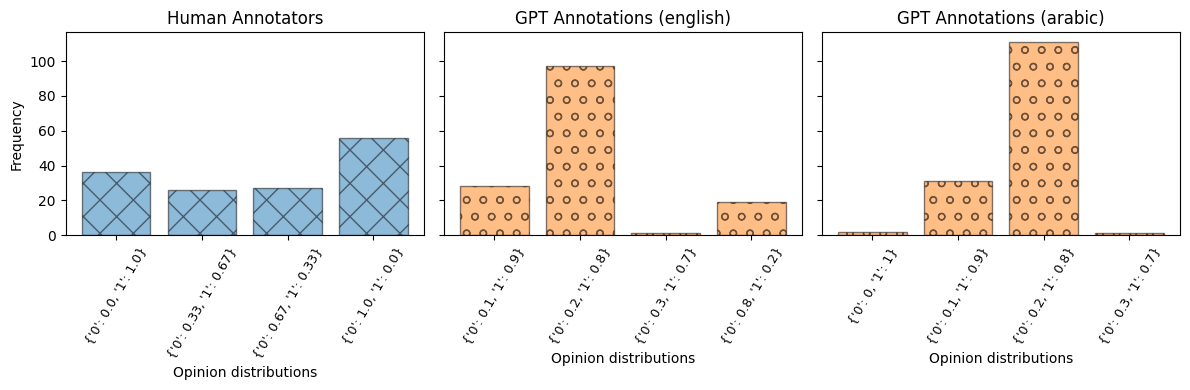
- GPT-3.5-turbo exhibits a strong bias toward assigning high confidence to the offensive class, particularly when prompted with Arabic text, resulting in 100% false positive errors on the HS-Brexit dataset.
- The model's F1 score drops significantly on Arabic prompts (0.256) compared to English prompts (0.448), indicating language-specific performance degradation.
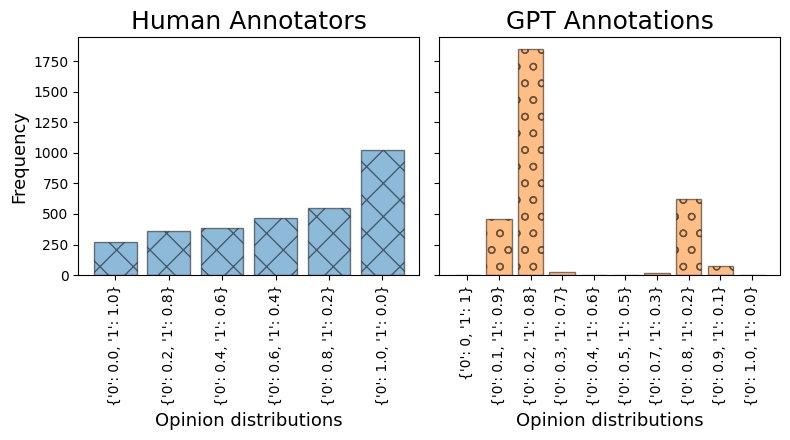
- LLM-generated opinion distributions show higher average entropy than human distributions, indicating greater uncertainty and less concentration on a single label.
- The model consistently produces bimodal distributions favoring {'0':0.2, '1':0.8} and {'0':0.8, '1':0.2}, diverging from human consensus patterns.
- Despite matching baseline performance in some cases, GPT-3.5-turbo consistently underperforms fine-tuned models on both F1 and cross-entropy metrics.
- The study confirms that direct prompting of LLMs to output opinion distributions leads to misalignment with human labeling, especially in non-English contexts and for sensitive content.
Read this paper
Open the full text in the Nubint reader and ask about any passage as you read.
Read this paper on NubintThis review was generated by AI from the original paper. Please check the paper before citing it.