
[Paper Review] The Faiss library
Faiss is an industrial-grade toolkit for vector similarity search that provides a flexible set of indexing, compression, and non-exhaustive search methods, with a benchmarking framework to explore Pareto-optimal tradeoffs between accuracy, speed, and memory.
Vector databases typically manage large collections of embedding vectors. Currently, AI applications are growing rapidly, and so is the number of embeddings that need to be stored and indexed. The Faiss library is dedicated to vector similarity search, a core functionality of vector databases. Faiss is a toolkit of indexing methods and related primitives used to search, cluster, compress and transform vectors. This paper describes the trade-off space of vector search and the design principles of Faiss in terms of structure, approach to optimization and interfacing. We benchmark key features of the library and discuss a few selected applications to highlight its broad applicability.
Motivation & Objective
- Explain the design principles and tradeoffs in vector similarity search.
- Describe the architecture and components of Faiss as a toolbox rather than a single method.
- Show how compression and non-exhaustive search enable scalable high-accuracy ANN in practice.
- Present benchmarking approaches and applications to illustrate broad Faiss applicability.
Proposed method
- Describe the tradeoff space of vector search and Faiss design principles.
- Explain the two main tools—vector compression and non-exhaustive search—and how they enable flexible indexing.
- Outline the library structure, interfaces, and how Faiss can be used as a building block or scriptable tool.
- Introduce the benchmarking framework that searches Pareto-optimal configurations of index components.
- Discuss preprocessing and encoding choices (e.g., PCA, OPQ) and their impact on accuracy and efficiency.
Experimental results
Research questions
- RQ1What are the essential tradeoffs in vector similarity search relevant to Faiss?
- RQ2How do compression and non-exhaustive search contribute to scalable ANN performance in Faiss?
- RQ3How can Faiss indices be configured to balance accuracy, speed, and memory under different constraints?
- RQ4What preprocessing and encoding strategies improve ANN performance in Faiss?
- RQ5How does Faiss integrate with downstream systems and real-world applications?
Key findings
- Faiss exposes a design space where accuracy, memory, and speed can be traded off via compression and non-exhaustive search options.
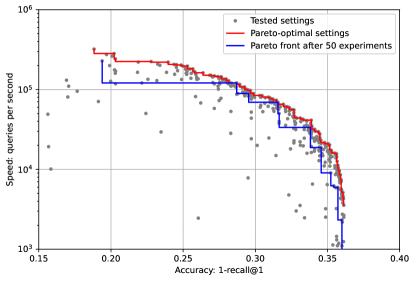
- A benchmarking framework can prune large parameter spaces to Pareto-optimal configurations for given constraints.
- Faiss supports both CPU and GPU search and a range of index types that can be composed for different scales and use-cases.
- Preprocessing transformations (e.g., PCA, random rotations, OPQ) improve quantizer effectiveness and retrieval accuracy.
- The library is demonstrated across applications including trillion-scale indexing, text retrieval, data mining, and content moderation.
Better researchstarts right now
From paper design to paper writing, dramatically reduce your research time.
No credit card · Free plan available
This review was created by AI and reviewed by human editors.