
[Paper Review] The Feasibility and Inevitability of Stealth Attacks
This paper demonstrates that stealth attacks—where an attacker modifies an AI model's weights without altering its performance on unseen data—are not only feasible but increasingly inevitable in modern deep learning systems. By exploiting over-parameterization and high-dimensional latent spaces, the authors show that a single-neuron modification can enable full control over model outputs on specific triggers, with near-certain success under mild assumptions, revealing a critical vulnerability in model sharing and deployment pipelines.
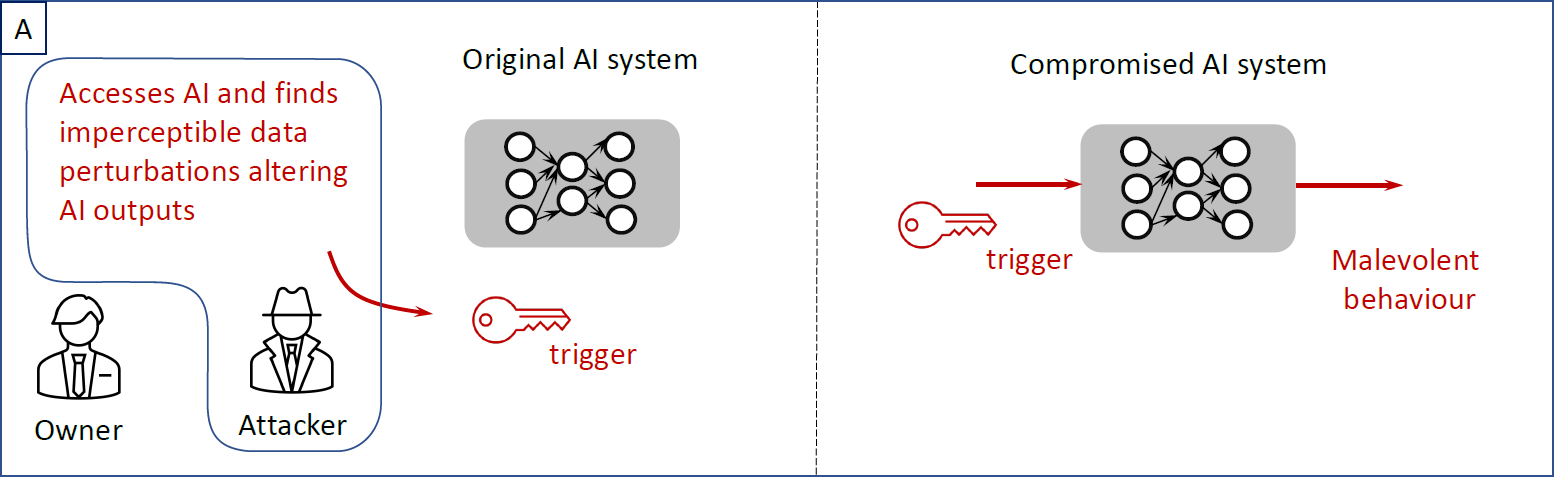
We develop and study new adversarial perturbations that enable an attacker to gain control over decisions in generic Artificial Intelligence (AI) systems including deep learning neural networks. In contrast to adversarial data modification, the attack mechanism we consider here involves alterations to the AI system itself. Such a stealth attack could be conducted by a mischievous, corrupt or disgruntled member of a software development team. It could also be made by those wishing to exploit a ``democratization of AI'' agenda, where network architectures and trained parameter sets are shared publicly. We develop a range of new implementable attack strategies with accompanying analysis, showing that with high probability a stealth attack can be made transparent, in the sense that system performance is unchanged on a fixed validation set which is unknown to the attacker, while evoking any desired output on a trigger input of interest. The attacker only needs to have estimates of the size of the validation set and the spread of the AI's relevant latent space. In the case of deep learning neural networks, we show that a one neuron attack is possible - a modification to the weights and bias associated with a single neuron - revealing a vulnerability arising from over-parameterization. We illustrate these concepts using state of the art architectures on two standard image data sets. Guided by the theory and computational results, we also propose strategies to guard against stealth attacks.
Motivation & Objective
- To investigate the feasibility and inevitability of stealth attacks that modify AI models without degrading performance on validation data.
- To develop implementable attack strategies that manipulate model behavior on specific triggers while remaining undetected on a fixed, unknown validation set.
- To analyze the theoretical probability of success for such attacks under varying constraints on model structure, trigger design, and attack accuracy.
- To identify design-level vulnerabilities in deep learning models that enable these attacks, particularly in over-parameterized architectures.
- To propose practical defense strategies based on model architecture, pruning, and hashing to mitigate the risk of such stealth compromises.
Proposed method
- The authors introduce a general open-box stealth attack framework where the attacker modifies model parameters (e.g., weights and biases) to induce a desired output on a trigger input while preserving performance on a fixed, unknown validation set.
- They develop three algorithmic strategies: (1) trigger design within a ball containing validation set representations; (2) camouflage of triggers to resemble legitimate data by aligning latent representations; and (3) constrained attacks within low-dimensional subspaces of the latent space.
- Theoretical analysis relies on concentration of measure in high dimensions, showing that attack success probability approaches one as latent space dimension increases, even with minimal perturbations.
- Key theoretical bounds (Theorems 1–3) quantify success likelihoods based on model dimensionality, attack accuracy (parameterized by α), and reachability conditions.
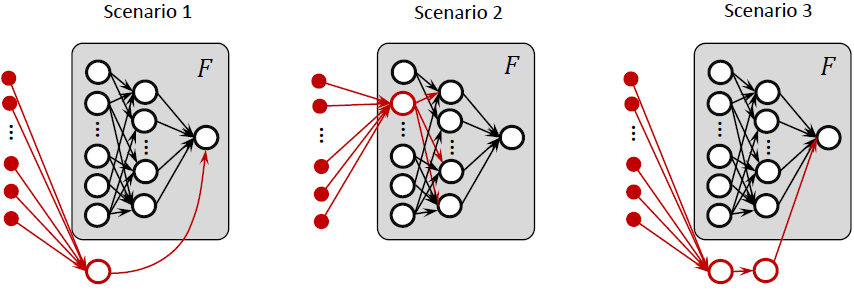
- The method includes a one-neuron attack strategy, proving that modifying just a single neuron’s weights and bias can fully control output on a trigger input.
- Empirical validation is conducted on state-of-the-art image classification models (e.g., ResNet, DenseNet) using CIFAR-10 and ImageNet, demonstrating high feasibility of one-neuron attacks.
Experimental results
Research questions
- RQ1Can an attacker modify a deep learning model’s parameters to induce arbitrary outputs on a specific trigger input while maintaining identical performance on an unknown validation set?
- RQ2What is the theoretical likelihood of success for such stealth attacks, and how does it depend on the dimensionality of the model’s latent space?
- RQ3How can attack triggers be designed to appear legitimate by aligning their latent representations with those of real data samples?
- RQ4To what extent can stealth attacks succeed even with low-accuracy trigger generation, particularly in low-dimensional subspaces?
- RQ5What model design and deployment practices can effectively mitigate the risk of such stealth compromises?
Key findings
- The probability of successful stealth attack approaches one as the dimension of the model’s latent space increases, even with minimal perturbations, demonstrating the inevitability of such attacks in high-dimensional models.
- A one-neuron attack is theoretically and empirically feasible: modifying just a single neuron’s weights and bias can fully control the model’s output on a trigger input while preserving performance on a validation set.
- Attack success is highly probable even when the attacker has limited control over trigger design, provided the trigger’s latent representation lies within a ball containing the validation set’s representations.
- Camouflaged triggers—those with latent representations near real data points—can be constructed successfully using Algorithm 2, enabling stealthy backdoor deployment.
- Theoretical bounds (Theorems 1 and 2) show that success likelihoods are robust to moderate inaccuracies in trigger generation, especially in high-dimensional spaces.
- Over-parameterization and high intrinsic dimensionality of latent spaces are key enablers of stealth attacks, making model pruning and dimensionality reduction effective defense strategies.
Read this paper
Open the full text in the Nubint reader and ask about any passage as you read.
Read this paper on NubintThis review was generated by AI from the original paper. Please check the paper before citing it.