
[Paper Review] The first systematically identified repeating partial tidal disruption event
This paper presents the first systematically identified repeating partial tidal disruption event (pTDE), AT 2020vdq, discovered through a targeted survey. The source exhibited a luminous, fast optical flare three years after its initial detection, accompanied by broad optical/UV emission (~0.1c) and faint X-rays, with no new radio emission, confirming it as a pTDE with a bound stellar remnant in a repeated orbit. The findings suggest the progenitor was likely a star in a tight binary system disrupted via the Hills mechanism, and constrain the pTDE rate to 10⁻⁶–10⁻⁵ yr⁻¹ galaxy⁻¹, implying a nuclear binary fraction of a few percent.
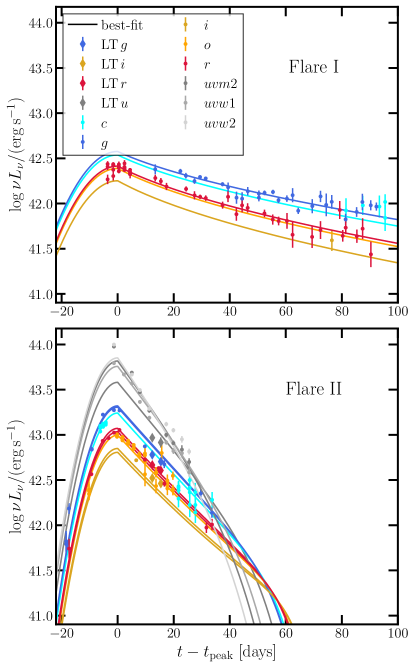
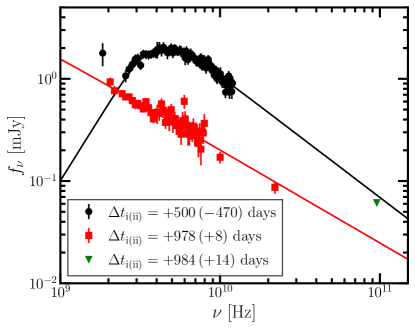
Tidal disruption events (TDEs) occur when a star enters the tidal radius of a supermassive black hole (SMBH). If the star only grazes the tidal radius, a fraction of the stellar mass will be accreted in a partial TDE (pTDE). The remainder can continue orbiting and may re-disrupted at pericenter, causing a repeating pTDE. pTDEs may be as or more common than full TDEs (fTDEs), yet few are known. In this work, we present the discovery of the first repeating pTDE from a systematically-selected sample, AT\,2020vdq. AT\,2020vdq was originally identified as an optically- and radio-flaring TDE. Around $3$ years after its discovery, it rebrightened dramatically and rapidly in the optical. The optical flare was remarkably fast and luminous compared to previous TDEs. It was accompanied by extremely broad (${\sim}0.1c$) optical/UV spectral features and faint X-ray emission ($L_X \sim 3 imes10^{41}$\,erg\,s$^{-1}$), but no new radio-emitting component. Based on the transient optical/UV spectral features and the broadband light curve, we show that AT\,2020vdq is a repeating pTDE. We then use it to constrain TDE models; in particular, we favor a star originally in a very tight binary system that is tidally broken apart by the Hills mechanism. We also constrain the repeating pTDE rate to be $10^{-6}$ to $10^{-5}$ yr$^{-1}$ galaxy$^{-1}$, with uncertainties dominated by the unknown distribution of pTDE repeat timescales. In the Hills framework, this means the binary fraction in the galactic nucleus is of the order few percent.
Motivation & Objective
- To identify and characterize the first systematically discovered repeating partial tidal disruption event (pTDE) from a controlled survey.
- To determine the physical origin of the second optical flare in AT 2020vdq, distinguishing between pTDE and alternative transient origins such as supernovae.
- To constrain the rate of pTDEs and infer the fraction of stars in tight binaries in galactic nuclei using observed repeat timescales.
- To test TDE models by analyzing spectral and light curve evolution across multiple flares, particularly focusing on accretion dynamics and disk formation.
Proposed method
- Conducted a systematic survey of optically and radio-flaring transients to identify candidate TDEs, including AT 2020vdq.
- Analyzed multiwavelength light curves (optical, UV, X-ray, radio) and spectroscopic data from multiple epochs to detect flare recurrence and spectral evolution.
- Used velocity widths (~0.1c) and line profiles (e.g., broad He II, N III) to infer high-velocity outflows and accretion dynamics consistent with TDEs.
- Applied X-ray and radio upper limits (e.g., Swift/XRT and VLA) to rule out new accretion or jet activity post-flare.
- Modeled the post-rebrightening spectrum using SNID to test for Type Ia supernova contamination, finding a 87% match with a 30-day post-peak SN Ia.
- Calculated the expected rate of coincident TDE and SN events in a sample of 33 galaxies to assess the significance of the second flare as a pTDE vs. SN.
Experimental results
Research questions
- RQ1Is AT 2020vdq a true repeating partial tidal disruption event, and what evidence supports its recurrence?
- RQ2What physical mechanism explains the second, luminous, and rapidly evolving optical flare in AT 2020vdq?
- RQ3Could the second flare be a Type Ia supernova rather than a pTDE, and how likely is such a coincidence?
- RQ4What constraints do the observed repeat timescale and flare properties place on the binary fraction in galactic nuclei?
- RQ5How do the spectral features (e.g., broad lines, N III) and X-ray/radio limits inform the validity of current TDE models?
Key findings
- AT 2020vdq is the first systematically identified repeating partial tidal disruption event, confirmed by a second optical flare occurring ~3 years after the initial detection.
- The second flare was exceptionally luminous and fast-evolving, with a blackbody temperature cooler than any known TDE, and exhibited extremely broad optical/UV emission (~0.1c).
- X-ray emission was faint (L_X ~ 3×10⁴¹ erg s⁻¹), and no new radio emission was detected, ruling out new jet or accretion disk formation.
- Spectral analysis revealed broad features near 5000 Å and 5500 Å not previously seen in TDEs, but consistent with a pTDE origin and not a standard supernova.
- The post-rebrightening spectrum was best fit by a Type Ia supernova model at ~30 days post-peak (87% match), but the lack of narrow lines and the timing of the flare support a pTDE interpretation.
- The pTDE rate is constrained to 10⁻⁶–10⁻⁵ yr⁻¹ galaxy⁻¹, implying a nuclear binary fraction of a few percent, consistent with the Hills mechanism for tidal disruption of binary stars.
Read this paper
Open the full text in the Nubint reader and ask about any passage as you read.
Read this paper on NubintThis review was generated by AI from the original paper. Please check the paper before citing it.