
[Paper Review] The foreground transfer function for HI intensity mapping signal reconstruction: MeerKLASS and precision cosmology applications
This paper validates the use of a foreground transfer function to reconstruct power spectra in H i intensity mapping surveys, demonstrating sub-percent accuracy in signal recovery even with >50% negative bias on large scales. Using simulations of the MeerKLASS survey, it establishes a robust recipe for constructing and applying transfer functions, showing resilience to errors in mock fiducial parameters and enabling precise cosmological inference despite aggressive foreground cleaning.
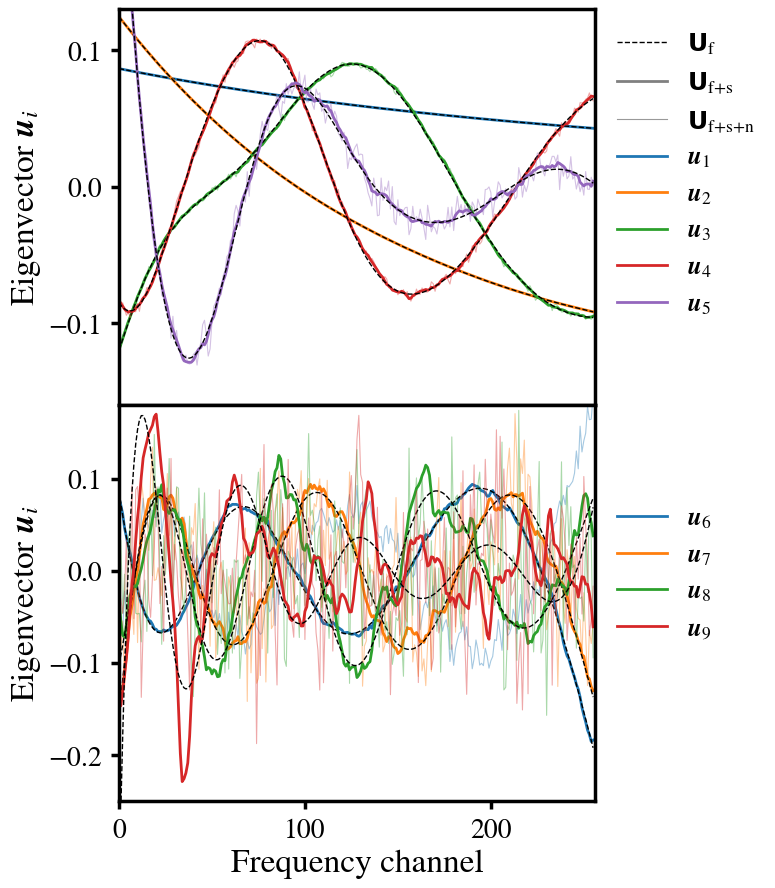
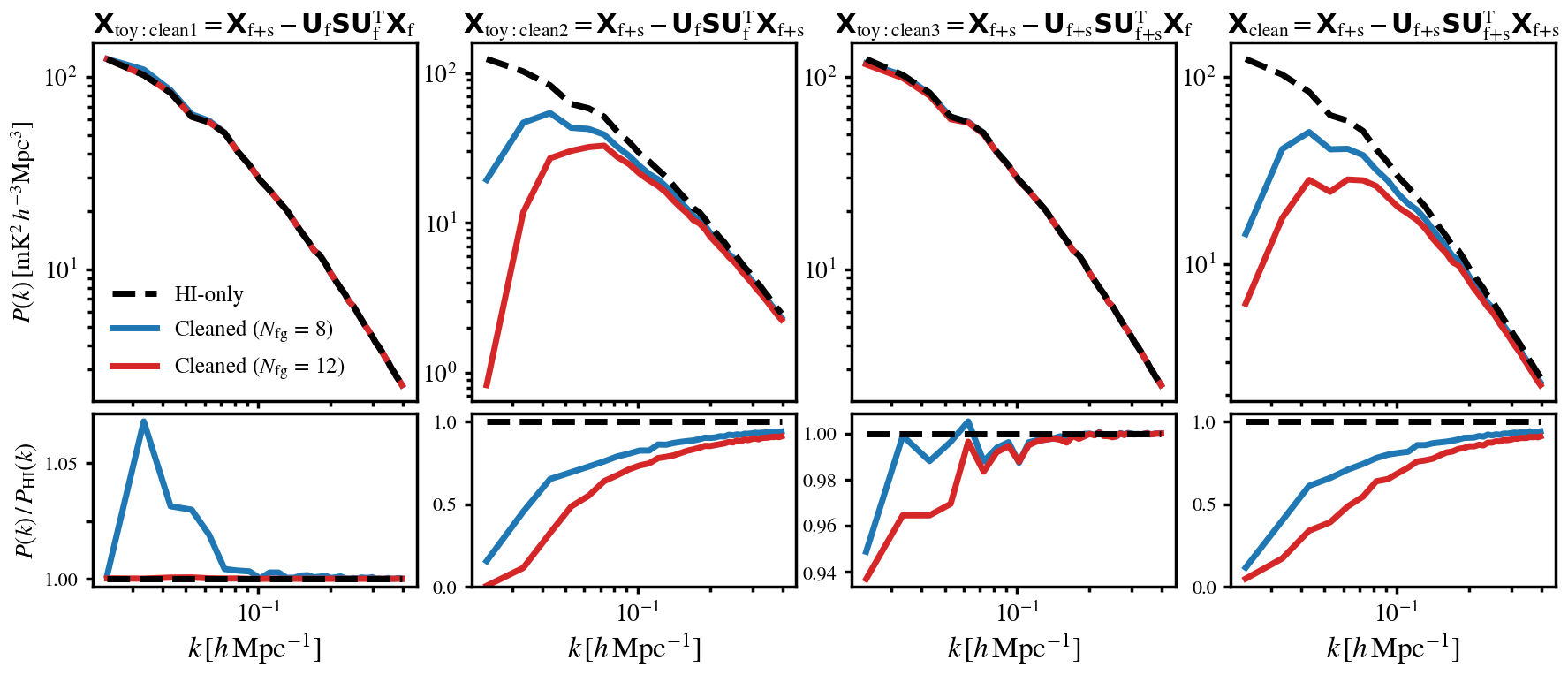
Blind cleaning methods are currently the preferred strategy for handling foreground contamination in single-dish HI intensity mapping surveys. Despite the increasing sophistication of blind techniques, some signal loss will be inevitable across all scales. Constructing a corrective transfer function using mock signal injection into the contaminated data has been a practice relied on for HI intensity mapping experiments. However, assessing whether this approach is viable for future intensity mapping surveys where precision cosmology is the aim, remains unexplored. In this work, using simulations, we validate for the first time the use of a foreground transfer function to reconstruct power spectra of foreground-cleaned low-redshift intensity maps and look to expose any limitations. We reveal that even when aggressive foreground cleaning is required, which causes ${>}\,50\%$ negative bias on the largest scales, the power spectrum can be reconstructed using a transfer function to within sub-percent accuracy. We specifically outline the recipe for constructing an unbiased transfer function, highlighting the pitfalls if one deviates from this recipe, and also correctly identify how a transfer function should be applied in an auto-correlation power spectrum. We validate a method that utilises the transfer function variance for error estimation in foreground-cleaned power spectra. Finally, we demonstrate how incorrect fiducial parameter assumptions (up to ${\pm}100\%$ bias) in the generation of mocks, used in the construction of the transfer function, do not significantly bias signal reconstruction or parameter inference (inducing ${<}\,5\%$ bias in recovered values).
Motivation & Objective
- To assess the viability of using a foreground transfer function to reconstruct power spectra in low-redshift H i intensity mapping surveys, particularly for precision cosmology.
- To identify and correct systematic errors in transfer function construction that could bias signal recovery or cosmological parameter inference.
- To demonstrate the robustness of the transfer function method under realistic survey conditions, including aggressive foreground cleaning and imperfect mock simulations.
- To provide a validated, reproducible recipe for constructing and applying transfer functions in auto-correlation power spectrum analysis.
- To evaluate the transfer function's utility in error estimation and its resilience to uncertainties in fiducial cosmological parameters used in mock generation.
Proposed method
- Simulate realistic H i intensity mapping observations for the MeerKLASS survey, including instrumental effects, noise, and foreground contamination.
- Apply blind foreground cleaning techniques to the simulated data, which induce scale-dependent signal loss.
- Inject synthetic H i power spectra into the cleaned data to measure the ratio of recovered to true power spectra, forming the transfer function.
- Construct the transfer function using a consistent, validated recipe that accounts for noise, beam effects, and survey geometry.
- Apply the transfer function to reconstruct the true power spectrum, correcting for signal loss across all scales.
- Estimate errors in the reconstructed power spectrum using the variance of the transfer function across multiple simulations.
Experimental results
Research questions
- RQ1Can a foreground transfer function accurately reconstruct the true H i power spectrum in the presence of aggressive foreground cleaning that induces >50% negative bias on large scales?
- RQ2What are the critical steps in constructing a transfer function that avoid introducing systematic biases in signal recovery or cosmological parameter inference?
- RQ3How sensitive is the transfer function reconstruction to errors in the fiducial cosmological parameters used to generate the simulation mocks?
- RQ4Can the transfer function variance be reliably used to estimate uncertainties in the reconstructed power spectrum?
- RQ5What are the limitations of the transfer function method when applied to single-dish H i intensity mapping data with complex beam patterns or $1/f$ noise?
Key findings
- The transfer function reconstructs the true H i power spectrum to within sub-percent accuracy, even when foreground cleaning induces a >50% negative bias on the largest scales.
- A correctly constructed transfer function is robust to errors in fiducial parameters used in mock simulations, with biases in recovered signal values remaining below 5% even under ±100% parameter deviations.
- The transfer function variance provides a reliable estimate of uncertainty in the reconstructed power spectrum, enabling proper error propagation in cosmological analysis.
- Deviation from the recommended recipe for transfer function construction—such as incorrect normalization or scale-dependent treatment—can introduce significant systematic biases in signal recovery.
- The method remains effective across a range of survey sizes and observational effects, demonstrating broad applicability to future intensity mapping surveys.
- The study highlights the continued relevance of transfer functions despite advances in blind foreground cleaning and forward modelling, especially given the uncertainty in future data analysis pipelines.
Read this paper
Open the full text in the Nubint reader and ask about any passage as you read.
Read this paper on NubintThis review was generated by AI from the original paper. Please check the paper before citing it.