
[论文解读] The GALAH Survey: Chemical Clocks
本文提出一种基于XGBoost的机器学习方法,仅利用化学丰度估算恒星年龄,对GALAH DR3巡天中近250,000颗恒星的年龄估计精度达到1–2 Gyr。该方法实现了银河系盘面大范围的年龄测定,重现了关键的年龄-运动学趋势,并实现了弱化学标记,但同时也揭示了在当前丰度精度下强化学标记的局限性。
Previous studies have found that the elemental abundances of a star correlate directly with its age and metallicity. Using this knowledge, we derive ages for a sample of 250,000 stars taken from GALAH DR3 using only their overall metallicity and chemical abundances. Stellar ages are estimated via the machine learning algorithm $XGBoost$, using main sequence turnoff stars with precise ages as our input training set. We find that the stellar ages for the bulk of the GALAH DR3 sample are accurate to 1-2 Gyr using this method. With these ages, we replicate many recent results on the age-kinematic trends of the nearby disk, including the age-velocity dispersion relationship of the solar neighborhood and the larger global velocity dispersion relations of the disk found using $Gaia$ and GALAH. The fact that chemical abundances alone can be used to determine a reliable age for a star have profound implications for the future study of the Galaxy as well as upcoming spectroscopic surveys. These results show that the chemical abundance variation at a given birth radius is quite small, and imply that strong chemical tagging of stars directly to birth clusters may prove difficult with our current elemental abundance precision. Our results highlight the need of spectroscopic surveys to deliver precision abundances for as many nucleosynthetic production sites as possible in order to estimate reliable ages for stars directly from their chemical abundances. Applying the methods outlined in this paper opens a new door into studies of the kinematic structure and evolution of the disk, as ages may potentially be estimated for a large fraction of stars in existing spectroscopic surveys. This would yield a sample of millions of stars with reliable age determinations, and allow precise constraints to be put on various kinematic processes in the disk, such as the efficiency and timescales of radial migration.
研究动机与目标
- 开发一种仅基于化学丰度和金属量来估算恒星年龄的方法,绕过传统的年龄测定技术。
- 实现GALAH巡天中恒星的大规模年龄估算,其中传统年龄测定方法在大规模下不可行。
- 通过重现银河系盘面已知的年龄-运动学趋势,检验化学丰度作为恒星年龄代理指标的可靠性。
- 通过分析固定形成半径处年龄-丰度关系的离散度,评估强化学标记的可行性。
- 通过识别多核合成站点高精度、高信噪比丰度测量的需求,为未来光谱巡天提供指导。
提出的方法
- 该方法使用XGBoost机器学习算法,基于化学丰度模式和总体金属量预测恒星年龄。
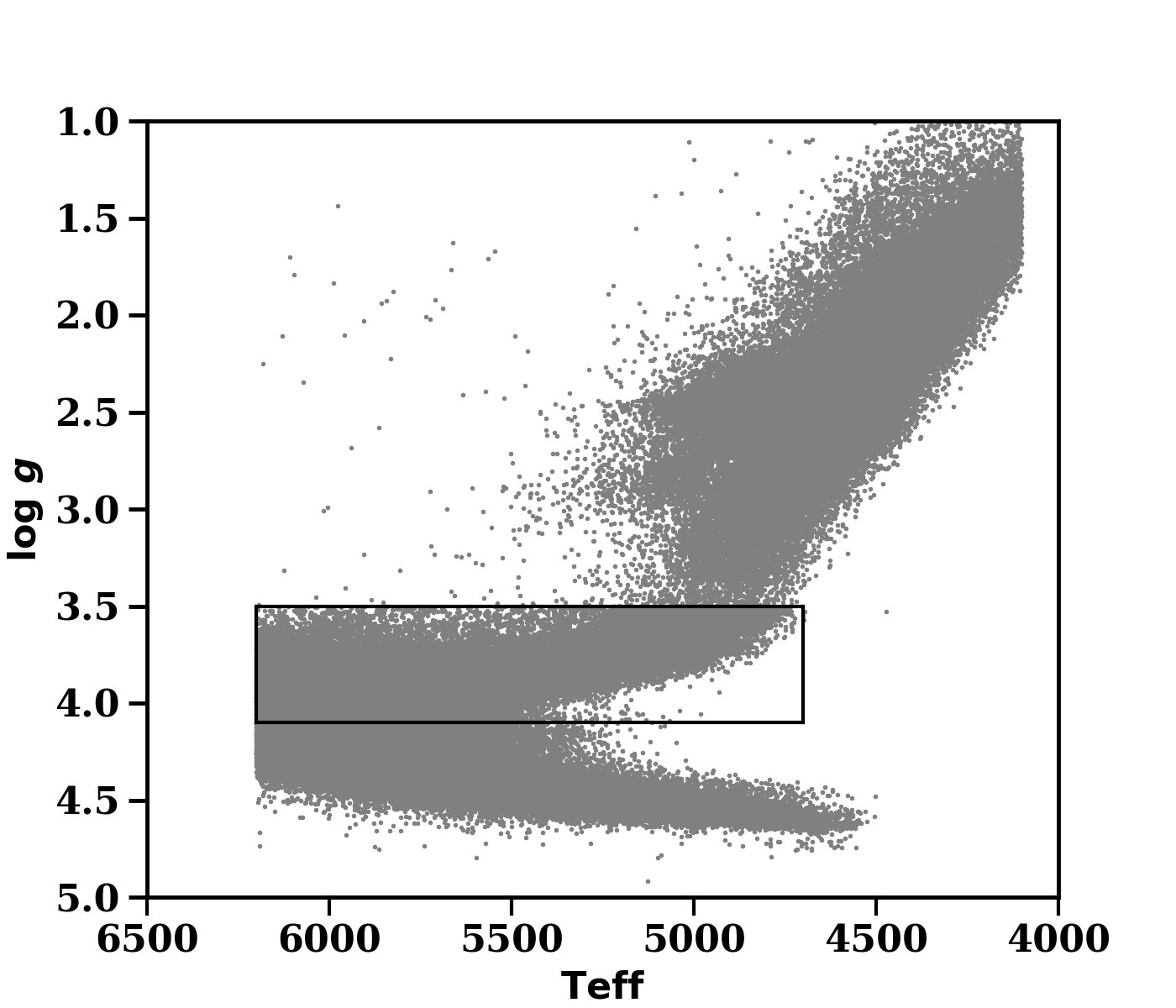
- 训练集由通过等值线匹配获得精确年龄的主序拐点(MSTO)恒星组成。
- 将GALAH DR3中250,000颗恒星的化学丰度作为年龄预测的输入特征。
- 通过重现太阳邻域及银河系盘面整体的已知年龄-速度弥散关系对模型进行验证。
- 通过年龄估计精度和与Gaia运动学趋势的一致性来评估模型性能。
- 通过分析信噪比、有效温度和表面重力对年龄-丰度关系的影响,考虑系统性不确定性。
实验结果
研究问题
- RQ1是否可以仅依靠化学丰度可靠估算恒星年龄,而无需依赖等值线或星震学?
- RQ2当使用基于化学丰度的年龄估计时,Gaia观测到的银河系盘面年龄-速度弥散关系在多大程度上能够重现?
- RQ3在给定形成半径处,年龄-丰度关系的离散度在多大程度上限制了强化学标记的可行性?
- RQ4需要多高的丰度精度才能实现可靠的年龄估算并探测细微的银河系化学演化效应?
- RQ5该方法是否可推广至其他大规模光谱巡天,以实现对数百万颗恒星的年龄测定?
主要发现
- XGBoost模型在仅使用化学丰度估算年龄时,对GALAH DR3样本中的大多数恒星实现了1–2 Gyr的中位数年龄精度。
- 该方法成功重现了太阳邻域的年龄-速度弥散关系以及Gaia数据中观测到的全局盘面趋势。
- 在固定形成半径处,年龄-丰度关系的离散度极小,表明化学丰度随时间和空间的变化微小,限制了当前精度下强化学标记的可行性。
- 研究发现,当前约0.05 dex的丰度精度不足以实现强化学标记,因为小尺度银河系演化效应被测量噪声所掩盖。
- 更高信噪比的光谱以及更广的元素覆盖范围——特别是s-过程元素——对于提高年龄精度和探测细微化学演化特征至关重要。
- 该方法可实现大规模弱化学标记,在结合未来巡天时,可为银河系盘面数百万颗恒星提供可靠年龄。
![Figure 2: The age-[ $\alpha$ /Fe] relation for the MSTO training set.](https://ar5iv.labs.arxiv.org/html/2011.13745/assets/Figures/mstoagealpha.png)
更好的研究,从现在开始
从阅读论文到最终审阅,大幅缩短您的研究时间。
无需绑定信用卡
本解读由 AI 生成,并经人工编辑审核。