
[Paper Review] The Hyperspherical Geometry of Community Detection: Modularity as a Distance
This paper introduces a hyperspherical geometry for community detection, framing modularity maximization as minimizing angular distance to a modularity vector on the hypersphere. It redefines community detection as a two-step projection method—mapping networks to hyperspherical points and projecting to clustering vectors—offering a geometric interpretation of modularity, resolving its resolution limit, and enabling new non-modularity-based methods that outperform traditional approaches on real networks.
We introduce a metric space of clusterings, where clusterings are described by a binary vector indexed by the vertex-pairs. We extend this geometry to a hypersphere and prove that maximizing modularity is equivalent to minimizing the angular distance to some modularity vector over the set of clustering vectors. In that sense, modularity-based community detection methods can be seen as a subclass of a more general class of projection methods, which we define as the community detection methods that adhere to the following two-step procedure: first, mapping the network to a point on the hypersphere; second, projecting this point to the set of clustering vectors. We show that this class of projection methods contains many interesting community detection methods. Many of these new methods cannot be described in terms of null models and resolution parameters, as is customary for modularity-based methods. We provide a new characterization of such methods in terms of meridians and latitudes of the hypersphere. In addition, by relating the modularity resolution parameter to the latitude of the corresponding modularity vector, we obtain a new interpretation of the resolution limit that modularity maximization is known to suffer from.
Motivation & Objective
- To develop a geometric framework for community detection using hyperspherical embeddings of clusterings.
- To reinterpret modularity maximization as minimizing angular distance to a modularity vector on the hypersphere.
- To generalize modularity-based methods into a broader class of projection-based community detection techniques.
- To provide a new geometric explanation for the resolution limit in modularity optimization.
- To design and evaluate novel community detection methods that do not rely on null models or resolution parameters.
Proposed method
- Represent each clustering as a binary vector indexed by vertex-pairs, embedding it into a metric space.
- Extend the clustering space to a hypersphere, enabling geometric operations like angular distance computation.
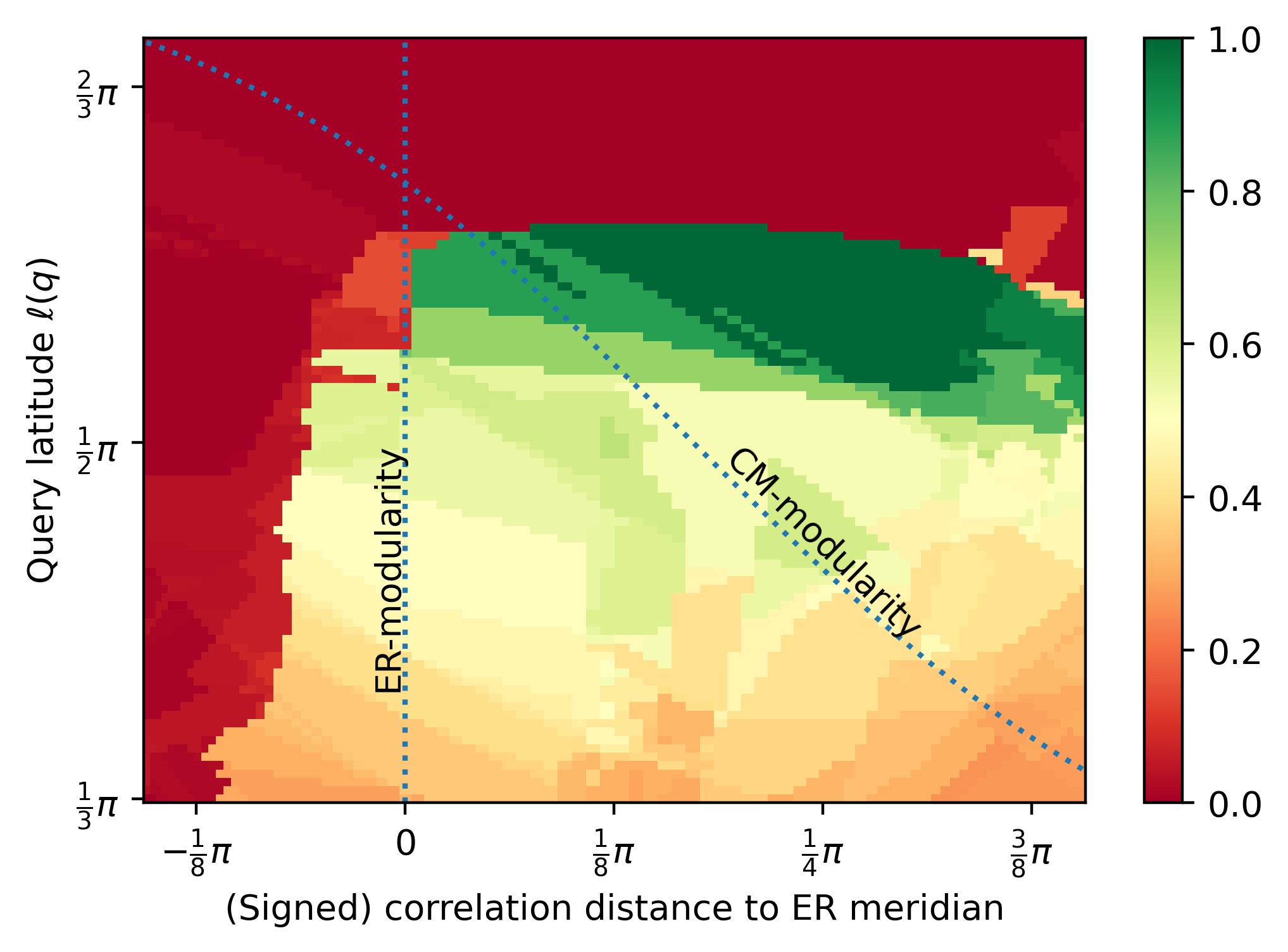
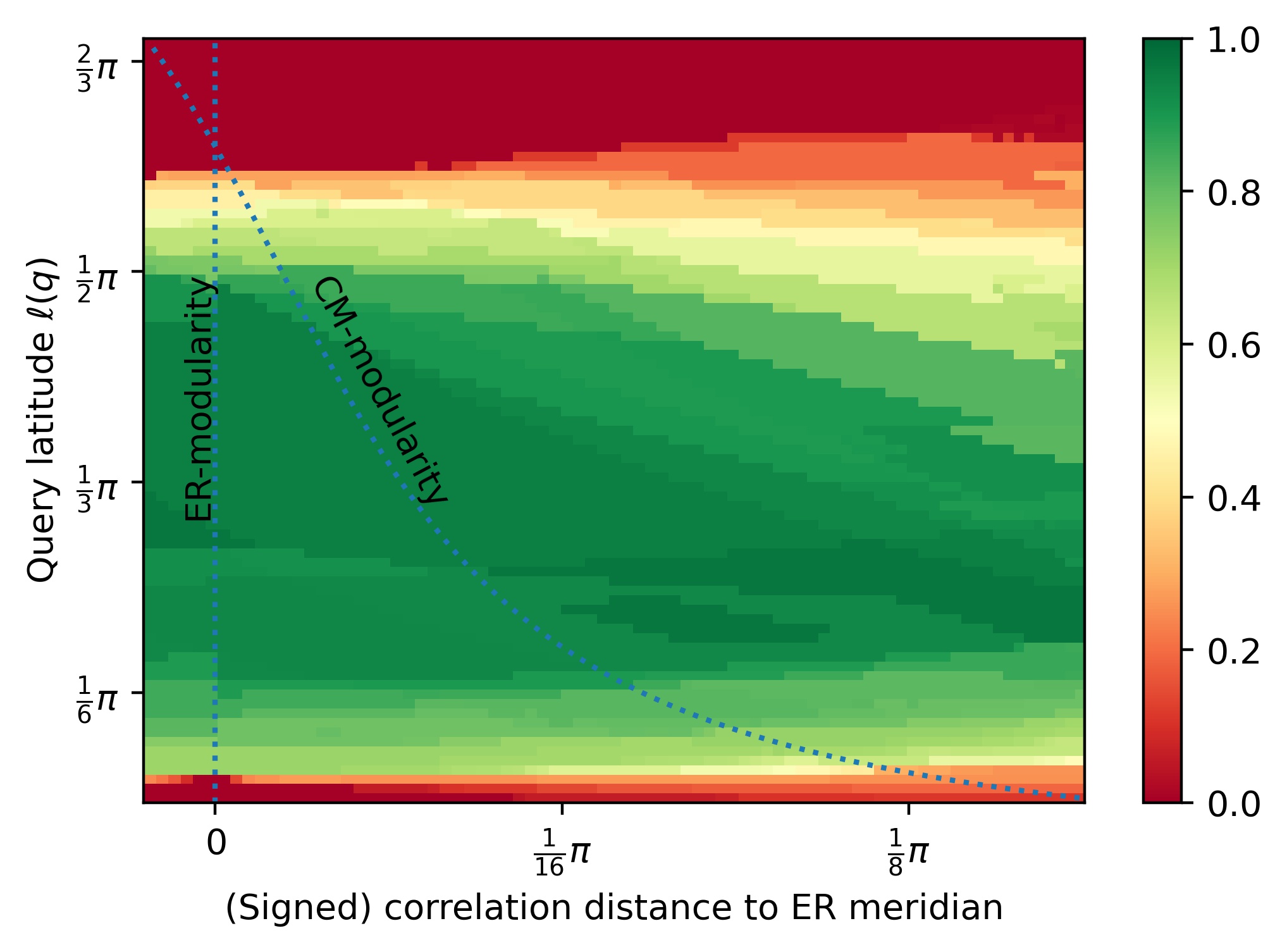
- Define modularity vectors as points on the hypersphere, with their latitude encoding the resolution parameter.
- Reformulate modularity maximization as minimizing the angular distance between the network's query vector and the modularity vector.
- Introduce a general class of 'projection methods' that map a network to a point on the hypersphere, then project to the nearest clustering vector.
- Use the correlation distance (via arccosine of the correlation coefficient) as the primary validation metric, enabling geometric invariance and bias-free evaluation.
Experimental results
Research questions
- RQ1How can community detection be reinterpreted through a geometric lens using hyperspherical embeddings?
- RQ2Can modularity maximization be equivalently framed as minimizing angular distance to a modularity vector on the hypersphere?
- RQ3What new community detection methods emerge from generalizing modularity beyond null models and resolution parameters?
- RQ4How does the geometric framework explain the resolution limit in modularity-based methods?
- RQ5Can projection-based methods that do not rely on modularity still outperform traditional approaches on real-world networks?
Key findings
- Modularity maximization is geometrically equivalent to minimizing the angular distance between the network's query vector and the modularity vector on the hypersphere.
- The resolution limit in modularity is reinterpreted as a geometric constraint related to the latitude of the modularity vector on the hypersphere.
- The proposed class of projection methods generalizes modularity-based detection and includes methods not describable via null models or resolution parameters.
- New projection methods, such as those based on the weighted vector w(G), outperform standard modularity and Louvain on real-world networks like Karate, Dolphins, and Political Blogs.
- The correlation distance, derived from the arccosine of the correlation coefficient, serves as a robust, bias-free validation metric invariant to clustering granularity.
- The Louvain algorithm is interpreted as an approximate nearest-neighbor projection on the hypersphere, suggesting potential for improvement via advanced approximate nearest-neighbor algorithms.
Read this paper
Open the full text in the Nubint reader and ask about any passage as you read.
Read this paper on NubintThis review was generated by AI from the original paper. Please check the paper before citing it.