
[Paper Review] The Impact of Reasoning Step Length on Large Language Models
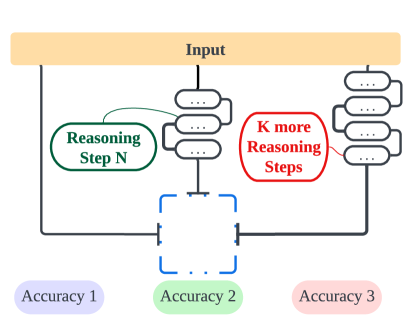
This paper investigates how reasoning step length in Chain-of-Thought (CoT) prompting affects large language model (LLM) performance. By systematically expanding or compressing reasoning steps while keeping all other factors constant, the authors demonstrate that longer reasoning chains significantly improve reasoning accuracy—even when steps contain incorrect information—highlighting step count as a critical factor over factual correctness. The findings offer practical, scalable guidance for optimizing CoT in complex reasoning tasks across diverse LLMs.
Chain of Thought (CoT) is significant in improving the reasoning abilities of large language models (LLMs). However, the correlation between the effectiveness of CoT and the length of reasoning steps in prompts remains largely unknown. To shed light on this, we have conducted several empirical experiments to explore the relations. Specifically, we design experiments that expand and compress the rationale reasoning steps within CoT demonstrations while keeping all other factors constant. We have the following key findings. First, the results indicate that lengthening the reasoning steps in prompts, even without adding new information into the prompt, considerably enhances LLMs' reasoning abilities across multiple datasets. Alternatively, shortening the reasoning steps, even while preserving the key information, significantly diminishes the reasoning abilities of models. This finding highlights the importance of the number of steps in CoT prompts and provides practical guidance to make better use of LLMs' potential in complex problem-solving scenarios. Second, we also investigated the relationship between the performance of CoT and the rationales used in demonstrations. Surprisingly, the result shows that even incorrect rationales can yield favorable outcomes if they maintain the requisite length of inference. Third, we observed that the advantages of increasing reasoning steps are task-dependent: simpler tasks require fewer steps, whereas complex tasks gain significantly from longer inference sequences. The code is available at https://github.com/MingyuJ666/The-Impact-of-Reasoning-Step-Length-on-Large-Language-Models
Motivation & Objective
- To investigate the impact of reasoning step length on CoT prompting effectiveness in large language models.
- To determine whether increasing or decreasing the number of reasoning steps affects model accuracy, independent of factual correctness.
- To assess whether the benefits of longer reasoning chains are consistent across different tasks and model sizes.
- To evaluate whether the structure of reasoning steps, rather than question content, drives performance improvements.
Proposed method
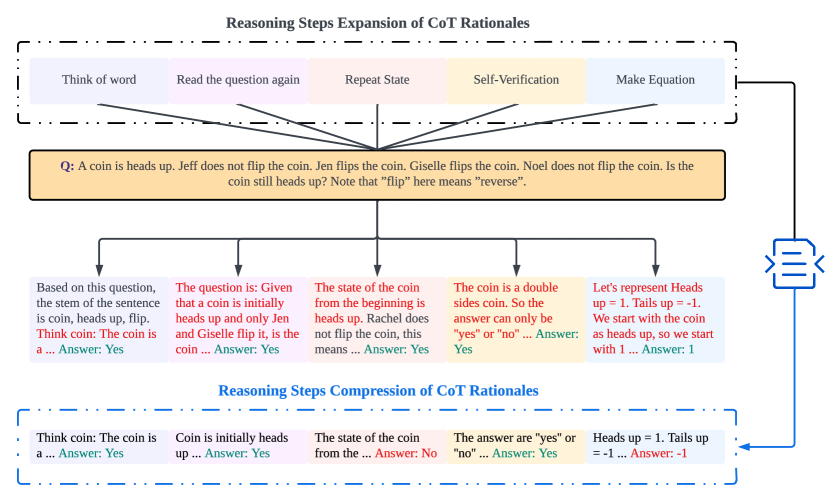
- Conducted controlled experiments by expanding or compressing reasoning steps in CoT demonstrations while preserving all other prompt elements.
- Modified zero-shot prompts by adding 'you must think more steps' to encourage longer reasoning sequences.
- Used Auto-CoT and Few-Shot-CoT setups across multiple datasets (e.g., GSM8K, MultiArith) and LLMs (GPT-3.5, GPT-4, text-davinci-002).
- Compressed reasoning steps in demonstrations to test performance degradation, comparing against baseline and full-length versions.
- Introduced misleading information into reasoning chains to test whether length alone sustains performance gains.
- Analyzed performance across model sizes to assess scaling behavior and tolerance to step length manipulation.
Experimental results
Research questions
- RQ1Does increasing the number of reasoning steps in CoT prompts improve LLM reasoning accuracy, even without adding new information?
- RQ2What happens to model performance when reasoning steps are compressed, even when key information is preserved?
- RQ3Can incorrect but lengthy reasoning chains still improve reasoning performance?
- RQ4How does the benefit of longer reasoning steps vary across different tasks and model architectures?
- RQ5To what extent does the content of the question influence CoT performance, compared to step count?
Key findings
- Lengthening reasoning steps in CoT prompts significantly improves LLM reasoning accuracy across multiple datasets, even without introducing new information.
- Shortening reasoning steps—while preserving key information—leads to a substantial decline in model performance, regressing to zero-shot baseline levels.
- Even incorrect rationales can yield favorable outcomes if they maintain a sufficient length of inference, indicating that logical continuity matters more than factual accuracy.
- The performance gain from longer reasoning chains is task-dependent: complex tasks benefit more than simpler ones.
- The strategy of extending reasoning steps improves zero-shot CoT performance, with measurable accuracy gains observed when prompts are modified to demand more steps.
- Larger models like GPT-4 show higher tolerance to step length manipulation, while smaller models like text-davinci-002 benefit most from step extension in terms of performance boost.
Read this paper
Open the full text in the Nubint reader and ask about any passage as you read.
Read this paper on NubintThis review was generated by AI from the original paper. Please check the paper before citing it.