
[Paper Review] The In-Sample Softmax for Offline Reinforcement Learning
This paper proposes In-Sample Actor-Critic (InAC), a novel offline reinforcement learning algorithm that replaces the standard softmax with an in-sample softmax to restrict bootstrapping to only actions present in the dataset, avoiding overestimation from out-of-distribution actions. The method ensures convergence, supports entropy regularization, and outperforms or matches IQL and other baselines, especially on datasets with suboptimal behavior policies, while enabling effective online fine-tuning.
Reinforcement learning (RL) agents can leverage batches of previously collected data to extract a reasonable control policy. An emerging issue in this offline RL setting, however, is that the bootstrapping update underlying many of our methods suffers from insufficient action-coverage: standard max operator may select a maximal action that has not been seen in the dataset. Bootstrapping from these inaccurate values can lead to overestimation and even divergence. There are a growing number of methods that attempt to approximate an \emph{in-sample} max, that only uses actions well-covered by the dataset. We highlight a simple fact: it is more straightforward to approximate an in-sample \emph{softmax} using only actions in the dataset. We show that policy iteration based on the in-sample softmax converges, and that for decreasing temperatures it approaches the in-sample max. We derive an In-Sample Actor-Critic (AC), using this in-sample softmax, and show that it is consistently better or comparable to existing offline RL methods, and is also well-suited to fine-tuning.
Motivation & Objective
- Address the overestimation problem in offline reinforcement learning caused by bootstrapping from out-of-distribution actions not covered in the dataset.
- Develop a simple, convergent method for offline RL that respects the support of the dataset's action distribution without requiring explicit modeling of the behavior policy.
- Provide a practical alternative to existing methods like IQL that rely on expectile regression and may be skewed by suboptimal actions in the dataset.
- Enable effective online fine-tuning by ensuring the policy remains grounded in the offline data distribution during initial training.
Proposed method
- Define the in-sample softmax as a temperature-controlled softmax over only actions with non-zero probability in the dataset's action distribution.
- Prove that the in-sample softmax maintains contraction and convergence properties under standard assumptions, ensuring stable learning.
- Design an In-Sample Actor-Critic (InAC) algorithm that modifies the actor update to sample only from in-sample actions, avoiding reliance on learned policy approximations.
- Use a decreasing temperature schedule to make the in-sample softmax approach the in-sample max, enabling a smooth transition to greedy behavior.
- Implement the method using off-the-shelf deep RL components with minimal modifications, preserving simplicity and compatibility with existing frameworks.
- Leverage dataset sampling directly for actor updates, eliminating the need for behavior policy modeling or complex regularization.
Experimental results
Research questions
- RQ1Can an in-sample softmax be used to stabilize bootstrapping in offline RL while maintaining convergence and practicality?
- RQ2How does the in-sample softmax compare to expectile regression (as in IQL) in terms of robustness to suboptimal data distributions?
- RQ3Does the in-sample softmax approach the in-sample max as the temperature decreases, and can this be leveraged for policy improvement?
- RQ4Can the resulting InAC algorithm achieve competitive or superior performance compared to state-of-the-art offline RL methods on standard benchmarks?
- RQ5How well does InAC generalize to online fine-tuning scenarios after offline pre-training?
Key findings
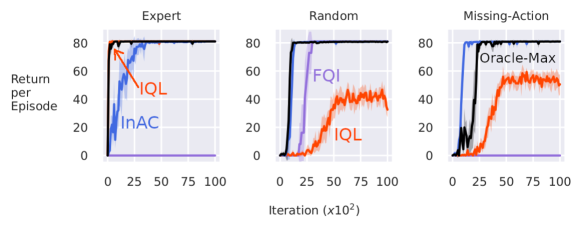
- InAC consistently outperforms or matches IQL across multiple MuJoCo environments, especially on Medium-Expert and Medium-Replay datasets where IQL performance degrades after fine-tuning.
- The performance drop of IQL after online fine-tuning in Hopper and Walker2d suggests that expectile regression may be sensitive to skewed data distributions, a limitation mitigated by InAC.
- InAC maintains strong performance during online fine-tuning, with policy performance improving or remaining stable, indicating robustness to distributional shift in online phases.
- The in-sample softmax converges and approaches the in-sample max under decreasing temperature, validating its theoretical foundation.
- InAC requires minimal architectural changes to standard actor-critic, making it easy to implement and integrate into existing RL pipelines.
- The method avoids hallucinated value updates by restricting bootstrapping to only in-distribution actions, reducing overestimation and improving policy stability.
Read this paper
Open the full text in the Nubint reader and ask about any passage as you read.
Read this paper on NubintThis review was generated by AI from the original paper. Please check the paper before citing it.