
[Paper Review] The Inflation Attention Threshold and Inflation Surges
The paper introduces an inflation attention threshold where agents increase attention to inflation once inflation exceeds about 4%, estimates regime-specific attention levels, and shows this threshold creates nonlinear dynamics in the Phillips Curve with meaningful monetary policy implications. Calibrations reproduce US inflation surge dynamics and imply welfare losses under Taylor rules are larger when attention thresholds are active.
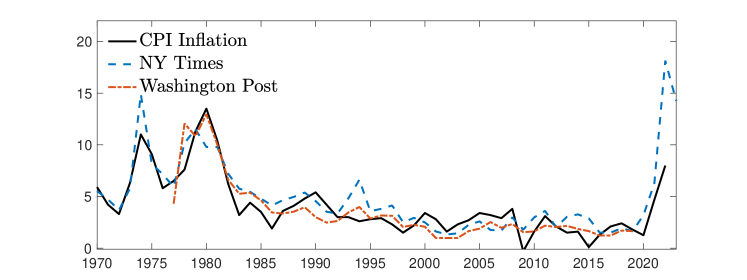
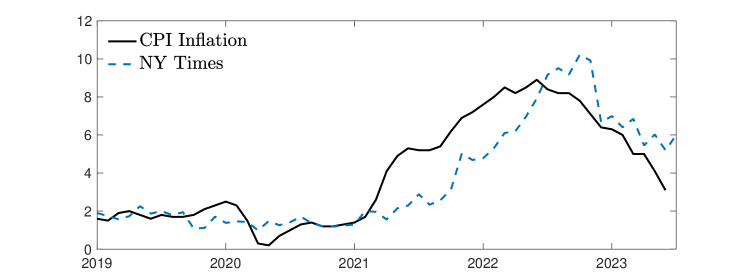
At the outbreak of the recent inflation surge, the public's attention to inflation was low but increased quickly once inflation started to rise. In this paper, I quantify when and by how much the public's attention to inflation changes, and derive the macroeconomic implications of these attention changes. I estimate an attention threshold at an inflation rate of about $4%$, and that attention doubles when inflation exceeds this threshold. Adverse supply shocks become more inflationary in times of high attention, and the increase in people's attention to inflation in 2021 accounts for half of the subsequent supply-driven inflation. I develop a model accounting for the attention threshold and show that shocks that are usually short lived lead to a persistent surge in inflation if they induce an increase in people's attention. The attention threshold further lengthens the last mile of disinflation after an inflation surge, and leads to an asymmetry in the dynamics of inflation.
Motivation & Objective
- Motivate why attention to inflation matters for inflation dynamics and policy.
- Estimate an inflation attention threshold and regime-specific attention levels from long-running survey data.
- Integrate the threshold into a New Keynesian model to derive nonlinear Phillips Curve dynamics.
- Calibrate the model to US data to match inflation and inflation expectations during recent surges.
- Assess normative implications for monetary policy under attention-driven inflation dynamics.
Proposed method
- Estimate attention levels using a threshold regression on a dynamic Kalman-filter style expectation formation model.
- Allow attention to switch regimes when lagged inflation crosses an estimated threshold.
- Estimate two regime-specific attention parameters (low and high) and the threshold by minimizing squared residuals.
- Calibrate a New Keynesian model with limited attention and a regime-switching attention mechanism.
- Compare model dynamics with and without the attention threshold, and with rational expectations.
- Assess welfare implications under simple Taylor-type monetary policy rules.
Experimental results
Research questions
- RQ1What is the estimated inflation attention threshold observed in survey data?
- RQ2How do attention levels differ between low- and high-inflation regimes?
- RQ3How does introducing an inflation attention threshold affect inflation and inflation expectations dynamics in a New Keynesian framework?
- RQ4What are the welfare and monetary policy implications when attention is regime-dependent?
- RQ5Do empirical findings broadly align with recent US inflation surge dynamics?
Key findings
- Estimated attention threshold at 3.98% (mean expectations) and 3.63–4.41% under different specifications.
- Low attention gamma_pi,L ≈ 0.18; high attention gamma_pi,H ≈ 0.36 (mean/overall specs); high-attention regime doubles attention.
- Threshold-crossing leads to nonlinear amplification in the Phillips Curve and aggregate demand, intensifying inflation when attention rises.
- Calibrated model reproduces hump-shaped inflation dynamics and evolving expectations observed in the US during the recent surge.
- Taylor-rule-like policies generate larger welfare losses under the attention-threshold model than under rational expectations or fully informed models.
- Attention is higher in high-inflation periods, and media coverage of inflation rises with higher inflation, reinforcing the attention effect.
Read this paper
Open the full text in the Nubint reader and ask about any passage as you read.
Read this paper on NubintThis review was generated by AI from the original paper. Please check the paper before citing it.