
[Paper Review] The JWST Resolved Stellar Populations Early Release Science Program II. Survey Overview
This paper presents the JWST Early Release Science program for resolved stellar populations, using 27.5 hours of NIRCam and NIRISS imaging on three diverse Local Group targets—M92, Draco II, and WLM. It delivers the deepest color-magnitude diagrams to date, reaching the hydrogen burning limit in M92 (mF090W ≈ 28.2, M ≈ +13.6), the lowest-mass stars outside the Milky Way in Draco II (0.09 M☉), and 1.5 mag below the oldest main sequence turnoff in WLM, validating the NIRCam ETC and enabling advanced photometry with DOLPHOT modules.
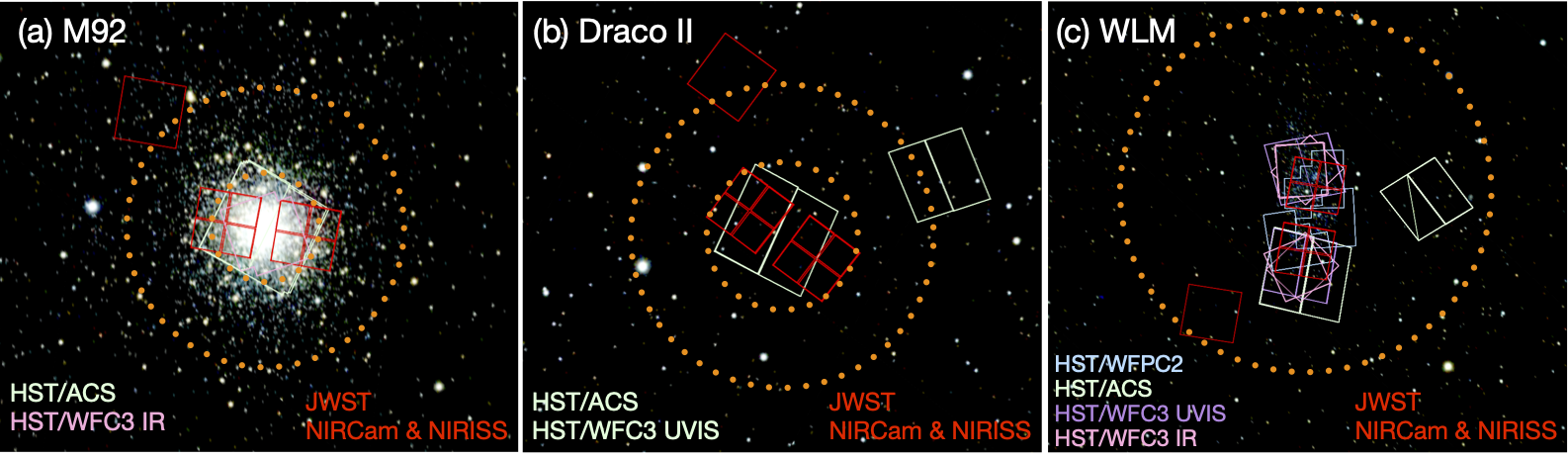
We present the JWST Resolved Stellar Populations Early Release Science (ERS) science program. We obtained 27.5 hours of NIRCam and NIRISS imaging of three targets in the Local Group (Milky Way globular cluster M92, ultra-faint dwarf galaxy Draco II, star-forming dwarf galaxy WLM), which span factors of $\sim10^5$ in luminosity, $\sim10^4$ in distance, and $\sim10^5$ in surface brightness. We describe the survey strategy, scientific and technical goals, implementation details, present select NIRCam color-magnitude diagrams (CMDs), and validate the NIRCam exposure time calculator (ETC). Our CMDs are among the deepest in existence for each class of target. They touch the theoretical hydrogen burning limit in M92 ($<0.08$ $M_{\odot}$; SNR $\sim5$ at $m_{F090W}\sim28.2$; $M_{F090W}\sim+13.6$), include the lowest-mass stars observed outside the Milky Way in Draco II (0.09 $M_{\odot}$; SNR $=10$ at $m_{F090W}\sim29$; $M_{F090W}\sim+12.1$), and reach $\sim1.5$ magnitudes below the oldest main sequence turnoff in WLM (SNR $=10$ at $m_{F090W}\sim29.5$; $M_{F090W}\sim+4.6$). The PARSEC stellar models provide a good qualitative match to the NIRCam CMDs, though are $\sim0.05$ mag too blue compared to M92 F090W$-$F150W data. The NIRCam ETC (v2.0) matches the SNRs based on photon noise from DOLPHOT stellar photometry in uncrowded fields, but the ETC may not be accurate in more crowded fields, similar to what is known for HST. We release beta versions of DOLPHOT NIRCam and NIRISS modules to the community. Results from this ERS program will establish JWST as the premier instrument for resolved stellar populations studies for decades to come.
Motivation & Objective
- To establish JWST as the premier facility for resolved stellar population studies in its early operations.
- To test and validate the performance of NIRCam and NIRISS instruments on diverse stellar systems across a wide dynamic range in luminosity, distance, and surface brightness.
- To develop and deploy DOLPHOT modules for NIRCam and NIRISS to enable high-precision crowded-field photometry for future science.
- To validate the NIRCam Exposure Time Calculator (ETC) v2.0 using empirical signal-to-noise ratios from real data.
- To produce the deepest color-magnitude diagrams (CMDs) ever obtained for globular clusters, ultra-faint dwarfs, and star-forming dwarfs.
Proposed method
- Conducted 27.5 hours of NIRCam and NIRISS observations on three targets: M92 (globular cluster), Draco II (ultra-faint dwarf), and WLM (star-forming dwarf galaxy).
- Performed initial photometric reductions using DOLPHOT, a widely used crowded-field photometry package, with newly developed NIRCam and NIRISS modules.
- Calculated signal-to-noise ratios (SNRs) from DOLPHOT for individual stars and compared them to predictions from the NIRCam ETC v2.0.
- Generated deep color-magnitude diagrams (CMDs) using F090W and F150W filters, reaching faint magnitudes and low-mass stars.
- Compared observed CMDs to PARSEC stellar evolution isochrones to assess model fidelity, particularly in the low-mass regime.
- Assessed PSF fitting performance and SNR accuracy, accounting for saturation at bright magnitudes and PSF mismatches at faint magnitudes.
Experimental results
Research questions
- RQ1How deep can JWST’s NIRCam and NIRISS instruments probe the stellar populations of diverse Local Group targets in terms of magnitude and mass?
- RQ2To what extent do the predictions of the NIRCam ETC v2.0 match the actual signal-to-noise ratios measured in real data?
- RQ3How well do current theoretical stellar models (PARSEC) reproduce the observed colors of low-mass stars in M92 and Draco II?
- RQ4Can the DOLPHOT photometry pipeline be effectively adapted for JWST’s NIRCam and NIRISS data, especially in crowded fields?
- RQ5What are the dominant systematic effects (e.g., crowding, PSF mismatch) that influence SNR measurements in deep JWST imaging?
Key findings
- The F090W–F150W CMD of M92 reaches mF090W ≈ 28.2 (M ≈ +13.6), touching the theoretical hydrogen burning limit for stars with mass <0.08 M☉ and achieving SNR ≈ 5.
- The CMD of Draco II detects stars as low as 0.09 M☉, with SNR = 10 at mF090W ≈ 29, representing the lowest-mass stars observed outside the Milky Way to date.
- The CMD of WLM extends approximately 1.5 magnitudes below the oldest main sequence turnoff, reaching mF090W ≈ 29.5 (M ≈ +4.6) with SNR = 10.
- The PARSEC stellar models show good qualitative agreement with the observed CMDs but are systematically ~0.05 mag bluer than the data in the lower main sequence for M92 and Draco II, likely due to limitations in modeling low-mass stellar atmospheres.
- The SNRs measured by DOLPHOT for stars in M92 agree with the NIRCam ETC v2.0 predictions within ~20% across most of the magnitude range, with larger deviations at the bright and faint extremes due to saturation and PSF mismatches.
- Beta versions of DOLPHOT modules for NIRCam and NIRISS, along with theoretical PSF models, are publicly available, enabling broader community use for future crowded-field photometry.

Read this paper
Open the full text in the Nubint reader and ask about any passage as you read.
Read this paper on NubintThis review was generated by AI from the original paper. Please check the paper before citing it.